Fossil Fuels and Right-Wing Populism

This post explores the way in which right wing populist parties use climate denial as a key part of their agenda.  In thinking about the topic, I found Andreas Malm’s excellent book ‘White Skin – Black Fuel on the danger of Fossil Fascism’ very helpful.  Early on in the book, Malm notes that: 

“All European far-right parties of political significance in the early twenty-first century expressed climate denial.”

The book weas written 3 years ago but it’s hard to think of more recent exceptions.  So, there’s definitely something to be explained here.
Clearly climate denial didn’t start with the rise of right-wing populism.  From the 1970’s onwards the major oil and gas companies, particularly Exxon, were researching the impact of greenhouse gas emissions on the environment and at the same time funding organisations like the Global Climate Coalition in the US whose role was to argue that pushing large amounts of CO2 into the atmosphere was not a problem.  Privately they knew from early on that fossil fuel extraction would have a devastating effect on the global climate.  In 1995 the GCC in an internal document wrote that 

“the potential impact of human emissions of greenhouse gases such as CO2 on climate is well established and cannot be denied”

but in public they denied it.  

As a strategy outright denial had its limitations.  The Kyoto protocol signed in 1997 marked the beginning of a new strategy – a shift from denial to greenwashing.  

The three core tenets of Kyoto are:

  1. Postpone the showdown with Fossil Fuels into distant future.
  2. Place no serious limits on fossil fuel extraction.
  3. New opportunities for generating profit.

In the UK, the industry’s plans for the North Sea are a good example of postponing any showdown with fossil fuels.  The strategy is based on continuing extraction through to and beyond 2050 and the development of a so-called net zero oil and gas basin.  Here net zero depends on heroic assumptions about techno-fixes such as carbon capture and storage combined with creative accountancy that ascribes all responsibility for the carbon in the oil and gas that’s produced to the users.  Globally there are virtually no regulatory limits on the production of fossil fuels.  It’s assumed that any run down will be as a result of market forces.  At the same time trading carbon permits has been highly profitable in financial terms and has allowed the industry to claim that the trade contributes to reducing carbon emissions.  There is next to no evidence that carbon trading and offsetting has reduced greenhouse gas emissions.

So as far as big business goes, we are still in the era of greenwashing.  Big oil and gas are at pains to argue that they want to protect the planet.  And almost all governments around the world are in lockstep with fossil fuel industry in this strategy.  Practically, depending on local circumstances the form that greenwashing takes varies, but everywhere it’s about maintaining or enhancing the profitability of fossil capital and preserving the existing infrastructure.  So, in the UK for example hydrogen is touted as the answer to domestic cooking and heating.  In the short to medium term this would probably mean higher carbon emissions than the existing use of natural gas and if ultimately the hydrogen was all green, i.e. produced by electrolysis it would be fantastically inefficient.  Requiring the use of up to seven times as much electricity than would be required to simply electrify cooking and heating.  But it’s attractive to the industry because it enables the continuation of existing economic and technical infrastructure.

The result of all this is that investment is skewed away from forms of energy use and production that are sustainable and rapidly achievable – and rather than supporting a just transition for workers and communities existing inequalities are maintained and ramped up. The ongoing cost of living crisis in which poor consumers of gas and electricity contribute to eye watering profits for energy producers and distributors is a case in point.

And it’s this that has provided fertile ground for right wing populist parties.

Five decades of neo-liberalism has syphoned money and resources from public to private and increased inequality everywhere so that working class people are anxious or scared about climate, cost of living, war, housing, growing old – in a world where the belief that their parents or grandparents had that things would be better for the next generation is dead.  Most people don’t trust established politicians – established parties offer variations on the same neo-liberal agenda.  Into this vacuum has stepped forms of right-wing populism that purport to offer alternatives to the ‘establishment’.

Right wing populism takes different forms – sometimes taking over long-established parties – Trump and the Republican Party in the US.  Or in the UK the continuing rise of right-wing populists as a major, perhaps majority faction within the Tory party.  Sometimes emerging from explicitly fascist formations, for example, Le Pen in France or Meloni in Italy.  And sometimes completely new organisations, for example the AfD in Germany.  None of them are into Greenwashing.  They are all about Climate Denial.

In Spain a prominent member of right wing populist party Vox explains climate change as 

“any change on the sun, the moon, the rotation of the earth, volcanoes and naturally occurring atmospheric phenomena but absolutely not on CO2 emitted by humans. It would, said Abascal, be ‘very arrogant’ to believe that humans could alter the climate. It would be ‘even more arrogant’ to think that the alteration could be rectified by ‘coercive laws and taxes’.”

The AfD in Germany has increased its influence through organising around climate issues, demonising perhaps the biggest climate movement around the world, foregrounding the cost-of-living crisis and agitating around the farmers protests.  Often supported and facilitated in this by the state and the police.

It’s obviously not just climate that is building the new far right.  Climate issues intersect with the legacy of neo-liberalism, migration and racism and the failure of the left to provide an alternative that speaks to working people’s insecurity and against individualistic solutions.  The far-right populists feed off social media fuelled confusion and conspiracies.  Very often angry or frightened people looking for answers find them in apparently anti-establishment and authoritative voices online.  

So, what’s to be done.  I think we can see the embryo of an alternative in the picket lines and in the huge response to the ongoing horror in Gaza.  It’s struck me standing on UCU picket lines last year, and then again in the last few months picketing and leafleting outside the Leonardo arms factory in Edinburgh, how many of the passing drivers beep their horns and wave.  Early in the morning many of them are white van drivers, very few of them will be in a union.  There’s are real possibility of breaking the rise of the populist right.  But if I’m right about why they’ve been able to build on climate I think part of what a revitalised left has to do is set it’s face firmly against partnership with fossil capital and clearly against solutions like CCS for continuing oil and gas production and hydrogen for domestic heating that preserve the power of fossil capital.  And that means for example that UNITE, RMT and GMB need to stop supporting the oil and gas industry’s North Sea transition deal.
Update on St Fitticks

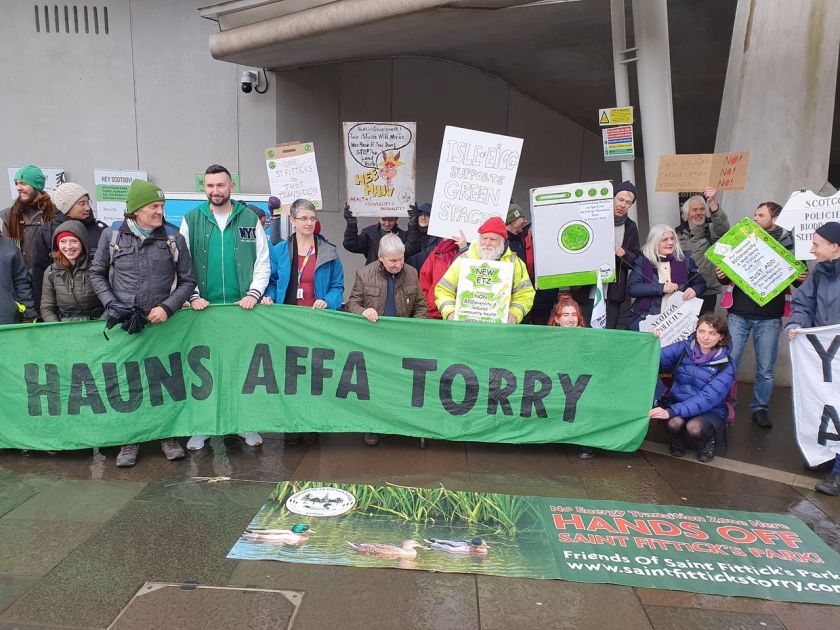
Demonstrating outside the Scottish Parliament in January 2023

Campaigners in Torry are still waiting on the Scottish Government announcement that was expected back in January. Each month it has been put back another 28 days and is now due on 6th May. If the government gives the go ahead to the current plans for the ETZ (Energy Transition Zone) it will be a decisive step down a road that panders to the oil and gas industry and has nothing to with social justice. St Fitticks Park, which the plans would take over for industrial use, is the only green space in a working class area that suffered from decades of pollution as a result of the oil and gas industry. Most recently a new Energy from Waste incinerator, built close to a primary school, has led to a further deterioration in living conditions.

This film from REELNews highlights the issues involved and the resistance of the local community. Please share it widely.

In the film it’s noted that it’s not clear what use the new industrial zone will be put to. However, since the film was made campaigners have found evidence that there will be a large hydrogen storage facility – with 80% blue hydrogen and 20% green – that will be used to convert the cooking and heating supply for 20,000 social housing tenants in Aberdeen. If this goes ahead not only will Torry lose it’s green space many of its residents will be locked in to a very expensive energy future.

St Fitticks deserves to be a national campaign. The issues it raises around social justice, the use of hydrogen and carbon capture are national issues and they expose the weaknesses and contradictions in Scottish Government Energy Policy.

Share this post – support the St Fitticks campaigners.

Read more detail and watch video from the campaign here and here.

COP27 ‘Don’t be fooled by Sisi’s climate lies’

A message from the Egypt Solidarity Campaign

Egyptian activists warn ahead of COP27 summit

As Egypt prepares to host the COP27 climate summit in November 2022, Egyptian activists have issued an urgent appeal to the global climate justice movement not to be taken in by the regime’s claims to speak on behalf of ordinary people in the Global South. In a statement published by Egypt Solidarity Initiative, the Egyptian Campaign for Climate and Democracy warns that the regime of Abdelfattah al-Sisi is planning to use the COP27 conference to burnish its reputation after presiding over a decade of brutal repression. 

“The aim of this greenwashing is twofold: first, to extract as much financial aid as possible from the rich industrialised countries. Most of this money will end up being syphoned out of the country into the bank accounts of Sisi and his generals in those same industrialised countries. Second, is to distract from his abysmal human rights record, and as usual, the leaders of the supposedly democratic Western governments will allow him to get away with it.” 

The Egyptian Campaign for Climate and Democracy

While the COP27 conference takes place, thousands of people have been jailed and abused for demanding basic democratic rights, including journalists, activists, academics and students. The response of the military regime to protests and campaigns related to environmental issues has been just as harsh, whether over plans to build coal-fired power stations, polluting industries or the destruction of green spaces. Climate justice movements attending the summit are likely to find themselves alongside ‘astroturf’ government-sponsored ‘climate campaigns.’ 

“No real Egyptian opposition activists will be allowed near Sharm El-Sheikh during the conference. It would be a shame if genuine global grassroots movements are fooled into taking part in such a state-orchestrated charade” 

The Egyptian Campaign for Climate and Democracy

This appeal follows a similar warning by jailed activist Alaa Abdelfattah, a British citizen who was convicted of ‘terrorism’ for posts on social media and other trumped charges. Alaa has been on hunger strike since 2 April to protest at the abusive conditions in prison. He is also calling for a consular visit from the British embassy. “Of all the countries to host [the COP27] they chose the one banning protest and sending everyone to prison, which tells me how the world is handling this issue. They’re not interested in finding a joint solution for the climate,” he told his sister during a prison visit. 

Writer and activist Naomi Klein has also sounded the alarm. “The international climate movement must start paying attention to what is happening in Egypt’s prisons,” she told the Guardian. “We cannot sleepwalk to Cop27 as if these are not crimes against humanity.”

The TUC has also called on the British government to hold the Egyptian regime to account during COP27 for its attacks on workers’ rights to organise. In a statement published in June, ahead of preparatory talks in Bonn ahead of the COP27 conference, the TUC said: 

“The Egyptian trade union organisations affiliated to the ITUC – the Egyptian Federation of Independent Trade Unions and the Egyptian Democratic Labour Congress – have faced repeated repression, with labour organisers forced to retire, limiting the unions’ ability to function. … Vital to tackling the climate emergency is the need for freedom of association and the rights of workers and communities to organise for change. Since seizing power, the Egyptian government has consistently demonstrated a disregard for human life and these fundamental freedoms. By hosting COP27 in Sharm el-Sheikh, the Egyptian government will have an unprecedented opportunity to greenwash its atrocious record in human rights”

TUC statement, 10 June 

What you can do: 

  • Read the full statement from Egyptian activists online here
  • Share with climate networks in your country and on social media 
  • Take action in solidarity with Egyptian political prisoners, write to your MP or government calling on them to demand the Egyptian regime releases political detainees and stops repressing protest.Go to FreeAlaa.net for more information on Alaa’s campaign. Find out more here about the cases of journalist and lawyer Hisham Fouad and Haitham Mohamedain.

The ‘net zero’ con trick

Last month the Department for Business, Energy and Industrial Strategy, together with Oil and Gas UK released the text of the North Sea Transition Deal.  We will look at this document in more detail in a future post. 

Suffice it to say that this is ‘transition’ that references the climate crisis, and talks about net zero, but is wholly driven by the interests of the oil industry.  The two big ticket items in the strategy are ‘Carbon Capture and Storage’ and ‘Hydrogen’.  And although the document comes out of Westminster, the minutes of the North Sea Transition Forum that brings together the industry with the UK and Scottish governments, suggest that Holyrood is on board with the strategy. 

A case study on the Oil and Gas UK website illustrates the kind of thinking that informs the strategy.  The study is headlined 

Injecting new life into assets – Supporting Net-Zero goals and producing more oil. A novel polymer flooding agent is helping to improve field recovery rates and accelerate the energy transition process.

You may need to read those headlines a few times!  The new polymer makes it easier to extract the oil.  This reduces the amount of carbon emissions associated with the effort of extraction.  Oil is pumped faster, and more oil can be extracted from a given reservoir.  So, there’s a small reduction in emissions at the point of production and more oil released into the system.  The magic here is that we are not supposed to count this massively greater amount of carbon because the greenhouse gases will be captured (by as yet unavailable technology).  And, of course, the polymer is available now – the oil is being pumped now – and carbon capture may be available at some unknown point in the future.  

Check out Scot.E3’s campaigning pledge for COP26 which outlines action to cut through the greenwashing and magical thinking that currently characterises policy on transition from fossil fuels.

Photo by Snapper CC BY 2.o