Harland and Wolff: occupying for nationalisation, jobs and the climate

As workers at Belfast’s Harland and Wolff shipyard fight to save their jobs, demanding nationalisation as the employer goes into administration, Brian Parkin from ScotE3 reports on the response from the UK Construction Rank and File group, argues for solidarity and highlights links with action to tackle the climate emergency.  This article was first published on http://www.rs21.org.uk

The mighty shipyard of Harland and Wolff, whose enormous cranes, Samson and Goliath, dominate the Belfast skyline, is now facing the final phase of closure. Most famed for being the shipyard that built the ill-fated Titanic, these yards and their local supply companies employed up to 30,000 workers at their peak. Now, after repeated capacity and job-sheddings, only 121 workers remain.

The remaining workers have been given redundancy notices, but have said no to the supposed inevitability of market forces and the whims of hedge-fund capital. In a bid to save their jobs, they have mounted a workplace occupation. These men and women of the Unite and GMB unions are not looking back to the days of mighty ocean liners and battleships. Instead, they have evaluated the productive assets of the yards and have seen them as part of the vital industrial capacity that can begin to turn the tide in the battle against climate change. They have combined their technical skills with their knowledge of the Harland and Wolff production potential with a vision of how they can fabricate the structures and internals of wave, wind and tidal units that can harness the vast renewable resources that can provide clean, affordable and abundant energy.

All too aware of empty promises and crocodile tears of politicians and would-be investors, the workforce have played their ultimate hand: they have occupied and taken over the means of production in order to prevent asset strippers and bailiffs moving in and destroying further the productive potential of their sole means of production – and with it the hope of clean energy technologies so badly needed as climate change accelerates.

But these workers cannot fight alone. So far their unions have promised official support. But that support will be conditional – until a prospective bidder comes along with the any rescue bid inevitably demanding further flexibility and productivity promises of the workforce. Which is why the example of the UK Construction Rank and File in promising solidarity is so important. And now, within weeks of the global climate strikes and protests on 20 September, the climate change movement has a concrete example to put workers’ action centre stage.

Harland and Wolff and an emerging campaign of former BiFab workers in Fife are at last bringing together the issues of jobs worth having within a campaign for a planet capable of being saved.

The UK Construction Rank and File passed the following motion at its annual general meeting on Saturday 3 August:

  1. The Annual General Meeting of the UK Construction workers rank and File note the heroic factory occupation of the Harland and Wolff plant in Belfast in their bid to save jobs.
  2. We further note their demand that the present plant and jobs therein be turned over to the production of renewable energy technologies that will not only meet the growing demand for clean renewable sources of energy, but will also make a vital contribution to the fight against impending and potentially catastrophic climate change.
  3. In their present struggle the H&W workers are showing the way by which in the fight for jobs, the conversion of employment and means of production can be redeployed into both socially and environmentally dedicated ends.
  4. We commend the leadership on Unite for the official support that they are extending to the H&W occupation and call upon the wider labour movement to take up the fight for jobs, communities and the energy needs and environmental responsibilities of future generations.
  5. Furthermore, we urge all workers to support next month’s climate strikes and protests, both as a show of solidarity with H&W, but as a sign of the commitment to the working class’s vital role in the fight against climate change and our planets environment and eco-systems.
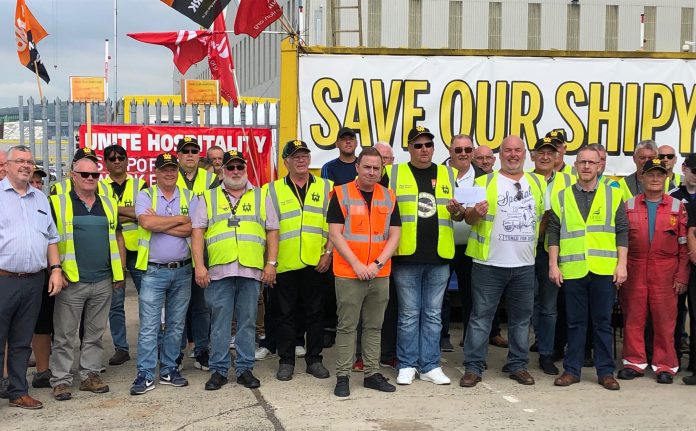
Save-Our-Shipyard-e1565021353605-696x431Photo: Unite construction branch on twitter
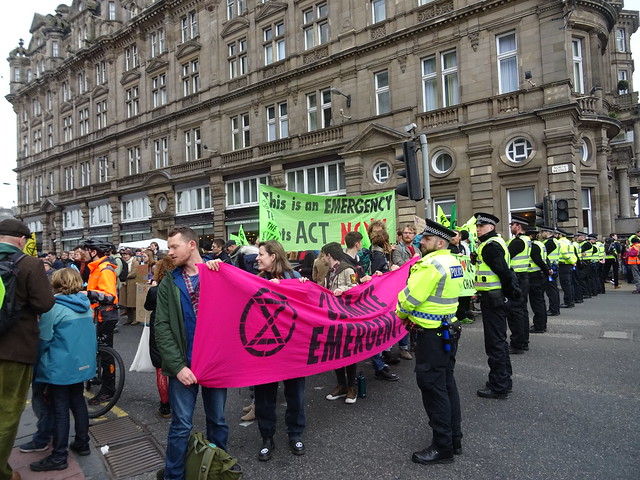
Climate Camp

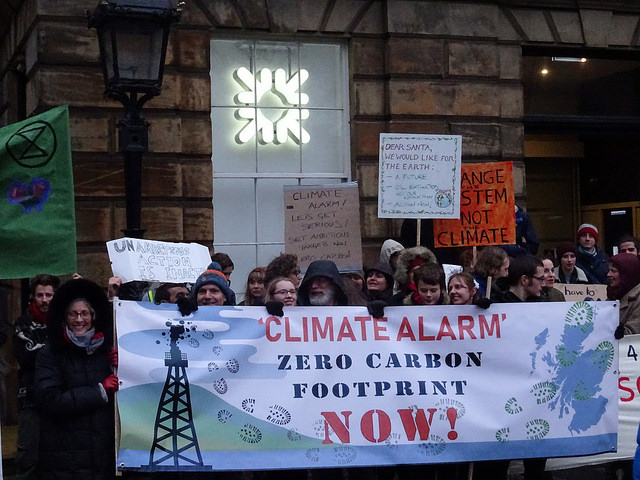
We’ll be running a workshop at the XR Climate Campo at Holyrood on Monday evening (17th June), 7pm – it’s on ‘Climate jobs, just transition and building a movement with social justice at its heart’ – do come along if you can and in any case support the Climate Camp – on this week from this evening until Thursday.

47570064912_7c65f72a1b_z

Sea Change

This week has seen the publication of an important report on North Sea oil and gas.  ‘Sea Change – climate emergency, jobs and managing the phase-out of UK oil and gas extraction’.  The report is co-published by Platform, Oil Change International and Friends of the Earth Scotland. It finds that

  • The UK’s 5.7 billion barrels of oil and gas in already-operating oil and gas fields will exceed the UK’s share in relation to Paris climate goals – whereas industry and government aim to extract 20 billion barrels;
  • Recent subsidies for oil and gas extraction will add twice as much carbon to the atmosphere as the phase-out of coal power saves;
  • Given the right policies, job creation in clean energy industries will exceed affected oil and gas jobs more than threefold.

Recommendations to the UK and Scottish Governments include:

  • Stop issuing licenses and permits for new oil and gas exploration and development, and revoke undeveloped licenses;
  • Rapidly phase out all subsidies for oil and gas extraction, including tax breaks, and redirect them to fund a Just Transition;
  • Enable rapid building of the clean energy industry through fiscal and policy support to at least the extent they have provided to the oil industry, including inward investment in affected regions and communities;
  • Open formal consultations with trade unions to develop and implement a Just Transition strategy for oil-dependent regions and communities.

We hope to publish a longer review of the report in the near future.  However, in the meantime we strongly recommend downloading, reading and sharing the PDF.

2018-07-19 08.57.05


NFLA Seminar on just transition

On Friday 10th May I attended the Nuclear Free Local Authorities (NFLA) Scotland Spring Seminar in Dundee on behalf of Scot.E3. The subject of the seminar was ‘Dealing With Climate Change, Just Transition and Divestment Issues’.

The four presentations grappled with issues of just transition and sustainability from a local authority perspective:

You can use the hyperlinks to access the presentations. NFLA have also produced a useful briefing on some of these issues – ‘Climate Emergency’ Declarations and the practicalities in Local Authority Action to go ‘Carbon Neutral’

Eileen Cook

46798793304_28f8245813_z


Energy from Waste

The UK’s Green Investment Bank had a short and inglorious history; founded in 2012 it was privatised in 2017.  The private company is now called the Green Investment Group – a wholly owned financial arm of the Australian development company Macquarie. The company also owns the formerly US owned incineration company Wheelabrator.  The group is playing a role in energy from waste schemes.  In Scotland the Green Investment GroupIG has taken an equity risk of 50% capital in the Earl’s Gate EfW CHP project at Grangemouth. Wheelabrator incineration is at the heart of the project.  Earl’s Gate boasts the capacity to ‘treat’ more than 20% of Scotland’s municipal waste.  Local authorities are being drawn into long-term and dubious ‘green’ capital projects with virtually no public debate.

The evolution of the Green Investment Bank is a salutary lesson in what happens when policy initiatives are based on market ideology.

geograph-5887688-by-Derek-HarperImage by Derek Harper CC BY SA 2.0 https://www.geograph.org.uk/photo/5887688

Notes and actions from the April organising meeting

Notes from Scot.E3 Edinburgh organising meeting180419

  • Attending PS, ZT, CM, PC, EC, BP – apologies from KW, WB, SB, MD
  • Agreed to rewrite the preamble to the article that responds to criticisms of Just Transition in the light of the new STUC statement on climate action and publish it on the blog.
  • The leaflet we distributed on the first day of the STUC in Dundee was well received.Thanks to SCND for hosting the fringe meeting on jobs, divestment and sustainability that we spoke at – about 30 people attended.  We also joined a discussion organised by the STUC with young people from recent climate action.
  • Throughout the meetingideas for further briefings/resources/blog posts came up in discussion. These included:
  • The case for taking INEOS into public ownership
  • Sustainable housing
  • Divestment, nuclear decommissioning and a sustainable future
  • Why nuclear shouldn’t be part of a just transition
  • A critical look at energy from waste schemes

If you are interested in contributing to any of these please let us know.

  • There will be a climate bloc on Edinburgh May Day (4thMay) – we are working with Friends of the Earth Scotland to build this. PC will check whether we can organise a meeting for people on it to attend afterwards possibly at the May Day Bookfair at the Leith Community Centre, Sunday 5th
  • We still need to find a couple of people who can take the Scot.E3 banner through to the Glasgow May Day march (5thMay). The banner will be on the Edinburgh march on the 4th, can anyone take the banner through to Glasgow for this given that we also have to cover the Leith event.
  • We’ve been invited to speak at the Edinburgh Green Party meeting, 7.30pm at the Augustine Church on 25thApril – PC to speak.
  • Edinburgh City Council Climate emergency meeting 25thApril, 6pm at the City Chambers Scot.E3 have been asked to host a table – WB taking responsibility for this but others welcome – you’ll need to register at this Eventbrite link https://www.eventbrite.co.uk/e/climate-emergency-action-needed-6pm-thur-25-apr-edinburgh-city-chambers-tickets-59567249246
  • Nuclear Free Local Authorities Scotland seminar on climate change, just transition and divestment issues, Dundee City Chambers, 10th May – EC going to this
  • State Energy Company

Urban change in a time of climate crisis

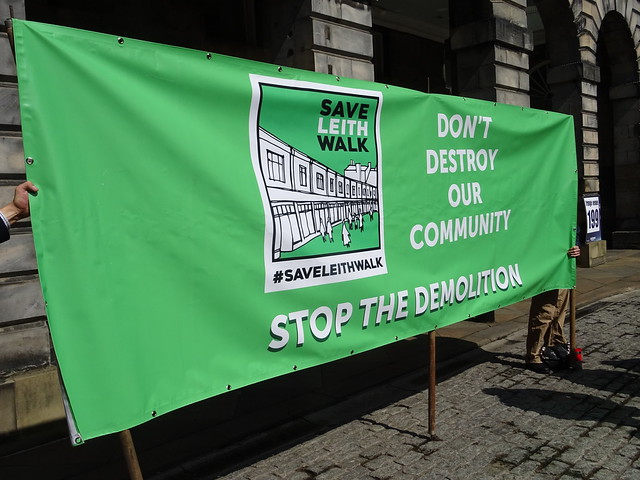
Housing is a central issue in the transition to a long term sustainable economy.  As a group Scot.E3 has produced resources on Fuel Poverty and we are currently working on more resources that look at how passive houses and a mass campaign of home insulation could contribute to a just transition while at the same time as improving the quality off people’s lives.  We’re pleased to publish a post by Save Leith Walk activist Ian Hood on the work that the campaign has done to think about the future of hosing in their area.

43291439955_b92aa80253_z

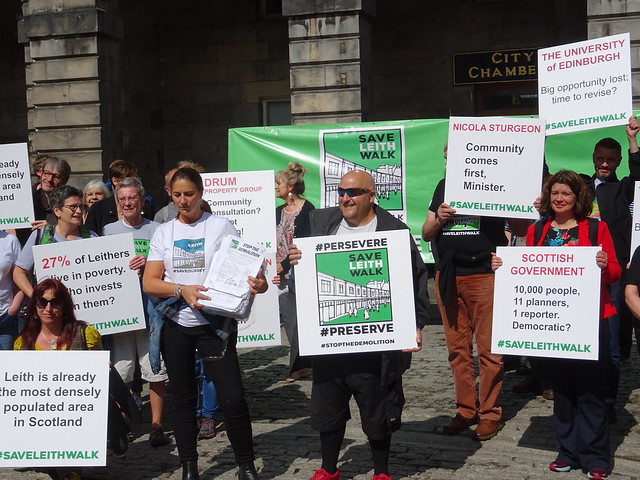
Early in 2018, it became clear that developers wanted to demolish a long parade of shops in Leith Walk and replace it with a student accommodation.  A popular local campaign emerged to challenge this and in January 2019 Edinburgh Council agreed that the building should not be demolished and that the proposed development was unacceptable.  Planning Permission was refused.

But the campaign has always been about more than just opposing the wishes of developers.  To be successful in the long run we need to promote an alternative vision, one that reflects the needs of the local community and can take it forward.

Over the last year campaign members have spoken to thousands of local workers and residents about what is important to them. We have directly canvassed the opinions of hundreds of local people about their preferences for new development in the Leith Walk area.   This was followed up by a local community planning workshop that looked at the needs and wishes of people who lived in the area.

And at the heart of the emerging view was the sense that any new development had to be both sustainable and promote strong environmental values.

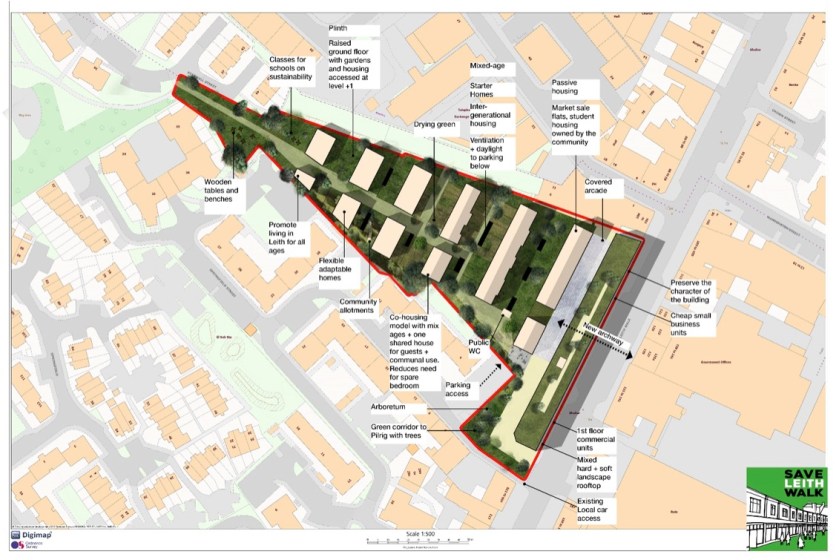
We did not create a single business plan or an architectural map for developers.  We identified the three different elements that can contribute to the vision.  Sketch maps that illustrate each of these were drawn up.   The need for more social housing dominated in all of the visions and also important were business space, community support and green space.

Running through the core of the vision is the idea that ecological and environmental issues are not add ons at the end of a planning process but integral to any design.

blog image leith

Community Housing (see image above) faces up to the long term problem of housing provision in Leith and provides a range of solutions to housing need.  Building diverse housing that allows people to live and play together strengthens our communities in fundamental ways.

  • Opening up to the Leith Walk community by creating new access through the centre of the building.
  • A covered walkway could be created at the rear of the building bringing the housing units into connection with the sandstone building.
  • Up to Eleven housing blocks in different sizes and shapes could be built in the land behind offering a range of housing opportunities including
    • Open Market homes,
    • intergenerational housing,
    • flexible and adaptable homes,
    • co-housing models
  • Designed to the Passive Housing standards making environmentally friendly homes.
  • Living walls could blend the development into the surrounding space
  • There could be a shared guest house and other community space reducing the need for spare rooms and encouraging sharing.
  • Affordable student housing owned by the community.

Community Cohesion is about strengthening community links and helping people to focus on the challenges that affect them and develop new skills to tackle them.   It can create a new vision of community where people from different racial, class, gender, age and religious backgrounds are partners in their own futures.

  • A refreshed building, made Green Energy resilient.
  • New opportunities to existing businesses and new small, low cost starter units.
  • Blocks of colony style eco homes consisting of 1, 2 and 3 bedroom flats to allow for real flexibility over time.Social housing block providing accessible housing for older people and disabled people.
  • A Community Event Centre that could offer classes and social opportunities.
  • Opportunities for beehives, public artworks, fruit trees, bench seating. And an open air market.

Community Enterprise addresses the challenge of how to create employment opportunities in Leith that meet the demands of the global market.  It recognises that businesses are stronger when cooperation and mutual support are part of a shared value basis.  Working together to create jobs, new business and entrepreneurial opportunities can transform our community.

  • The building would be refreshed, upgrading it with an accessible green roof and additional business pods.
  • The existing shops and business would be revitalised to offer opportunities to existing businesses as well as offering small, low cost starter units.
  • Design attention to wellbeing and support for locals. A community bakery could be integral part of the building to allow people to come together, to bake bread together and to share bread together.
  • A social enterprise and community space to train and share business skills including incubator units for creative, media, IT and other businesses.
  • A block of open market starter, eco homes with space for new businesses
  • Additional green space with open meadows planted with wildflowers, recreational natural green space, community orchard, accessible allotments, beehives and vegetable gardens.

Our vision seeks to build on the strength of the existing community and to create new ways of bringing people together.  They can enhance the area, preserve its diversity and inclusivity, and contribute towards Leith having a bright future in the 21stcentury.

The Stead’s Place site is too small to contain all of these solutions but we will work with other sites and local stakeholders over the next few months to develop our plans.

Urban development today in the light of a real Climate Crisis needs to work with people’s needs and not be imposed by profit seekers.   Single sites cannot be allowed to simply focus on one issue, retail, student accommodation, tourism but must integrate different part of the community’s need into a coherent vision.

We have started that work and welcome the support of others in continuing to develop this vision.

Ian Hood

Save Leith Walk

For More Information and contact us

Email:  Info@saveleithwalk.org

Web:www.saveleithwalk.org

30329970098_c74bb057ff_z

American Climate Rebels

A post from REEL News

In 2018, Reel News went on a 14 week tour of North America to look at grassroots struggles around climate change, particularly struggles around a “just transition” from fossil fuels to renewable energy, where workers and communities control the process so that they benefit from the transition, and around “just recovery” – recovery from extreme weather events which do not exascerbate current inequalities.

What we found were inspiring and visionary struggles all over the continent, led by working class communities of colour, with people organising just transitions and just recoveries themselves. Now, we’ll be presenting what we found in the form of a weekly online 11 episode series starting on Sunday April 14th – 7pm UK time, 3pm New York City time, Midday California time.

Episode 1 is about Alberta, Canada, where the long oil sands boom  has come to an end. Falling oil prices are leading to thousands of job losses – which has started a serious conversation in the labour movement about transitioning away from oil to renewables. The need is becoming more urgent as the big oil sands companies look to maximise profits and slash even more jobs through automation. This film looks at a number of initiatives, the history of oppression of First Nations people to get the resources in the first place, and a rare chance to hear from oil sands workers themselves, including women and First Nations workers.

With the current growing uprising over climate change giving renewed hope, we’re hoping that this will not only inspire you further – but will also help a little in putting the idea of just transition at the forefront of the movement.

‘Unlocking the job potential of zero carbon’

‘Unlocking the job potential of zero carbon’ from the Green European Foundation is a valuable addition to the evidence base that a socially just transition to a zero carbon economy is practical and possible.   The authors model the impact on jobs, short-term (during the transition) and long term, of moving to zero carbon by 2030. The estimates they provide are conservative – they don’t consider the additional employment that would be created by the additional economic activity – they don’t consider jobs in the supply chain and they don’t include activity for which rigorous data is unavailable.

The new report’s approach is not identical to the work done by the Campaign Against Climate Change published in the Million Climate Jobs Pamphlet. However, their forecasts for the whole of the UK are very similar.   They expect 980,000 additional jobs will be required during the transition reducing to 710,000 after zero carbon is reached. New jobs are calculated on a regional basis with a full breakdown available in the report’s appendix. The number of new jobs during the transition is estimates as 60,946 falling to 26,905 in the long-term.

44414766780_2d28a453ac_z


WWF report

A new report on ending Scotland’s contribution to climate change, written by vivideconomics and commissioned by WWF Scotland was published on January 23rd.   ‘A Climate of Possibility: Harnessing Scotland’s natural resources to end our contribution to climate change’ argues that:

Scotland is a country laden with natural advantages for net zero. From our abundant renewable energy resource, to our large land area suitable for carbon sinks such as forests and restored peatlands, to our history of innovation and skilled workforce, this report shows we can hit net zero before other UK nations and be among the global leaders on this issue. 

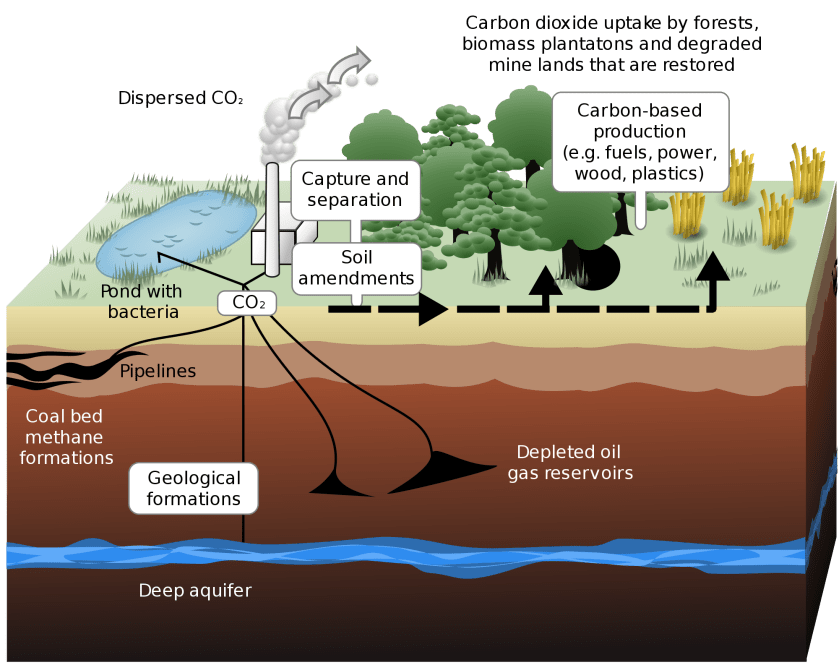
There’s much to be commended in the introduction to the report. The authors are absolutely right that we have multiple options. However, as the report develops, one option, Greenhouse Gas Reduction through Carbon Capture and Storage (CCS), is given prominence. In my view this is unhelpful. CCS is an unproven technology that would be capital intensive (making the involvement of corporations inevitable) and take longer than we’ve got. A specialist paper on CCS notes that

Although technologies regarding the capture and storage of CO2 exist, the overall cost of using current CCS procedures is still high and must be substantially reduced before it can be widely deployed. There are multiple hurdles to CCS deployment that need to be addressed in the coming years, including the absence of a clear business case for investment in CCS, and the absence of robust economic incentives to support the additional high capital and operating costs associated with CCS.

The fundamental point is (see ScotE3 Briefing 3: Time for action ) that the world desperately needs sources of energy which are clean, secure and affordable, and which can be readily put under democratic control. Fossil fuels have none of those characteristics. To continue to extract, burn and rely on them, and depend on greenhouse gas removal to address climate change, would mean continuing with insecurity of supply, oil imperialism and wars (Venezuela and Iran examples currently in the news), and high energy prices in order to meet the profit margin requirements of the big corporations who control their extraction and distribution. A focus on CCS plays into the hands of the corporations.

Mike Downham

NB We’d welcome further contributions on this topic.

image from commons.wikimedia.org 

2000px-carbon_sequestration-2009-10-07.svg