Review | Lifehouse -taking care of ourselves in a world on fire

Adam Greenfield argues that the key battles over climate are lost and activists should focus on adapting to the results of that failure. Pete Cannell responds that the only possible choice is to keep fighting for social change.

A version of this review was first published on the rs21 website.

In October 2012 hurricane Sandy wrought havoc on the eastern seaboard of the US. The storm surge overwhelmed New York’s sea defences and destroyed the homes and livelihoods of many thousands of working-class New Yorkers. The response of the city authorities was slow and totally inadequate. In its place, networks built a year earlier through Occupy Wall Street stepped in to mount a huge programme of mutual aid which became known as Occupy Sandy. Adam Greenfield, the author of Lifehouse, was one of the volunteers.

Hurricane Sandy flooding – image by David Shankbone (Creative Commons)

2024 was the first year that global average temperatures exceeded pre-industrial levels by 1.5°. Each year since 2022, global average temperatures have increased at an unprecedented rate. Year on year, global heating is matching the most extreme end of the range of possibilities predicted by climate scientists. And, while energy generated from solar and wind power increases apace, fossil fuel use is at an all-time high and greenhouse gas emissions continue to rise. Even if there were a massive shift to a low carbon economy tomorrow, rising temperatures, extreme weather and rising sea levels are baked into the global system for decades, probably centuries, to come. 

In his new book Lifehouse: Taking Care of Ourselves in a World on Fire Greenfield responds to this scenario by arguing that attempts to mitigate climate change have failed.  He makes three assumptions:

that a so-called ‘green energy transition’ will not take place in time to prevent the most consequential drivers of change from happening; that reparative ’geoengineering’  will not be attempted at the necessary scale or, if attempted, will not work as intended; and that in the time available to us, we will not invent some other technology capable of siphoning carbon from the atmosphere at the necessary scale, and rescuing ourselves that way.

Considering this, he calls on activists to redirect their efforts to adapting to the inevitable consequences of that failure. The core of the book draws on his experience of Occupy Sandy, the ideas of social theorist Murray Bookchin and other examples of collective social organisation including the Black Panthers and Rojava. 

Providing our own commons

The climate movement has always included activists who have argued for a return to nature, a retreat to a rural life that would involve rejecting all aspects of modernity. Greenfield’s position is different.  He recognises that most of the world’s population live in big urban centres and will likely continue to do so.  Building on his Occupy Sandy experience he suggests that every area needs to develop a Lifehouse, a building or complex of buildings that would form a focus for mutual aid, care and support for the local community – a place to meet and organise, find and share skills, grow food, provide medical services and much more. In any given urban area there would be many such sites. 

Greenfield expects that the deepening impact of the climate crisis will have a disrupting effect on the operation of the complex interconnected system that is 21st century capitalism.  This is certainly true. He also assumes that the retreat from state provision of public services that has developed in the neo-liberal era will continue.  He argues that:

if the state withdraws from [the provision of public goods] then there is only one possible response, which is for populations to self-organize to provide their own commons.

Accepting this, Greenfield then pays little attention to the state as he develops the Lifehouse concept.  I think this a profound mistake for reasons which I will attempt to address in the rest of this review. 

Greenfield’s articulation of Bookchin’s ideas recognises real problems with the Lighthouse model.  He notes that local systems of mutual aid may well be predicated on exclusivity, racist or misogynist ideas. Clearly the survivalist movement in the US is an example of this.  And in response to the cost-of-living crisis in Britain the far right was, and remains, proactive in setting up food banks and spaces where people could seek support.  His response is to suggest that the Lifehouse model should include an assumption of connectedness or confederation with other Lifehouses. He also notes that Lifehouses are likely to attract hostile responses from the state or from non-state reactionary forces. Again, I think this is right. While states welcome some forms of substitution for welfare services – typically charity run food banks and other services – they are much less keen on initiatives that involve collective working-class organisation.

The repressive state

The Lifehouse model assumes explicitly that it is possible to organise outside the state and alongside the state.  Greenfield argues that we should start building Lifehouses now. But almost everywhere that brings you up against a state that is increasingly repressive and intolerant of dissent, in a context of militarism, racism, misogyny and transphobia and the growth of the far right.  If we forswear mitigation and throw all our energies into adaptation it seems to me that we are in effect surrendering the ground to reaction. Greenfield notes at one point that a dystopian future might yet include small, favoured patches of relative normality, refuges for the rich. We can be sure that such enclaves would be armed to the teeth. On the other hand, if we focus on adaptation and turn to building Lifehouses our small patches of mutual aid and cooperation would have no such defence.

I want to argue that the alternative is to take system change seriously. That means breaking and replacing the capitalist system.  I’m conscious that here and now that might seem as utopian as the idea that we can remodel the world as a connected web of confederated Lifehouses.  I’m open to the idea that a sustainable world might look something like Adam Greenfield’s vision.  But the key challenge is surely how we can turn the world upside down and end the system which is driving us to disaster?  And here socialists have a historic responsibility.  

It’s clear that the climate crisis is systemic. The capitalist system has driven huge increases in material wealth through the exploitation of human labour and through commodification of the environment and material world. The system depends on continual growth and is incompatible with sustainable existence on a finite world. Revolutionary socialists have always argued that if those who labour seize the means of production, the fruits of human labour could be shared equally.  We talk about a world to win that could provide comfort, leisure and security for all. Today, however, the world we inherit is one where, as a result of the environmental damage caused by two centuries of industrial capitalism, the conditions of human existence are far more inhospitable than was the case previously.  The socialist revolution would necessarily apply the emergency brake to runaway climate change, but it can’t stop the damage that has already been done. The conditions for human existence in a world without capitalism will present a challenge for survival. Many of the world’s major cities will be underwater, there will be mass migration as some areas become too hot for human habitation and food production will be under huge strain in a world where extreme weather events are far more frequent. 

Socialists can’t promise a future of what has been called ‘fully automated luxury communism’. But we can expose the lies and deceptions of mainstream bourgeois governments and the far-right populists who are jockeying to replace them with the promise of a return to some earlier and mythical time of comfort and security. No such promise is possible in a world on fire.  Of course, exposing the lies is only possible if there are demonstrably possible alternatives and that’s our task to develop and popularise. 

The global working class

The wealth of the capitalist ruling class is built on the labour of generations of workers around the world and the blood and bones of the untold millions who were murdered through war and colonisation as capitalism spread around the globe. It is a system of great power and sometimes open, sometimes concealed, brutality. However, it depends for its existence on a global working class. Moreover, in this era of late capitalism it depends critically on complex systems and long global supply chains that can break if key workers withdraw their labour or under the impact of extreme weather events.  It’s brittle and vulnerable. That’s why Adam Greenfield’s argument for giving up on mitigation is so wrong.

Winning political arguments about who’s to blame for the crisis and how to ensure a secure future for all is not easy. In hard times it’s necessary for the left to articulate ‘freedom dreams’. Part of the argument has to be about a new economy that provides that security. But it also needs explicit recognition that the system that puts profit before the lives of people and trashes the life chances of future generations has to end. Achieving that goal requires a compelling vision and building collective power in workplaces and communities around the world. Along the way some states may be forced to make concessions and take mitigating action – but the only sustainable end game is the overthrow of those states.

This critique of Lifehouse is not an attack on mutual aid.  Practices of mutual aid are a vital and necessary part of working-class resistance – most notably in the urban centres of the global south. At times they may be essential to sustain class struggle and community survival but always against the state. To build sustainable centres for collective support and organisation requires the development of networks of resistance built through class struggle.  And if we do that then we can aspire to so much more.


Lifehouse: Taking Care of Ourselves in a World on Fire
Adam Greenfield
Post-election battlegrounds for climate and social justice 

On 4 July, the climate-trashing Tory government will be replaced, as good as certainly by Keir Starmer’s “changed” Labour party.

For all its talk of “green prosperity”, Labour plans to work closely with the corporations that profit from North Sea oil and gas and from generating electricity – and who intend to produce, and use, fossil fuels for as long as they can.

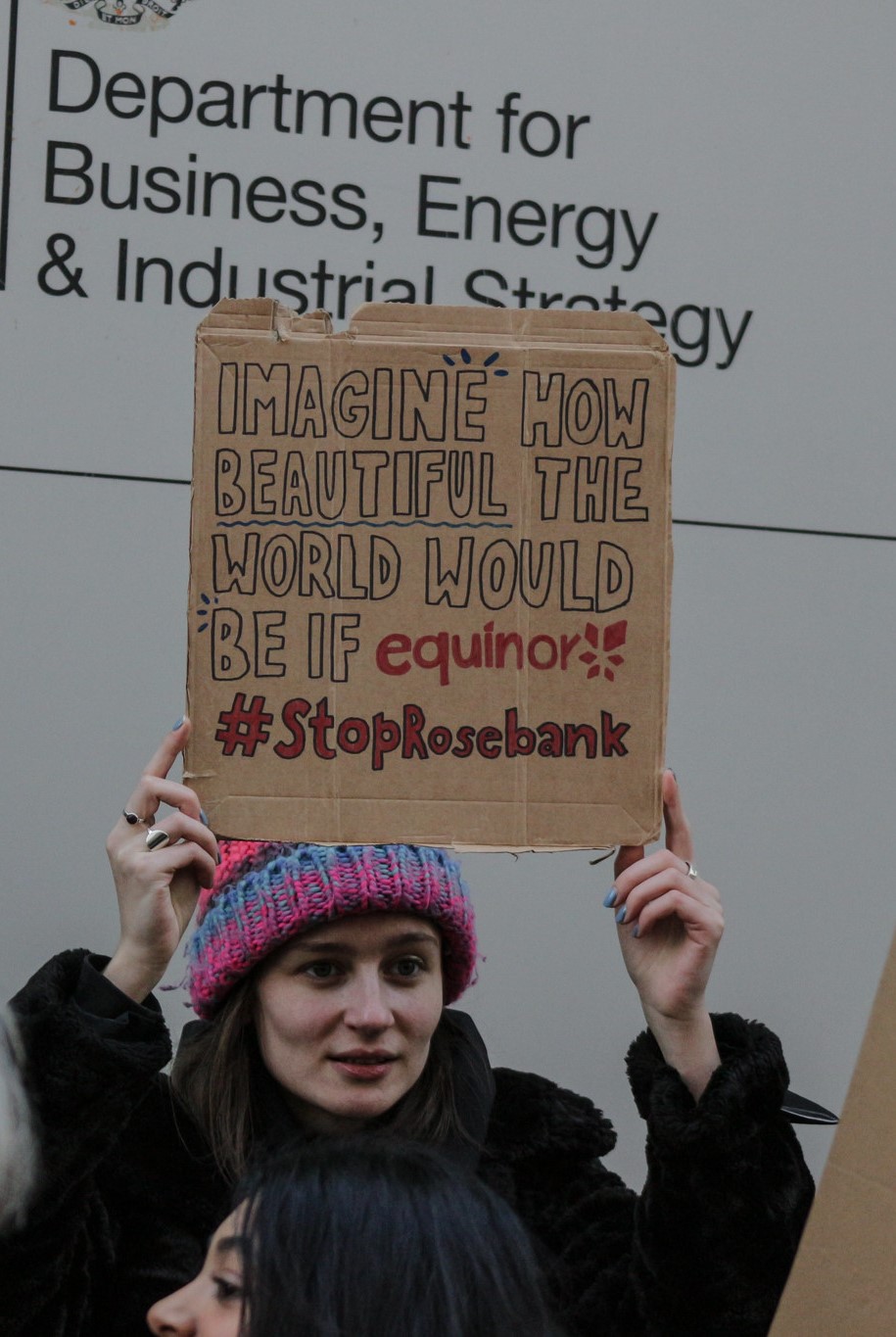
A protest at government offices against the Rosebank oil field project, January 2023. Photo by Steve Eason

Labour’s plans for cutting greenhouse gas emissions from homes and cars are hopelessly timid, because of its conviction that private business does it best.

Under Labour, we will in my view make progress against social injustice and climate change only insofar as social movements and the labour movement:

(i) confront and confound the government, and

(ii) show that action on climate change, far from costing ordinary people money as the extreme right claim, is 100% compatible with combating social inequalities.

In this article I try to identify the likely battlegrounds between our movements and a Starmer-led Labour government:

Fossil fuel production and the path away from it (part 1); electricity generation at national (part 2) and local (part 3) levels; avoiding false technofixes (part 4); and changing the way energy is used in homes and transport (part 5). Part 6 is about bringing these separate, but connected, issues together.

1. Transition away from fossil fuel production on the North Sea

The election-time slanging match about the North Sea’s future has featured politicians’ and union leaders’ cynicism at its worst. In opposition to this, our movement needs serious conversation about how to fight for working people’s livelihoods and run down oil and gas production simultaneously.

The political war of words has focused on Labour’s commitment not to issue new licences to explore for oil and gas in the North Sea.

The Scottish National Party, which fears losing parliamentary seats to Labour, has lashed out with a claim – shown by BBC Verify to be false – that this would cost “100,000 jobs”. This is “a clear about-face” from the SNP, which last year “committed to a built-in bias against granting new licences”, the Politico web site reported.

“Exaggeration and misinformation helps no-one”, given the urgent need for “a clear-eyed conversation about how to ensure that Scottish workers benefit from the transition away from oil and gas”, Tessa Khan of the climate advocacy group Uplift said.

But exaggeration and misinformation is exactly what leaders of the Unite union, which represents many North Sea workers, contributed. They withheld support for Labour’s manifesto, because of its North Sea policy (as well as for much better reasons, such as its employment policies) and endorsed SNP leader John Swinney’s nonsense.

Unite leader Sharon Graham suggests that a ban on oil and gas licences is the main threat to North Sea jobs. That is not true. It usually takes more than ten years from licence issue for a field to start production, so there is only a very indirect connection. In recent years oil corporations’ decisions to slim down their North Sea operations has posed a far more immediate threat.

If Labour reverses its ban on new licences, the only beneficiaries will be those corporations – while the planetary disaster threatened by climate change would come one step closer, as the heads of the UN and International Energy Agency have pointed out. Indeed there is a powerful case for scrapping the already-granted licence for the giant Rosebank field.

Unite says it wants to “see the money and the plan” for the transition away from oil and gas. But as its leaders well know, plans already exist.

The Sea Change report, published five years ago, showed how the North Sea workforce could expand, with investment in wind power and other renewables. The oil companies and Tory government have other ideas, set out in the North Sea Transition Deal – which proposes spending £15 billion on their pet technofixes, carbon capture and hydrogen. (See also part 4 below.)

The Green New Deal Rising group disrupted an event sponsored by oil industry lobbyists at the Labour party conference in October last year. Photo by Jess Hurd

Unite, along with other unions, accepts these false solutions, and calls for investment in hydrogen and carbon capture, as well as wind power. 

Perhaps we should be talking about “rupture, rather than transition”, he said, to make gains for social justice and tackling climate change. This starts with uniting oil workers and Scottish working-class communitiesmore broadly. This is the conversation we urgently need.  

At a recent gathering of trade unionists concerned with climate policy, Pete Cannell of the campaign group Scot E3 argued that, given the dominance of this technofix narrative, “it’s legitimate to ask whether ‘just transition’ is any longer the right framing”.

2. Public ownership in the electricity system

Labour will set up a “publicly-owned clean power company”, GB Energy, paid for by a windfall tax on oil and gas producers. But GB Energy will own few, if any, electricity generation assets and will focus on partnerships with private capital. Labour also plans to leave the electricity transmission and distribution grids in private hands, and to leave largely unchanged the neoliberal electricity market rules that allowed corporations to reap billions by impoverishing households in the 2022 “energy crisis”. 

Labour intends to capitalise GB Energy with £8.3 billion over the next five years: £3.3 billion for a potentially useful Local Power Plan (see part 3 below), and £5 billion to “co-invest in new technologies” including floating offshore wind and hydrogen, and “scale and accelerate mature technologies” including wind, solar and nuclear.

Labour’s loud claim that GB Energy will “lower [electricity] bills because renewables are cheaper than gas” is not credible. This would require, at least, an investment far greater than £5 billion, allied to a root-and-branch overhaul of electricity markets.

More likely, GB Energy will, at best, fund new technologies that financial markets prefer not to risk their own money on – or even follow in the footsteps of Tony Blair’s disastrous Private Finance Initiative, with which corporations milked billions from the NHS. The Guardian, apparently briefed by Keir Starmer’s team, reported that GB Energy will probably start with “investments alongside established private sector companies”, including the chronically over-budget Hinkley Point, Sizewell C and Wylfa nuclear projects.

The Greens and others slammed Starmer, when he finally clarified on 31 May that GB Energy will essentially be an investment vehicle. But a trenchant critique had already been published last year: Unite’s Unplugging Energy Profiteers report, which warned that “unless combined with a public purchasing monopoly, or significant market reform intervention, [GB Energy] will have no impact on distorted pricing in the wholesale market”, and “by concentrating very limited resources on de-risking experimental forms of generation, GB Energy will use public resources to underwrite and further increase future potential profits for the private sector”.

Unite, and the Trades Union Congress, call for public ownership to be extended not only in electricity generation, but also in the supplybusiness and in transmission and distribution networks. Labour madesimilar calls in 2019, but has now ditched them.

Underinvestment in these networks is a scandal as damaging as the water companies’ rip-off: tens of billions of pounds’ worth of network upgrades are needed to facilitate renewable generation and close the gap on missed climate targets.

The National Grid’s Nechells electricity substation near Birmingham

Already, there are 10+year queues for renewables to be connected to the grid; house-builders are fitting climate-trashing gas boilers because they can not access electricity for heat pumps; battery storage lies unusedbecause companies’ computer systems are out of date … all while distribution networks paid out £3.6 billion in dividends to shareholders in 2017-21.

The system is in such a state that even Rishi Sunak’s dysfunctional government took regulatory powers away from National Grid and put them in the Future System Operator. Nick Winser, the electricity network commissioner, warned the government that unchanged, the system would leave “clean, cheap domestic energy generation standing idle, potentially for years”. “Very few new transmission circuits have been built in the last 30 years”, he said: unless jolted, companies could take up to 14 years to build them.

To make the electricity network fit for the transition away from fossil fuels, wider public ownership is crucial. Our movement needs to work out how to coordinate the fight for it.

3. Community energy and decentralised renewables

Labour promises to spend £3.3 billion on a Local Power Plan, under which GB Energy will “partner with energy companies, local authorities and cooperatives to develop up to 8GW of cheaper, cleaner power by 2030”. Up to 20,000 renewable projects will return “a proportion” of their profits back to communities. But “the detail on these plans is sparse”, the New Statesman reported – and so it is surely up to community organisations and the labour movement to discuss effective ways this money could be spent.  

Until now, central government has been a wrecking ball for community energy. In 2015, it changed planning rules, effectively blocking onshore wind projects. In 2019, it scrapped the feed-in tariff paid for electricity supplied to the grid from small-scale renewables. And for years – as decentralised renewables technology leaped forward internationally – it ignored calls to overhaul market rules. Small renewables projects were locked out of the grid by the need for a £1 million + licence, and other obstructions.

The Green New Deal all-party parliamentary group last year called for the regulatory system to be turned upside down, to end its bias in favour of the “big five” generators. It proposed a “European style ‘right of local supply’”; changes to rules on planning and public procurement; mandatory transparency of grid data; and other measures.

Such changes would make it possible to replicate the success of Energy Local in Bethesda, north Wales, which supplies locally-produced hydro power to households at below-grid prices. In April, the Common Wealth think tank proposed a “public-commons partnership” as the institutional form under which local authorities could develop such projects.

All this will take a fight, though. Otherwise, electricity corporates will spread their tentacles into decentralised renewables, as they are doing in the US and Australia.

Furthermore, we need to overcome the official labour movement’s residual reluctance to support community energy projects. The TUC’s recent renewables policy paper, which lists offshore wind, wave, nuclear and “zero carbon hydrogen” (?) as energy technologies – but not decentralised wind and solar – is, unfortunately, indicative.

Decentralised renewables, developed with cooperative, community and local authority forms of ownership and governance, can help to break corporate control of electricity provision, and open the way to democratise and decommodify it.

4. Opposing false technological solutions

False technofixes, including hydrogen and carbon capture, use and storage (CCUS) feature prominently in Labour’s election manifesto – the outcome of lobbying by the oil industry, for which they comprise a survival strategy. Nuclear power – expensive, dangerous, and beloved of the military – is there too, grabbing funds from proven, socially useful technologies such as home insulation, public transport and decentralised renewable power.

While the case against nuclear has been made, and the false logic of CCUS exposed, over decades, the drive for hydrogen is more recent: it is the oil companies’ alternative to electricity-centred decarbonisation. Energy systems researchers argue that, while hydrogen may be needed in future e.g. for steelmaking or energy storage, it will never be suitable for home heating, and hardly ever for transport. 

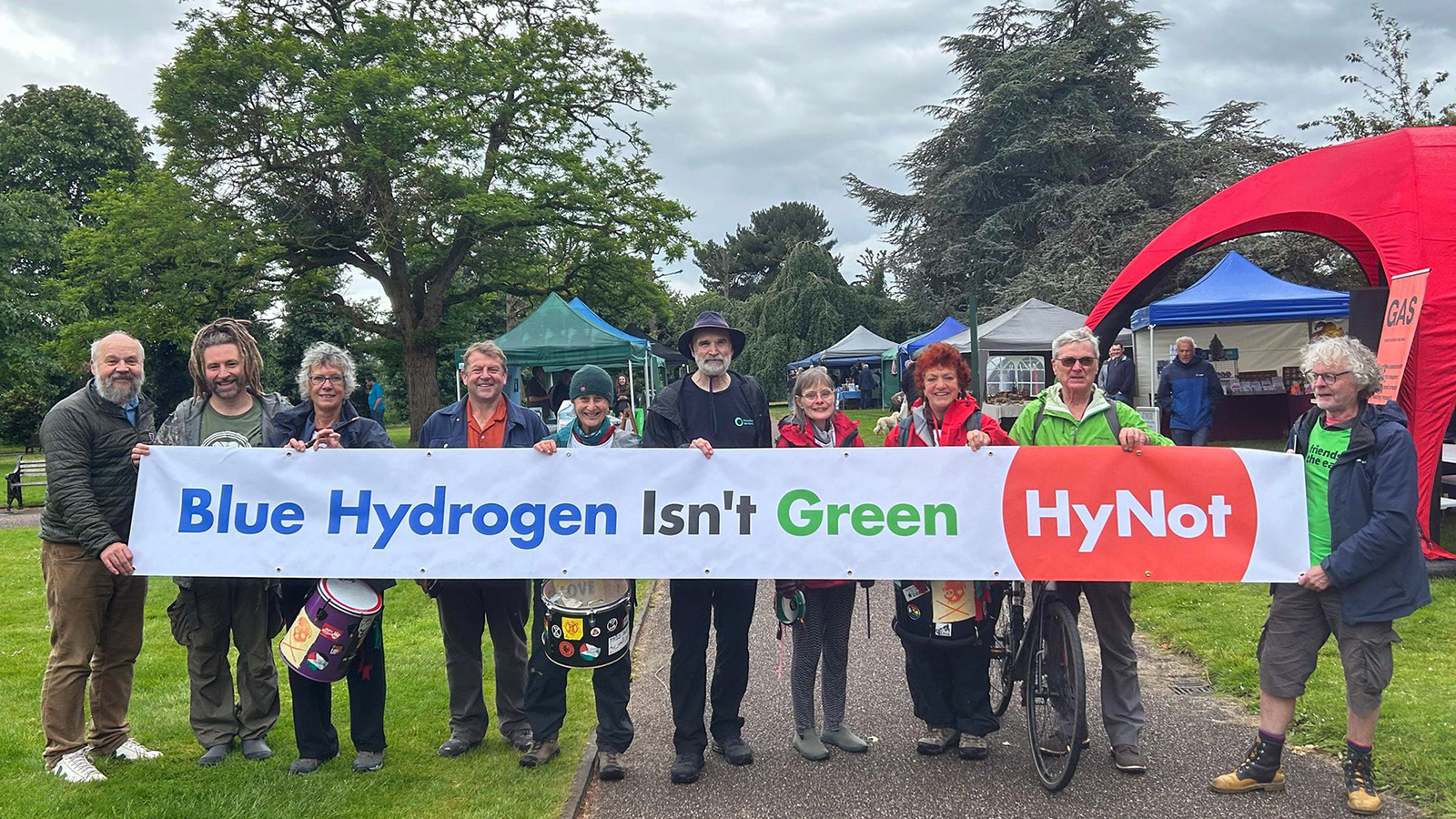
Demonstration by HyNot, which opposes hydrogen for home heating, at the Green Expo UK in Cheshire, last week. Photo from HyNot twitter feed

The Tory government has invested heavily in hydrogen, and the 2023 Energy Act provided a framework for its commercial development. But attempts to bribe communities into testing it out for home heating have hit setbacks. A planned test at Whitby, Merseyside, was cancelled last year after vigorous opposition by local residents and the HyNot campaign group. This year a second planned test at Redcar, Yorkshire, and a thirdone in Fife, Scotland, were both postponed.   

Catherine Green Watson of HyNot said: “These postponements are great progress for our campaign. But on Merseyside we still have strong local political support for hydrogen in industry, which should not be the priority. Instead, we need to concentrate on upgrading the electricity grid.”

We need a discussion in the labour movement and social movements about the social role of these technologies. We could work towards unity around the principle that they should not receive state funding that could go to quicker, more effective decarbonisation paths.

5. Energy use in our homes and transport 

Labour has scaled back its promises to invest in its Warm Homes Plan that will fund grants and low-interest loans for insulating homes and replacing gas boilers with heat pumps. Shadow energy secretary Ed Miliband last year talked about “up to £6 billion a year”; by the time Labour’s manifesto was published last week, this had shrunk to “an additional £6.6 billion over the course of the next parliament” (that is, over five years). Talk of upgrading 19 million homes had stopped; now it’s 5 million.

Labour has stuck with commitments to take railways back into public ownership, and to support municipal ownership and franchising of bus services. But it is also promising to “forge ahead with new roads”, and keep the transport system centred on private cars, at a time when researchers argue that this cuts dangerously across tackling climate change.

If Labour sticks to this course, determined by its neoliberal fiscal rules and by corporate lobbying, then key opportunities to cut UK carbon emissions, while improving people’s lives, will be missed. Researchers have been screaming for years that insulation and heat pumps, and superceding the car-centred transport system with better, cheaper public transport, are desperately needed to decarbonise homes and transport, the two largest sources of greenhouse gas emissions.

Battles on effective energy conservation in homes, transport and throughout the economy are part of the war to limit climate change.

Labour’s commitments are too timid to reverse the disasters caused by Tory policies. In the decade from 2012, annual completions of home insulation upgrades fell by nine tenths. The measures announced by government last year would take 190 years to improve the energy efficiency of the UK housing stock and 300 years to hit the government’s own targets for reducing fuel poverty, National Energy Action stated.

As for roads, the government could cancel the £10 billion Lower Thames Crossing scheme, final approval of which has been delayed until October, and apply to all future projects the principle adopted by the Welsh government – that they can only go ahead if compatible with climate policy.  

Labour may not only fail to deal with these gigantic sources of carbon emissions, but actually open up new ones. A grim example is Labour’s threat to overrule communities who question tech corporations who want to build fuel-guzzling data centres – which will help trash climate targets, to the benefit of those corporations alone.

6. Bringing the issues together

The stakes are high. Every new assessment by climate scientists underlines the conclusion reached by leading British researchers four years ago: that the UK’s decarbonisation targets are half as stringent as they need to be, to make a fair contribution to tackling global heating. The government’s own climate change committee says non-power sectors of the economy need to decarbonise four times faster than they are doing.

Tackling climate change, while reversing the effects of 14 years of neoliberal austerity policies, will not be easy. Indeed, Labour does not intend to: both decarbonisation and social policy will be subordinated to their fiscal rules.

The labour movement and social movements need to challenge and push back Labour’s pro-fossil-fuel, pro-austerity approach.  

We need to unite our forces and find the pressure points – be it saying “no”, to the Lower Thames Crossing project and similar, or finding openings for collective action, e.g. in the Local Power and Warm Homes plans.

To act effectively on climate, we need to keep in mind the necessity of holistic solutions, and reject illusory technofixes and greenwash narratives that claim to reduce emissions with one hand, and pour them into the atmosphere with the other. SP, 18 June 2024.

Fossil Fuels and Right-Wing Populism

This post explores the way in which right wing populist parties use climate denial as a key part of their agenda.  In thinking about the topic, I found Andreas Malm’s excellent book ‘White Skin – Black Fuel on the danger of Fossil Fascism’ very helpful.  Early on in the book, Malm notes that: 

“All European far-right parties of political significance in the early twenty-first century expressed climate denial.”

The book weas written 3 years ago but it’s hard to think of more recent exceptions.  So, there’s definitely something to be explained here.

Clearly climate denial didn’t start with the rise of right-wing populism.  From the 1970’s onwards the major oil and gas companies, particularly Exxon, were researching the impact of greenhouse gas emissions on the environment and at the same time funding organisations like the Global Climate Coalition in the US whose role was to argue that pushing large amounts of CO2 into the atmosphere was not a problem.  Privately they knew from early on that fossil fuel extraction would have a devastating effect on the global climate.  In 1995 the GCC in an internal document wrote that 

“the potential impact of human emissions of greenhouse gases such as CO2 on climate is well established and cannot be denied”

but in public they denied it.  

As a strategy outright denial had its limitations.  The Kyoto protocol signed in 1997 marked the beginning of a new strategy – a shift from denial to greenwashing.  

The three core tenets of Kyoto are:

  1. Postpone the showdown with Fossil Fuels into distant future.
  2. Place no serious limits on fossil fuel extraction.
  3. New opportunities for generating profit.

In the UK, the industry’s plans for the North Sea are a good example of postponing any showdown with fossil fuels.  The strategy is based on continuing extraction through to and beyond 2050 and the development of a so-called net zero oil and gas basin.  Here net zero depends on heroic assumptions about techno-fixes such as carbon capture and storage combined with creative accountancy that ascribes all responsibility for the carbon in the oil and gas that’s produced to the users.  Globally there are virtually no regulatory limits on the production of fossil fuels.  It’s assumed that any run down will be as a result of market forces.  At the same time trading carbon permits has been highly profitable in financial terms and has allowed the industry to claim that the trade contributes to reducing carbon emissions.  There is next to no evidence that carbon trading and offsetting has reduced greenhouse gas emissions.

So as far as big business goes, we are still in the era of greenwashing.  Big oil and gas are at pains to argue that they want to protect the planet.  And almost all governments around the world are in lockstep with fossil fuel industry in this strategy.  Practically, depending on local circumstances the form that greenwashing takes varies, but everywhere it’s about maintaining or enhancing the profitability of fossil capital and preserving the existing infrastructure.  So, in the UK for example hydrogen is touted as the answer to domestic cooking and heating.  In the short to medium term this would probably mean higher carbon emissions than the existing use of natural gas and if ultimately the hydrogen was all green, i.e. produced by electrolysis it would be fantastically inefficient.  Requiring the use of up to seven times as much electricity than would be required to simply electrify cooking and heating.  But it’s attractive to the industry because it enables the continuation of existing economic and technical infrastructure.

The result of all this is that investment is skewed away from forms of energy use and production that are sustainable and rapidly achievable – and rather than supporting a just transition for workers and communities existing inequalities are maintained and ramped up. The ongoing cost of living crisis in which poor consumers of gas and electricity contribute to eye watering profits for energy producers and distributors is a case in point.

And it’s this that has provided fertile ground for right wing populist parties.

Five decades of neo-liberalism has syphoned money and resources from public to private and increased inequality everywhere so that working class people are anxious or scared about climate, cost of living, war, housing, growing old – in a world where the belief that their parents or grandparents had that things would be better for the next generation is dead.  Most people don’t trust established politicians – established parties offer variations on the same neo-liberal agenda.  Into this vacuum has stepped forms of right-wing populism that purport to offer alternatives to the ‘establishment’.

Right wing populism takes different forms – sometimes taking over long-established parties – Trump and the Republican Party in the US.  Or in the UK the continuing rise of right-wing populists as a major, perhaps majority faction within the Tory party.  Sometimes emerging from explicitly fascist formations, for example, Le Pen in France or Meloni in Italy.  And sometimes completely new organisations, for example the AfD in Germany.  None of them are into Greenwashing.  They are all about Climate Denial.

In Spain a prominent member of right wing populist party Vox explains climate change as 

“any change on the sun, the moon, the rotation of the earth, volcanoes and naturally occurring atmospheric phenomena but absolutely not on CO2 emitted by humans. It would, said Abascal, be ‘very arrogant’ to believe that humans could alter the climate. It would be ‘even more arrogant’ to think that the alteration could be rectified by ‘coercive laws and taxes’.”

The AfD in Germany has increased its influence through organising around climate issues, demonising perhaps the biggest climate movement around the world, foregrounding the cost-of-living crisis and agitating around the farmers protests.  Often supported and facilitated in this by the state and the police.

It’s obviously not just climate that is building the new far right.  Climate issues intersect with the legacy of neo-liberalism, migration and racism and the failure of the left to provide an alternative that speaks to working people’s insecurity and against individualistic solutions.  The far-right populists feed off social media fuelled confusion and conspiracies.  Very often angry or frightened people looking for answers find them in apparently anti-establishment and authoritative voices online.  

So, what’s to be done.  I think we can see the embryo of an alternative in the picket lines and in the huge response to the ongoing horror in Gaza.  It’s struck me standing on UCU picket lines last year, and then again in the last few months picketing and leafleting outside the Leonardo arms factory in Edinburgh, how many of the passing drivers beep their horns and wave.  Early in the morning many of them are white van drivers, very few of them will be in a union.  There’s are real possibility of breaking the rise of the populist right.  But if I’m right about why they’ve been able to build on climate I think part of what a revitalised left has to do is set it’s face firmly against partnership with fossil capital and clearly against solutions like CCS for continuing oil and gas production and hydrogen for domestic heating that preserve the power of fossil capital.  And that means for example that UNITE, RMT and GMB need to stop supporting the oil and gas industry’s North Sea transition deal.

The Climate Contradictions of Gary Smith

Paul Atkin replies to an interview with the GMB union’s General Secretary Gary Smith in the Spectator.

In agreeing to be interviewed by the Spectator under the title “the folly of Net Zero” GMB General Secretary Gary Smith lets his members down; not least because remarks like these from a leading trade unionist help give Rishi Sunak encouragement to accelerate his retreat from the government’s already inadequate climate targets.

The phrase “the folly of Net Zero” makes as much sense as “the folly of getting into the lifeboats when the ship is sinking”

Difficulties in making a transition to sustainability does not mean that making it isn’t essential, and the faster we move the less damage is done. We can see that damage all around us even now. 

Gary doesn’t seem to get this, any more than Rishi Sunak does, and he latches on to some of the same lines as the PM does, albeit with a more pungent turn of phrase. To go through these point by point, quotes are either directly from Gary Smith or the Spectator.

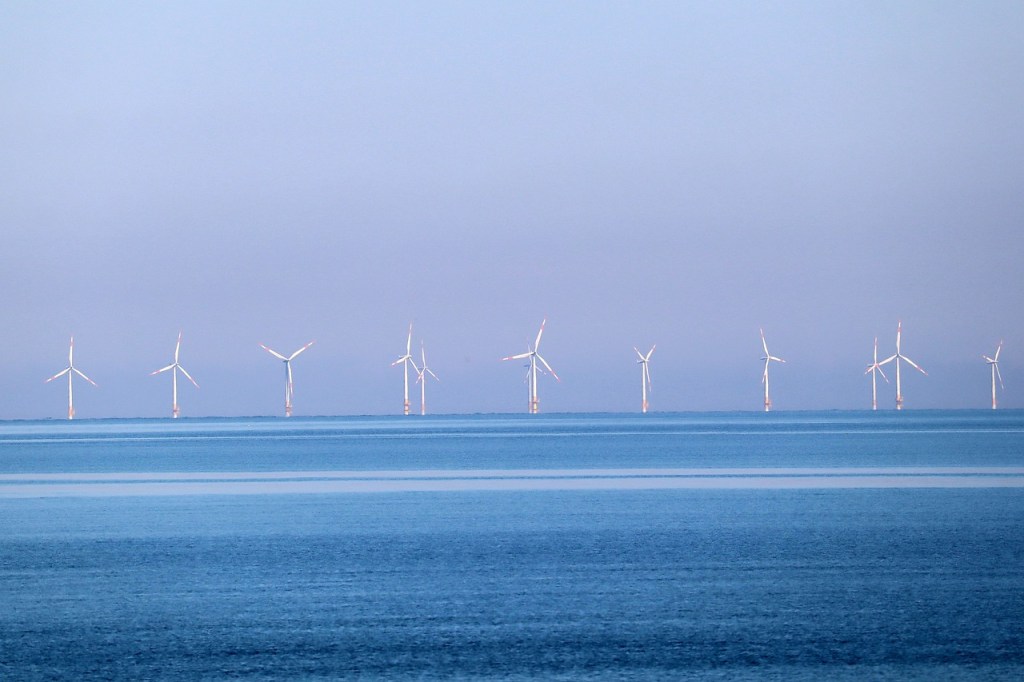
Image from pixabay.com CC0

Auctions for offshore wind power

“Now there will be no bids for the next round of licences because the wind industry can’t afford to put up the projects”

The article starts with an odd bit of misdirection, that echoes the entire right-wing press, on the results of the latest round Contracts for Difference auction for new electricity generation. This focusses on the absence of offshore wind bids at the strike price of £44 per Megawatt hour. The way the Spectator puts it is “The government and the renewables lobby hoped that a successful auction would show that wind power could compete with fossil fuels”. The fact is that it already does. There were no bids from fossil fuel sources at this price either; and the successful bids were all from renewable sources. 

  • 24 onshore wind projects
  • 1 Remote Island wind project
  • 56 Solar projects
  • 3 Geothermal projects
  • 11 Tidal stream projects.

These are slated to produce 3.7GW of power. So, renewables 95: Fossil Fuels 0. It’s quite clear which source is heading for the relegation zone.  And the International Energy Agency has just reported that electricity generation from fossil fuel sources declined by 7.4% in the whole OECD in the year to September,  so this is happening in every developed country.

Starmer’s 2030 net-zero carbon electricity deadline

“Starmer’s 2030 deadline is impossible, I don’t even worry about it

With 5GW of potential offshore wind projects not coming online, due to rising raw material and interest rate charges increasing costs beyond the auction price, you have to wonder if the government set this up to fail. With the current wholesale electricity price set at over £80 per Kilowatt hour, there was a lot of room to set a price (perhaps around £60 per KWH as suggested by the industry) that could have brought this on stream, and still cut the cost of electricity for customers. This will have a knock-on effect on bills and supply chain jobs – which have been projected on the basis of a tripling of UK offshore wind by 2030 – and choke them off unless the momentum is restored at the next auction. Anyone concerned about jobs in the supply chain will be campaigning between now and then to make sure this is the case. 

The stop-go market driven model embodied in the CfD system makes a consistent plan for energy transition vulnerable and chaotic. To take this process by the scruff of the neck and drive it through at the scale and pace that we need requires, as UNITE successfully argued at the TUC, public ownership of energy. 

Undersea cables

The National Grid can’t get undersea cables, There are 4 suppliers of cables in the globe, they’re all booked out to 2030”

If you are concerned with cutting carbon emissions and growing jobs, this is an argument for campaigning for more investment in cable laying and the jobs that go with them, not accepting current limited capacity as an insuperable obstacle. A very good use for some of that £28 billion Labour is pledged to ramp up to. 

North Sea drilling

“There will be more drilling in the North Sea”

Senior figures in the unions can’t afford to ignore the scientific reports on this matter. They are not ambiguous. NO new oil and gas exploration is compatible with Net Zero. 60% of existing reserves have to be kept in the ground to avoid catastrophic consequences.  Weaning ourselves off fossil fuels requires unions to fight for a just transition as rapidly as possible for their members in the oil and gas sector. Spinning a delusion that everything can carry on as it is, will speed us to a point at which sustaining jobs will be the least of our problems.

Renewables lobby

“The renewables lobby is very wealthy and powerful. I think people on the left, for good intentions, have got hoodwinked into a lot of this”

This is a breathtaking inversion of reality. How “wealthy and powerful” is the “renewables lobby” compared to the fossil fuel companies? Octopus compared to Shell? Vesta compared to BP, or Aramco, or Exxon?  According to the IMF, last year total fossil fuel subsidies were $7 Trillion. 7.1% of global GDP. That’s power. That’s wealth. We should note that this is $3 Trillion more than the total that would be needed globally to get us on track for sustainable development. Shell is now casually projecting that Net Zero will only be possible sometime in the 22nd century if they have their way, with no accounting at all for the social, economic and political consequences of that. Gary sees these companies as “people who we can work with” without reflecting that, since they have known about climate change for fifty years and tried to cover it up, with no “good intentions” at all, that hoodwinking is a large part of what they do.

UK net zero targets

“We’ve cut carbon emissions by decimating working class communities

Who does he mean by “we”? A better word would be “they”. The succession of Tory governments, in all their various guises, since 2010 have been bad for climate breakdown and the working class. They have put business imperatives (profit) above sustainability, and dumped costs of transition downwards onto those least able to afford it. Two examples. Insulation and solar energy installation fell off a cliff when the Tories “cut the green crap”, leading to thousands of lost jobs and higher bills as a result. 

Green levies

Green levies are a modern-day poll tax”

It’s also the case that, because it was the Tories, the schemes they had were skewed to subsiding the sort of consumers who could afford the upfront investment; while dumping the costs on everyone else’s bills. Hence Gary’s complaint that this was ‘disproportionately paid for by the poorest’. Quite so, but the answer to that is not to scrap insulation and solar panel installation altogether, but to approach it as a social mission to upgrade the “leaky, freezing council house(s)” that need it most first, and do it through Direct Labour run by Local Authorities; thereby creating jobs, cutting fuel poverty and improving health, as well as cutting energy demand and therefore emissions. Win, win, win. 

Green Jobs

It’s usually a man in a rowing boat sweeping up the dead birds”

Given that there were 19,600 jobs directly in offshore wind in 2022, and another 11,500 in the supply chain, that’s quite a lot of rowing boats. 30% of these are in Scotland. 15% in Yorkshire and Humber. If considering bird fatalities, Gary might note that in this study from the US, “for every one bird killed by a wind turbine, nuclear and fossil fuel powered plants killed 2,118 “. If we go for nuclear and stick with fossil fuels, we’re going to need a bigger boat.

According to Prof Sir Jim McDonald, president of the Royal Academy of Engineering, 30,000 new skilled workers would be required to retrofit buildings, while 60,000 technicians would have to be on hand to go one step further and install energy efficient heating systems in homes, offices and factories, with intensive training required. This is an extremely conservative estimate given that it can take four skilled workers six months to do a thorough retrofit on a house. In their latest Climate Jobs Report the Campaign Against Climate Change Trade Union Group argues that two million jobs will be required to deal with all 27 million homes and public buildings that need retrofitting if it were to be addressed seriously with the level of investment that’s needed.

That’s an awful lot of new jobs. Were the GMB to campaign for this, positively and proactively, some of these new workers might join.

Nuclear energy

“Smith is broadly positive about the future of green energy and sees Hinckley Point as a success story”

The argument that new nuclear is the core of future “green energy” is not consistent with any concern for impact on energy bills. The strike price for electricity generated by Hinckley Point is £93.50 per KWh. More than double the price at the last CFD auction and a third more than Offshore wind companies were pitching. This will go onto electricity bills and hit the poorest hardest. Small Modular Reactors are projected to be even more costly. So, whatever the green merits or otherwise of nuclear, it is not compatible with the concern for costs to customers that is foregrounded in his argument against “green levies”.

Hydrogen

Gary also argues for hydrogen, in general terms in this article. Elsewhere the GMB has pushed hard for hydrogen to be used as a mass replacement for natural gas for domestic cooking and heating. This is a complete non-starter on grounds of cost, emissions and safety. Unless the hydrogen is produced by renewable energy, the carbon emissions produced in making it are greater than if you just use natural gas in the first place. To produce sufficient hydrogen for mass domestic use using renewable energy would need far more wind farms than Gary is prepared to contemplate as a realistic possibility. Hydrogen has a role in some hard to decarbonise industrial sectors, so any green hydrogen we produce should be kept for that. It will be an expensive and precious resource that we should use accordingly. You have to add to that the concerns about how flammable the stuff is in a domestic context. As hydrogen is much lighter and more flammable than natural gas, the possibility of leaks and fires is much greater, so the existing infrastructure would need significant upgrading. A recent government report concluded that hydrogen in the home would be four times more dangerous than natural gas. A job creation scheme for the Fire Brigade perhaps, but probably one they’d rather not have.  That’s why people selected to trial it as a cooking and heating tool in Ellesmere Port rebelled against the prospect of a domestic Hindenburg disaster* in their kitchen, leading to the pilot project having to be scrapped. Many gas fitters are less than happy at the prospect of working with hydrogen for domestic heating or cooking for the same reason.

China and supply chains

“We’ve become increasingly dependent on China because we can’t secure our energy future”

Gary’s position on trade and supply chains is contradictory. The GMB has argued for a “Great British Supply Chain”, with an almost autarkic vision of everything from widgets to jackets to turbines being built here, and for the CFD auctions to be stopped until one is established.  At the same time, he quite rightly says he is “not a protectionist”, because workers lose out. But also, that the UK can’t do what the US is doing with the Inflation Reduction Act because it does not have a major reserve currency; which does not quite add up. He objects to the Tory approach for its “ideological bent” to neo liberal globalisation and buying the goods from the cheapest source, but also objects to imports from China as a “non-market economy” that “distorts the world economy”.

Gary seems to accept that China’s “non market economy” is more efficient at producing the necessary goods than the UK neo liberal economy is. In the case of energy, this is probably because they are investing more than twice as much in renewable energy generation than the EU and USA combined, and the UK lags behind both of these. Whether you agree with China’s definition of itself as “Socialist with Chinese characteristics”, or argue that it is a form of “state capitalism”, there’s no doubt that their state directed investment and coordination of state companies, academia and the private sector is beginning to produce the necessary goods at the necessary speed and scale. Just as well, because getting their dependence on coal down fast is crucial for all of us and, again according to the International Energy Agency, both possible and happening. 

And that brings us to the paradox of Gary’s position. To develop a comparable supply chain here would require investment on that scale. But he claims that investment even on the smaller scale being carried out in the US is beyond the UK’s capacity. To deploy the £28 billion that Labour projects that it will ramp up to (which will be comparable to the US and EU, so therefore about half the Chinese level) would either require direct state investment through newly created nationalised industries, or you have to bribe a multinational, which at the moment is “free money” that comes with no government stake or even a say for the workforce or affected communities. Tata is doing rather well out of this at the moment, with half a billion for an electric arc steel furnace in Port Talbot and another 600 million for their EV plant in Swindon. Gary’s complaint that the redundancies that come with this deal at Port Talbot shows that Just Transition is “fantasy land” undercuts the position that his members would expect him to take alongside the other affected unions – for a say in the transition, for investment in a wider range of viable technologies to sustain volume steel making and the jobs that go with it. If this is a “fantasy” then so is any prospect of defending those jobs. 

The reality is that “British” manufacturing is, for the most part, owned by multinationals and might be better understood as “production in Britain”. It also shows that companies like these and the Fossil Fuel majors in the North Sea about whom Gary argues “we’ve got to stop seeing them as the enemy and we’ve got to start seeing them as people who we can work with”, do not return the favour, and shut the unions out whenever they can.

More positively, it should be noted that high quality locally produced goods are not solely dependent on the national market and can also be exported, and companies based here, whoever owns them, do that too. In 2017, according to the Renewables UK Export Nation Report this included “an extraordinarily wide variety of goods and services, including supplying, installing and maintaining onshore wind turbines and components, designing gearboxes, manufacturing offshore wind turbine blades and steelwork, supplying and laying underwater power cables, installing, inspecting and maintaining offshore wind farms, providing helicopters, crew and vessels, developing wave and tidal energy projects and providing components for the marine energy industry, as well as designing software, conducting geological surveys, monitoring wildlife, and providing financial and legal services”. With properly targeted and coordinated R&D producing patents as part of a proper industrial strategy, there is a lot of room for growth in all of this, which matters for the sector because most of the growth in it will be “in Asia”.

“Failing to prepare is preparing to fail.” Benjamin Franklin

Transition and jobs growth will only happen if there is investment at scale and speed. Seeking to “moderate” Labour’s policy so that the investment doesn’t happen, means there will be no growth in jobs either. Without plans, and without union engagement in making them, we will stagnate at best. That is what we should be concentrating on now, so that mobilising people for transitions in their communities and workplaces that will cut their bills, boost jobs and cut our carbon emissions fast becomes part of the election campaign to drive the Tories out of office and cement Labour in government into actions that drive that forward. 

*I was once told at a SERA meeting by a representative of the Hydrogen industry that the reason the Hindenburg burned so fiercely was not because of the highly flammable gas that it was filled with, but because of the lacquer that was painted on the outside of the dirigible. He did this with a straight face.

By Paul Atkin

A Botched Rehearsal

Mike Downham reflects on the impact of Covid, the aftermath of COP26 and what we might do differently in future. This article was first published in Scottish Socialist Voice.

It’s nearly two long years since we began to become aware of the potential scale and danger of the new virus. At that point some prescient people suggested that how we reacted to the pandemic would be a rehearsal for our performance in the forthcoming big show of climate breakdown.

This wasn’t the first time ‘rehearsal’ had been used for how we organise on the left. John Berger described every act of resistance as a rehearsal. Colin Barker called his 1987 book about the uprisings in France, Chile, Portugal, Iran and Poland between 1968 and 1980 Revolutionary Rehearsals. And he used this title again in his subsequent book Revolutionary Rehearsals in the Neoliberal Age, written jointly with Gareth Dale and Neil Davidson published this year – posthumously for both Colin and Neil – which describes the uprisings in Eastern Europe, South Africa, Indonesia, Argentina, Bolivia, Venezuela, Sub-Saharan Africa and Egypt since 1989. 

It’s reasonable I think to say that we’ve made a right mess of the Covid rehearsal. Had we known two years ago what we know today, we would have learnt our lines and our cues more thoroughly. What we know today is that 9,634 people in Scotland have died; that the majority of these snuffed-out lives have been among the poor, the disabled and the marginalised; that 99,000 people in Scotland are living with Long Covid; that about 10% of children who catch the virus go on to have disabling poor health for weeks or months; and that the NHS has broken down.

That the NHS has actually broken down, no longer something we just fear might happen, was brought home to me this week by hearing about a middle-aged woman in the Paisley area with an 18-month history of severe neck pain who waited so long for surgery that she’s been forced to give up her job as a care-worker, then lost her home because she couldn’t keep up with her mortgage repayments. Not that this is the only tragic story about NHS failure we could tell between us.

Now the omicron variant (whether or not it turns out to be as bad as feared – we’ll have to wait a week or so before we know) is shouting at us from the wings, telling us that if we allow the virus to spread, whether in Scotland’s communities, schools and workplaces in an incompletely vaccinated population, or in largely unvaccinated countries sent to the back of the queue because they can’t pay, sooner or later we’re going to get a variant which will evade current vaccines.

And yet the cues were there in the script from the beginning. If we’d read it and learned it we’d have known we couldn’t trust the governments of wealthy counties, including Scotland, to not rely so heavily on vaccines, or to prioritise supply and reduce the cost of vaccines for poor countries, because these governments are locked into a system where profit trumps health. Yesterday’s top news was about Pfizer rubbing its hands as it suggested that annual vaccination was likely to be necessary – without mention of the financial and logistical implications of vaccinating eight billion people annually. Pfizer is relishing not only the prospect of a limitless market but also that it has outcompeted AstraZeneca both technically and in its propaganda.

Just as profit trumps health, so that the ruling classes allow the Covid virus to spread, it also trumps the devastating impacts of global heating which are unfolding for all humanity. COP26 has finally made it clear that neither wealthy governments nor the oil and gas corporations are going to take effective action in relation to global heating, despite being fully aware of and no longer denying the scale of the impacts which will result from their inactivity.

How can it be that one small fraction of human beings can inflict such suffering on the rest of their species? Andreas Malm and colleagues, in their new book White Skin, Black Fuel try to explain:

They are not perturbed by the smell from the blazing trees. They do not worry at the site of islands sinking; they do not run from the roar of approaching hurricanes; their fingers never need to touch the stalks from withered harvests; their mouths do not become sticky and dry after a day with nothing to drink … After the past three decades, there can be no doubt that the ruling classes are constitutionally incapable of responding to the catastrophe in any other way than by expediting it; of their own accord, under their inner compulsion, they can do nothing but burn their way to the end.

The lake at Sweetwater Creek State Park Lithia Springs GA is one of the sources that Georgia residents are dependent on for drinking water Image by Global Water Partnership CC BY-NC-SA 2.0

As we get our last call to take the stage in the climate crisis, what have we learned from the Covid rehearsal? What are our lines and what are our most critical cues?

The best approach to these questions may be to ask first what mistakes we made in the rehearsal, to avoid making them again. We should perhaps beware of:

  • Knocking politely on town-hall and parliament doors asking the politicians to do things few of them can even contemplate doing 
  • One-off marches and protests which aren’t part of a charted programme of resistance
  • Loosely knit coalitions, which dilute militancy with compromise
  • Hoping to build a social democratic party which could win at the ballot-box
  • Organising strictly within our political silos, whether parliamentary parties, or revolutionary groups, or single-issue institutions 
  • Underestimating the extent to which the ruling classes have stifled trade union power so that collective withdrawal of labour is no longer the readily available weapon it used to be 

How then can we organise, if not in these ways? First, the Covid pandemic is far from over – in fact it can be said to be at a critical point, with the prospect that vaccines may not protect us, and that relying on vaccines alone is not sustainable. We’ll only be able to overcome this pandemic through traditional public health measures, delivered through a greatly expanded and well-resourced public health service. This is what we can start turning our attention to and fighting for. Covid is offering us the experience of another rehearsal, the key changes needed to address both Covid and climate becoming more clearly the same – rolling out and investing heavily in existing technologies instead of switching to uncertain ones. Vaccination on its own becomes the equivalent of Carbon Capture and Storage, both of them profitable for the ruling classes but disastrous for the rest of us.

Second, COP26 has shown us that targeted and sustained direct action works. The Indian farmers, after a year’s disruptive presence in Delhi, during which 700 of them died at the hands of the police, have won a historic victory. The first thing Modi did when he returned from Glasgow was to announce that he was going to withdraw the three laws against which the farmers had been protesting. Two weeks later Shell announced that they are giving up their ten-year plan to extract oil and gas from the Cambo field. This is a huge victory for the Stop Cambo! campaign – a direct result of its persistent visibility in Westminster over the last year, then its strong performance at the COP in Glasgow.

Art, Pen and People by Randeep Mandoke CC0

But in the midst of our celebrations of these two wins, we can see that the farmers are continuing to swamp Delhi. They want to see the three laws actually withdrawn, not just hear a promise. It’s probable that even then they will continue their protest for further, more systemic changes. Stop Cambo! knows too that it must not relax. There’s still Siccar Point Energy to unseat (the majority partner in the development of the Cambo field), and there’s the UK Government to force into a decision that no extraction license will be granted. A win is the cue to increasing the strength of a protest, not to ending it.

Third, we would do well at this point to start discussing what so far we’ve shunned: how are we to oppose the state oppression which is bound to escalate in relation to increased direct action? Is XR right to remain adamant about non-violence? Or did Mandela have a point when he said “The attacks of the wild beast cannot be averted with only bare hands”?    

Eco Ableism is not the answer

Stephen McMurray argues that the climate movement needs to be a movement rooted in social justice, not one that falls into the trap of individualism and promoting policies which increase exclusion.  

With the COP conference taking place in Glasgow in Autumn 2021, there has been renewed focus on tackling climate change, particularly given the severe fires and floods which have affected many parts of the world.  There are however, concerns that policies which are aimed at reducing the emissions of greenhouse gases, may have a negative impact on the lives of people with disabilities.

Ableism is the discrimination or prejudice against people with disabilities in favour of non-disabled people. Eco ableism is defined as a failure by environmental activists to recognise that many of the climate actions they are promoting make life harder for people with disabilities.

Action to tackle climate change requires a wide range of policies and actions to reduce the emissions of greenhouse gases.  These include changing the way we travel and the way we generate and use energy. However, there is a danger that such policies could further marginalise people with disabilities.  This has been illustrated in Edinburgh, which introduced ‘Spaces for People’ in reaction to the Covid-19 pandemic.  Bollards were introduced to separate cyclists from vehicles and pavements widened.

Edinburgh Morningside: Copyright M J Richardson and licensed for reuse under this Creative Commons Licence.

Whilst improving cycling and walking routes to encourage people to cycle and walk more is vital in reducing transport emissions, there is evidence that they have made it harder for people with disabilities getting around.  Restricting parking with bollards and introducing double yellow lines has made it much harder for people with disabilities who rely on motorised vehicles to get shopping and socialise.

RNIB Scotland and the Edinburgh Access Panel have expressed serious concern over the introduction of floating bus stops, as it means that people with disabilities will have to cross cycle lanes to get on and off buses.  This is particularly worrying for people with visual impairments. 

Eco ableism is linked into the neoliberal agenda of tackling climate change by individualism.  That individual actions can influence the market and effectively tackle climate change. This ignores the reality that just 100 companies are responsible for 71% of global emissions.  Individualism can also be tied into victim blaming.  Many people with disabilities are limited in the individual actions they can take.  

There remain difficulties, for example in using public transport.  Only 80 out of 270 London Underground stations feature some form of step-free access. Furthermore, there is the issue of planning ahead to organise the wheelchair ramp and the worry that a member of staff won’t turn up on either end of the journey[ii].

With buses as well, wheelchair spaces are often taken by buggies, leading to tensions and arguments. This is despite a court ruling that drivers should ask passengers to make way for wheelchairs.   This can put wheelchair users off public transport and more reliant on private vehicles.

Much of the advice given to individuals to reduce their energy use is in the form of turning down the heating and watching what we eat.  However, many people with disabilities struggle to keep warm due to limited mobility and may require special diets, therefore reducing their choices.  A home insulation programme is desperately needed to reduce energy use and bills.  People with limited mobility should be prioritised.  

Even when it comes to electric cars, people with disabilities face challenges. Research found that there was concern in relation to; lifting the charge cable from the boot, manoeuvring the cable to the charge point, space or trip hazards around the car and charger, charging points not designed for wheelchair users and lack of public charging points.   

The challenge therefore, is to design the charging of electric cars to be accessible as possible.  There is a definite need to greatly increase the need of charging points.  Ideally, these should include disabled parking bays in the street, hospitals, GPs, supermarkets, and shopping centres.

The climate movement needs to be a movement rooted in social justice, not one that falls into the trap of individualism and promoting policies which increase exclusion.  Just as we should strive for a just transition for workers and communities, we should strive for policies that not only reduce greenhouse gas emissions, but also increase social justice and inclusion. 


Lighting a spark: How to Blow Up a Pipeline

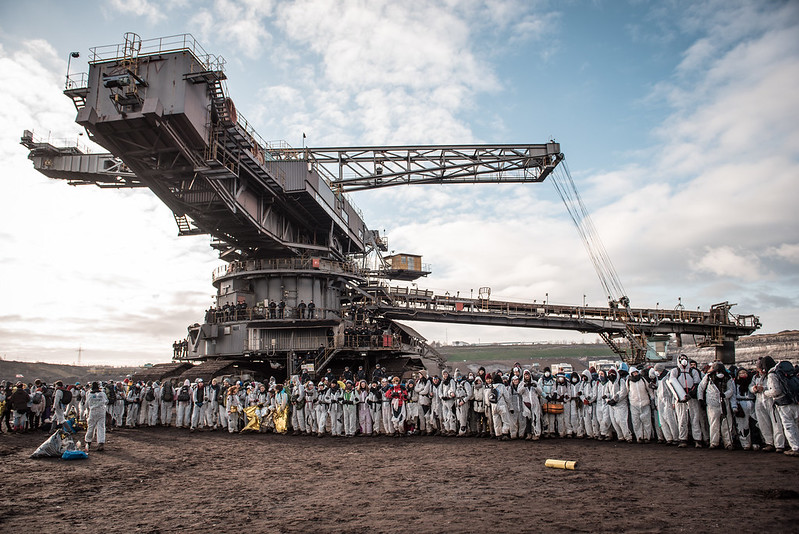
Ende Gelände activists targeting a coal mine in 2019. Photo: Tim Wagner/Flickr

Harry Holmes reviews Andreas Malm’s ‘How to Blow Up a Pipeline’. Harry argues that the book gives a balanced assessment of the conditions which make sabotage, vandalism, and other forms of strategic direct action necessary in a warming world. This review was first published by Bright Green and has also been reposted on the rs21 website. Malm’s book is designed to provoke debate on strategy and tactics and we would welcome further contributions on these issues.

How to Blow Up a Pipeline starts with what will be a familiar image for many. It’s the yearly climate negotiations, activists have streamed towards the conference space, pleading with representatives to ratchet up their ambition to tackle the climate crisis. People block city traffic with banners, with activists dancing and playing music in the reclaimed streets. The next day brings a giant public theatre performance, with environmentalists pretending to be animals run over by cars whilst ‘negotiators’ walk around with signs saying ‘blah blah blah’.

Was this a collection of Extinction Rebellion activists performing and blocking traffic? Was it even earlier, in 2015 at the Paris negotiations? Maybe it’s 2009, during the economic crisis and the Copenhagen conference? No, this image comes all the way from COP1, the climate conference that started it all – in the lost world that was 1995.

Speaking straight from his experiences of this first COP, Andreas Malm’s recollection of these early climate protests indicates a wider malaise – a certain sluggishness of environmental strategy. Despite the growth in awareness around the climate crisis and the rapid increase in the number of people organising for environmental justice, there has been limited change in the actions climate groups are willing to take to defend life.

In How to Blow Up a Pipeline, Malm has written a short and gripping manifesto which aims to wrench the climate movement out of its complacency. By convincingly arguing against movements’ dogmatic attachment to milquetoast non-violence, Malm makes clear that as the climate crisis escalates so too must the tactics of those seeking to defend life. Not content with simply dispelling the misguided understandings of pacifism environmentalists hold, How to Blow Up a Pipeline gives a balanced assessment of the conditions which make sabotage, vandalism, and other forms of strategic direct action necessary in a warming world. Coming out of the pandemic, with movements regrouping and attempting to navigate the mess that is the 2020s, this book is the shock to the system the world needs.

Beginning with the pacifism many climate movements advocate, a significant portion of this book is dedicated to dispelling the often ahistorical, whitewashed, and faulty justifications given for non-violence. To do this, Malm separates these arguments for non-violence into two forms; a moral pacifism focused on the wrongness of violence from an ethical perspective and a strategic pacifism centred on the advantages to environmental movements from committing to non-violence.

Learning to defend ourselves

It becomes clear that Malm has little time for the first form of pacifism. He turns to the case of Mohammad Rafiq, a 65 year old who stopped a right-wing terrorist attack on an Oslo mosque in 2019. As the gunman entered the building, the pensioner ran at him, tackling the would-be shooter to the ground where, with the help from other nearby men, they disarmed and beat the attacker. Malm points out that such self-defensive actions and any similar attempts to defend from far-right violence are unacceptable from the perspective of moral pacifism. With the struggle against the climate crisis being understood as a similarly defensive movement, focused on protecting life, Malm argues moral pacifism should hold little sway as a dogma. It risks being too rigid in the face of the escalating need to act in life’s defence.

Environmentalists’ deluded reading of the history of social change is not confined to past lifetimes either. Malm points out how groups like XR continue to invoke recent events, like the Poll Tax Rebellion of the early 1990s, as inspiration for non-violent ‘civil disobedience’, despite the Poll Tax famously being scrapped as riots rolled through London. Such a reading of history is not only one sided, but an act of positive erasure – an erasure which works to the detriment of the environmental movement’s strategic horizon.

Finding the radical flank

Looking at each of these past movements, Malm doesn’t reject the importance of the non-violent element. In fact, he suggests the opposite, the existence of a radical flank willing to commit acts of violence combined with a growing mass of non-violent organisers made change possible. Non-violence allows movements to grow larger quickly, it can secure sympathetic coverage in the public eye, and it can prevent government escalation. Because of this, non-violence always has a role.

Of course, no history of environmental movements would be complete without an assessment of the violent direct action of groups like Earth First! and similar Liberation Fronts in the 1980s to 2000s, who were responsible for the destruction of many a logging site. Malm suggests that their ultimate collapse was, at least in part, due to the lack of a wider mass movement where they could position as the radical flank. Malm’s polemical insight is that mass non-violence is the necessary condition for the impactful escalation to violent tactics and today, with climate strikes and Extinction Rebellions aplenty, we are not short of mass non-violent movements.

In short, it is not either/or but both, together in an escalating cycle. Malm argues the current environmental movement’s failure to accept the potential co-existence of both violence and non-violence reflects the wider collapse in revolutionary politics since the 1980s. In response to this collapse:

We have to learn how to fight all over again, in what might be the most unpropitious moment so far in the history of human habitation on this planet.

To begin these wide-ranging strategic conversations about fighting the climate crisis, Malm suggests focusing on two general goals – there is a need to announce and enforce a growing prohibition on new emitting devices, as well as rapidly reducing the lifetime of the polluting infrastructure and devices which already operate. The question, when bringing these general ideas down to Earth, is how precisely the environmental movement may go about this?

Building on Henry Shue’s distinction between luxury and subsistence emissions, Malm points to the increasingly violent role of luxury emissions, and the urgent need to focus efforts on these devices, whether SUVs or planes. There are several clear arguments given for focusing action on luxury devices, these are worth listing in full, albeit paraphrased:

  • As the effects of climate change are here, the harm from these luxury devices should be understood as immediate.
  • Luxury emitting devices like planes and cars allow the super-rich to also be hypermobile and escape the effects of climate change.
  • The ideological role of these devices is the championing of destructive lifestyles.
  • There is an ethical cost of how the money could have been better spent mitigating and adapting society to climate change.
  • In any reduction of emissions, it is better to reduce luxury emissions first rather than those necessary to secure subsistence.
  • Finally, and perhaps most crucially for Malm’s argument, there is the supremely demoralising role that these devices play. After all, if we cannot even get rid of SUV’s how are we meant to move towards a sustainable society?

Recognising this, Malm points to the need for violence to not just include the strategies of sabotage preventing new fossil fuel infrastructure from being built. It should also encompass the ways in which sabotage ‘can be done softly, even gingerly.’ Pointing to the mass movement in Sweden which deflated the wheels of SUVs during the night, Malm argues environmentalists should be comfortable engaging in extensive acts of vandalism targeting the luxury devices common in the Global North. Such violence would show how the ‘rich cannot have the right to combust others to death’, as well as preventing new emissions.

Unleashing new tactics

In opening up the horizon beyond non-violence, Malm invokes a further difficulty – precisely under what conditions does violence become necessary? What form might violence take? How to Blow Up a Pipeline makes clear that violence constitutes attacks on property, coming under the messy monikers like sabotage, vandalism, and demolition. This book is unequivocal that this does not extend to people or animals, nor property which is necessary for their subsistence. This still leaves much on the table, but Malm’s book should be read as a defence of destruction to property in a similar school as that of Osterweil’s In Defence of Looting.

Malm invokes scholars of direct action like William Smith, whose research points to important conditions which should be met for the successful escalation from non-violence. For Smith, escalation succeeds only if action would stop something which would likely cause harm, where mellower non-violent tactics have been exhausted, and where action is based on some wider ideal or charter, such as the Paris Agreement. Malm makes clear his view that these conditions are largely met for most fossil fuel infrastructure.

There are still several objections to escalation which could be posed. One is that governments have supremacy when it comes to repression and violence. As a result, escalation from the environmental movement could result in extreme crackdowns from states across the world. Malm accepts this asymmetry in power, in fact he suggests that it extends far beyond the ability of the state to commit violence. However, Malm points out that there is no law that this asymmetry ‘can never be overturned from below.’ Fighting climate change is a David vs Goliath fight in every sphere, whether economic, social, or militaristic. If we accept asymmetry as an argument against moving beyond non-violence, it would also mean abandoning nearly every climate struggle.

So Malm turns to the crucial argument many make for non-violence, that of popular support. The old story goes that abandoning non-violence leads to declining public opinion and a collapsing movement replete with infighting. Violent acts would be a ‘negative radical flank’, cutting into the wider non-violent movement. On the first issue of public opinion, Malm argues the role of social movements is not to take ‘an existing level of consciousness as a given, but rather to stretch it.’ Violence needs to stretch and drag society forward. This means that violent actions should be clearly explainable and acceptable in their wider context, with Malm suggesting perhaps the best strategy is to lie in wait for the next extreme weather event to strike at luxury emissions. With regards to the collapsing movement, Malm argues that the radical flank must simultaneously be prepared to be disowned by the wider movement, whilst also being receptive enough that in the case of either escalating repression or public backlash it can call off its actions.

The New Climate Laboratories

With regards to this last point, how are these contradictory characteristics to be satisfied? Being able to balance the tightrope of competing arguments for and against escalation is not something that Malm can answer in around 150 pages. In such a short work, one is left desiring the detail, the roadmap, where in practice the neat lines Malm draws can be observed. These will never appear, as only practice and thought together can bring this flourishing. What How to Blow Up a Pipeline does is effectively indicate strategic considerations and reflections which must be borne out in the practices of climate movements. There is no perfect tactic, no silver bullet, only a magazine of possible actions which environmentalists need to constantly assess as the crisis gets worse.

Malm puts his faith most of all in the climate camp movements like Ende Gelände and Reclaim the Power, where activists come together in mass numbers to shut down fossil fuel infrastructure. These camps can be built easily, allowing the movement to spread horizontally whilst also being planned well in advance. As the number of attendees rises, so too does the capacity to outmanoeuvre police and disrupt fossil fuel infrastructure. Malm invokes these spaces as the ‘unrivalled laboratory for learning this fight.’ If environmentalists are to develop the strategic acumen to pull the breaks on emissions, then what is need is a proliferation of these camps and any other equivalent ‘laboratories’ – we need spaces where climate activists can come together to learn and act with a sense of militancy. In the 2020s, Malm’s book points to the need to let a thousand laboratories bloom.

The final pages of How to Blow Up a Pipeline reflect on the opposite tendency to such escalating militancy – a climate fatalism which presents breakdown as inevitable. Many writers are encouraging society to ‘learn how to die’ and bring a deep pessimism about our capacity to change course. Whether in the work of Franzen, Scranton, or others, Malm rejects their pessimistic understandings of society’s future as that of a particular class interest. It is comforting for the rich of the Global North, unable to accept their need to change production and consumption, to ‘project this weakness of the flesh onto society’ and doom it to climate collapse. What is harder is internalizing the continued need for resistance.

With every part per million counting, with every stopped pipeline saving lives, and with every minute counting, the truth is the opposite of what the climate fatalists suggest. Looking to those who died in the Warsaw Ghetto uprising or who resisted within the extermination camps, Malm invokes the continued gesture of struggle against all odds. As Malm puts it:

Precisely the hopelessness of the situation constituted the nobility of this resistance. The rebels affirmed life so extraordinarily robustly because death was certain and still they fought on. It can never, ever be too late for that gesture. If it is too late for resistance to be waged within a calculus of immediate utility, the time has come for it to vindicate the fundamental values of life, even if it only means crying out to the heavens.

One hopes, like Malm, that it does not come to this, that we come to tackle the climate crisis with the ambition it needs before such hopeless struggle is necessary. What How to Blow Up a Pipeline does is act as a rallying cry for a climate movement far too comfortable in its ways, at a time where bold action is more than overdue.

How to blow up a pipeline is published by Verso at the beginning of January 2021 – we will have a small number of copies available for £10 (including UK postage). To enquire or order use the contact form.

‘Green Industrial Revolution’? Not with this plan

Boris Johnson’s ten point plan has received largely uncritical responses from the main stream media. We’re pleased to repost here the Campaign Against Climate Change’s ten point response. We welcome other contributions that develop or extend this critique.

We’ve had the big announcement: Boris Johnson’s ten point plan for a ‘Green Industrial Revolution’. But following initial positive headlines, the details start trickling out. £12 billion was announced, but just £3 billion, it emerges, is new money. This is paltry. Other countries have already made much larger commitments, including Germany’s green stimulus of over €40bn and France around €35bn. 

Most importantly, how does it stack up compared to the scale of the task facing us? Two years on from the IPCC’s ground-breaking report calling for an urgent transformation of the global economy to stay within 1.5C above pre-industrial levels, global emissions are still (excluding the limited impact of the pandemic) on an upward trend. As temperatures continue to rise, sea level rise is accelerating as polar ice melts. And in the background a steady stream of records broken for ‘natural’ disasters like hurricanes and wildfires, hitting the poorest hardest. 

The UK’s carbon budgets reflect out of date targets, an 80% cut in emissions by 2050. Previous policy failure means we are nowhere near on track to even stay within these deficient targets. This latest set of announcements is therefore doubly inadequate. It leaves a major hole in meeting even these out of date commitments. However we don’t just need to close that gap. Last year the government set a new climate commitment of ‘net-zero’ carbon by 2050. In relation to this new target, the gap is even greater. But unfortunately even ‘net zero by 2050’ doesn’t cut it. We need to act even faster than 2050 to be compatible with the Paris Climate Agreement.

Meanwhile, we also face a devastating pandemic leaving in its wake widespread unemployment. Now is the time for a real climate jobs programme to tackle the climate and jobs crises.

What would a real 10 point plan to tackle the climate crisis look like?

1. A comprehensive approach

Climate change cannot be tackled as an add-on, or a piecemeal approach that takes us one step forward, two steps back. We need a commitment that every economic policy, every spending commitment, every piece of legislation, will put us on track for a safer future, not jeopardise it by locking us in to business as usual. 

If the government had really taken on board the scale of the crisis, it would be rethinking the policies of unconditional corporate bailouts, planning deregulation, aviation expansion, road building, stifling onshore wind. It would not be giving a £16.5 billion windfall to military spending.

2. Meeting the needs of both people and planet  

Austerity has left us, more than ever, with a grossly unequal society with continued deep inequalities in race, gender and for disabled people. Underfunded public services are struggling. The move towards a zero carbon society must also ensure access to food, healthcare, education, income, job security, good, affordable, housing, clean and affordable energy and heat, public transport, clean air and green spaces for everyone.

There is huge public support to ‘build back better’ as part of recovery from the pandemic, investing in public services and frontline workers. Instead, a public sector pay freeze is being mooted. These are the wrong priorities: we need huge investment and expansion in the public sector and the people who work in it. 

3. ‘New Deal’ levels of spending

Boris Johnson has tried to compare his plans to Franklin Roosevelt’s New Deal. In today’s money, Roosevelt’s spending programme amounted to about £4,300 – for every American living through the turmoil of the Great Depression. In contrast £12 billion is about £180 each.

Our own ‘One Million Climate Jobs’ report or Green New Deal plans give more of a sense of the levels of investment and ambition needed if the government is taking this seriously. Other recent analyses include an IPPR report which estimates that £33 billion a year in additional annual investment is needed to meet the government’s net zero target, creating 1.6 million jobs, including £8 billion on homes and buildings and £10.3 billion on transport.

The pandemic has shown that money can be found. It has been found for other spending, including billions to private companies for medical supply and services in contracts awarded with no oversight, regulation or transparency. These are the sums of money that now need to be directed into tackling the climate crisis, sums that can actually make an impact in reducing emissions and would truly justify the term New Deal.

4. Not relying on techno-fixes that don’t solve the problem

There are valuable technologies that help us cut waste and greenhouse gas emissions. But those we’d call ‘techno-fixes’ are a double-edged sword. Despite serious drawbacks, these pull resources away from proven solutions (for example onshore wind and solar are not even mentioned in Johnson’s plan). They often support the continuation of fossil fuel infrastructure, and give a sense of false security about the need to radically cut energy use. Boris Johnson’s ten point plan overly relies on these techno-fixes which seriously undermine any genuine and far reaching attempt to transition the economy.

There is more detail below about why we are concerned about the emphasis on hydrogen, carbon capture and storage and nuclear energy. The promotion of ‘Jet Zero’ (zero carbon flying) also hides the fact that the scope for genuine decarbonisation of aviation is limited and the pursuit of ‘sustainable aviation growth a mirage. There should be no further airport expansion in a serious plan to tackle the climate crisis. While not mentioned explicitly in this latest plan, biofuels and biomass (burning wood for power) also fall into the same category – unsustainable while subsidised as ‘green’ technology. 

5. Provide decent, well paid, secure jobs

With a wide range of sectors hit by the pandemic, unemployment is expected to rise in 2021 to levels not seen since the 1980s. The transition to a zero carbon economy needs a workforce, but opportunities are being lost even when the investment is made. Manufacturing contracts for offshore wind supply have not been used to provide work for a skilled workforce in Scotland. Instead Scottish workers who could have been making the infrastructure needed for offshore wind have been made redundant. We need a proper climate jobs strategy, not a piecemeal approach rooted in a market based thinking. A strategy which is driven by understanding of the huge transition that is needed across manufacturing, transport, agriculture, construction, insulation, managing our land and biodiversity, in training and education. And one which seeks to create well paid secure jobs across these sectors to meet this challenge.

 The difficulties and delays with the recent Green Homes Grant are a warning example of what happens without this strategic approach including workforce skills. Trade unions have a key role. There are more accidents in non-unionised offshore wind jobs than there are in offshore oil. A worker-led Just Transition is needed. As set out in the One Million Climate Jobs report, a National Climate Service could take on key aspects of the transition to zero carbon, providing well paid, secure, flexible, permanent jobs in the public sector.

6. Keep it in the ground: phase out fossil fuel extraction 

Extraordinarily, the UK’s Infrastructure Act introduced in 2015 a legal obligation to maximise economic recovery of oil and gas. It was clear then, and even clearer now that we can’t continue fossil fuel extraction. Keeping the planet safe means leaving remaining fossil fuels in the ground. 

The oil and gas industry has already been hit hard by the economic impacts of the pandemic. We need instead a just transition for oil and gas workers as part of a strategy to phase out UK fossil fuel extraction. Many of these workers could be and want to be retrained to be part of a new offshore wind industry. 

We also need an immediate end to the anomaly whereby the UK offers billions of pounds of taxpayers’ money in financial support to companies that bid for work on fossil fuel projects overseas 

7. Tackling car dependency and increasing public transport, walking and cycling

The transport sector accounts for around a third of emissions in the UK. Surface transport alone represents around a quarter of our total emissions, while air pollution is a serious health problem. So far, electric vehicles have barely made a dent (less than 2% of new car sales), while SUVs represent over 40% of new cars sold.

But this cannot be solved by a simple like-for-like switch to electric vehicles. We need a property resourced and integrated public transport system under democratic public ownership. Alongside this, we need a reallocation of road space in towns and cities away from cars to walking, cycling and public transport, and a presumption in favour of development that reduces travel.

These changes would not just benefit our climate: the social inclusion and health benefits would be huge. It is shocking that the £27 billion currently intended for road building, which will significantly worsen our climate crisis, is far more than the entire ‘green industrial revolution’ budget touted as tackling the climate crisis. 

8. Decent homes for all

We do need a programme of mass retrofitting our homes and buildings to be warm and energy-efficient, but it must be much more ambitious. We also need to be wary of corner cutting which does little other than inflate the profits of companies.  Poorly fitted cavity wall insulation has been a scandal affecting thousands of homes with damp and mould, while post-Grenfell, there are still tower blocks with unsafe cladding. This is an example of where a National Climate Service could ensure high standards of work by employing a well trained public sector workforce with the goal of delivering warm homes and energy use reduction rather than quick and easy profits at the taxpayers expense. 

It is much easier and cheaper to build homes and public or commercial buildings to near-zero carbon energy standards, than it is to retrofit. The scrapping of the Zero Carbon Homes standard in 2015 was a huge step back, and proposed new energy standards are totally inadequate. One of the major problems facing the UK is a lack of affordable housing, in particular social housing. We need to invest in jobs to ensure decent homes for all – quite literally ‘build back better’.

9. Land use and agriculture

With the UK’s biodiversity in crisis, and agriculture a significant source of greenhouse gas emissions, it is not simply a matter of ‘plant more trees’. Alongside reforestation and protecting habitats, we need to consider land ownership, the vital role of access to nature for all, even and especially in urban environments and the potential of rewilding. Meanwhile, we are still waiting for the government to take the simple step of banning peat burning, an easy climate win which appears to be being blocked by grouse shooting interests.

There is huge potential for agriculture which is better both for climate and biodiversity. The government has been remarkably reluctant to promote, for both climate and health reasons, a dietary shift to reduce meat and dairy consumption. Without forgetting, when talking about diet, that the obesity crisis still coexists with real food poverty in one of the world’s richest nations.

With food and environmental standards likely to be a casualty of post-Brexit trade deals, it is clear that our unhealthy food system also has implications for workers rights and animal welfare. The prospect of further zoonotic diseases – and future pandemics – cannot now be ignored. Land use, our food system and biodiversity have to be a key part of any climate strategy. 

10. Climate justice beyond our borders

Any real climate policy must be rooted in climate justice. This is a global problem and the UK has a historically disproportionate contribution to the climate crisis. As well as doing our fair share in reducing domestic emissions, the UK’s policies must address this historic responsibility. 

The goods we import, as well as having their own carbon footprint, may also hide ecosystem destruction and exploitation of workers. So do the deals made by UK banks, pension funds and insurance companies. There must be no ‘solutions’ for this part of the world which rest on further damage and explotation of nature and people in other parts of the world, whether that be in mineral extraction or land grabs for carbon ‘offsetting’. Solutions must be rooted in climate justice, collaboration and internationalism. 

We need a real climate jobs plan, a real Just Transition, a real Green New Deal.

Techno-fixes – what’s the problem?

Carbon capture and storage technology (CCS) has promised to make fossil fuel burning environmentally friendly by capturing carbon dioxide from the smokestack emissions of power stations or industrial plants. However, additional fossil fuel burning is needed for energy to capture the carbon. The new funding promises to bring the total government funding back to £1 billion – the same amount promised for a pilot that was suddenly cancelled at the last minute in 2015. But CCS technology still has not been successfully scaled up elsewhere, with problems of finding reliable storage for the captured CO2. Certainly for power plants it seems more an attempt to continue fossil fuel production than a significant climate solution.

Hydrogen sounds like a great idea – a fuel that when burned, produces only water. But so-called ‘blue’ hydrogen is produced from fossil fuels and requires carbon capture and storage. It has been heavily promoted by gas companies. Meanwhile green hydrogen, generated from renewables, also has significant limitations. It is approximately 4-5 times less efficient than using renewable power directly because you have to convert power to a gas and back into power, and will probably take around 10 years to generate at scale. Hydrogen may have a place in the zero carbon economy for some hard-to-decarbonise uses.  But the idea that it is a cost or energy efficient way to heat the nation’s homes – and could be rolled out in the time needed – seems far less plausible. 

Nuclear is a dangerous, unnecessary and expensive diversion which will pull away investment from safe and cheap renewable energy which could come on stream quickly.

Scot.E3’s July organising meeting

We held our latest organising meeting on 23rd July. It was a chance to catch up and share ideas. You can find the full list of actions here and if there are particular actions that you would like to get involved with please do email us.

Part of the discussion focussed on the impact of Covid19 on the Scottish economy. We will soon be publishing an extended article on the importance of the education sector in the transition to a zero carbon economy – in light of this it’s very important to support education workers who are fighting to keep their jobs. Edinburgh Napier University is the first to announce that it is looking for compulsory redundancies. Do sign and share the petition in support of Napier staff.

In Glasgow jobs at First Bus are under threat – Get Glasgow Moving are looking for support for their campaign to take Glasgow bus services into public ownership. You can sign their petition here.

We are planning two public meetings, one on Ineos and one on a Worker Led Just Transition – watch this space for dates and further details.