Blog

Upcoming events in Fife, Glasgow and Edinburgh

Thursday 12thSeptember: Support Global action on climate crisis – meeting called by Edinburgh Trades Council at the Quaker, Meeting House, 7 Victoria Terrace EH1 2JL

Saturday 14thSeptember 11am: Demonstration organised by Fife Trades Council and the STUC – assemble Kirkcaldy Town House –if you are from Edinburgh and could volunteer to take the Scot.E3 banner – please let us know by emailing triple.e.scot@gmail.com

Friday 20thSeptember:Climate strike  – see details at https://scote3.wordpress.com/2019/09/09/climate-strike-20th-september/

Tuesday 24thSeptember: 7pm – 9pm:Stopping North Sea Oil and Gas Extraction – Scot.E3 meeting with speaker from Friends of the Earth Scotland, at the Kinning Park Complex, 43 Cornwall Street, Glasgow G41 1BA

Thursday 16thOctober: 7.30pm:Thinking global, acting local – the politics and practice of just transition – Scot.E3 meeting, part of the Edinburgh World Justice Festival at the Augustine Church, George 4thBridge, Edinburgh EH1 1EL

Saturday 16thNovember, 10am – 5pm:2019 Scot.E3 conference – ‘Thinking globally, acting locally – organising for a just transition’ Saturday October 5th at the St. Ninian’s Hall, Charteris Centre, The Pleasance, Edinburgh.  Please share the FB event: https://www.facebook.com/events/1133891030332559/ and the Eventbrite link https://tinyurl.com/y6bt6p5j

hand-936701_1920

Climate Strike 20th September

It’s just over a week now until the Climate Strike called for September 20th.  Check out the Scottish Youth Climate Strike website for a link to details of actions all round Scotland.  The Edinburgh Demo starts from the Meadows at 11am.

This video from REEL News gives some updates on solidarity action.  You might also like to check out our model resolution and a video guide to raising climate issues in your workplace.

Demand a Just Transition to renewable energy

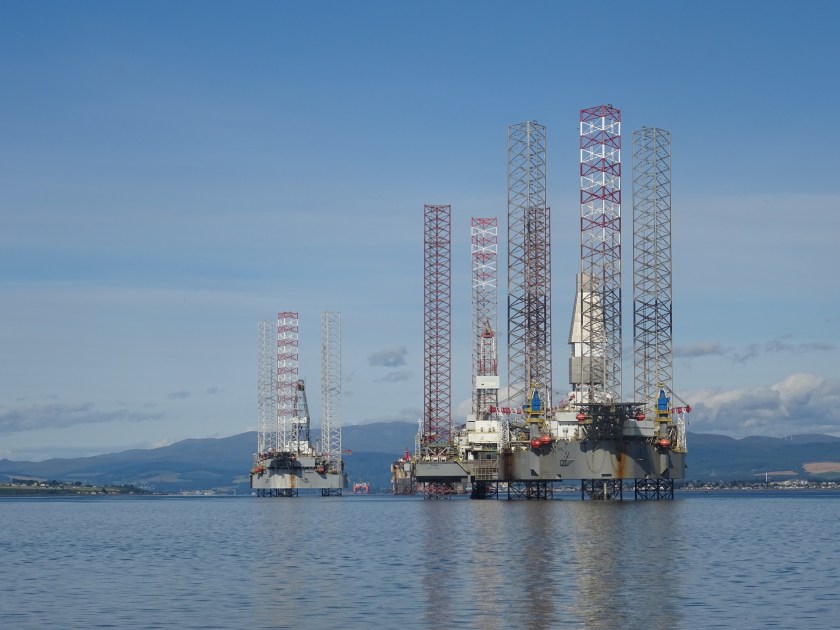
One of the lead stories on the BBC today is the UK’s oil and gas industry assertion that the best response to tackling greenhouse gas emissions is to continue production at maximum levels.  Oil and Gas UK’s “Roadmap to 2035” argues consumption would remain above the levels they could produce. 

Neil Rothnie, life long offshore oil worker and activist, argues the case for an end to business as usual and a just transition out of hydrocarbon production in the North Sea.

Both the UK oil industry and Government seem to think that new licenses should be issued and oil and gas exploration on the North Sea stepped up.   The industry estimates that 20 billion bbls of fossil fuel remain under the North Sea.  No one in authority seems to think that these reserves should not be fully exploited.

This begs the questions;

If a policy of business as usual is to be applied to the North Sea, why then should Saudi Arabian, Gulf of Mexico, Venezuelan, Sakhalin, Nigerian and other hydrocarbon reserves not also be fully exploited?

What would the effect of producing all the world’s oil and gas be on global warming and climate change?

The Scottish Government seem to be prepared to try and lead us to an independent Scotland based on a carbon economy.  According to the First Minister, Scotland’s carbon emissions would increase if oil production from the North Sea was stopped. This only makes any kind of sense if there is to be no transition to a renewable energy system to replace fossil fuel from the North Sea.

Despite government complacency, the oil industry will come under increasing pressure – financial and political – to reduce and eventually end hydrocarbon production, though perhaps not till it’s too late to avoid catastrophic climate change if the politicians and industry leaders have their way.

The past practice of both oil industry and Government suggests that the workforce, offshore and onshore, will then be abandoned to their own devices, creating the sort of wilderness in the North East of Scotland that the UK coalfields became when there was no just transition from coal.  Energy workers and their families from all over the UK would then be very badly affected.  Though this time it looks as though they won’t suffer in isolation if climate science predictions are realised.

The unjust transition from coal wasn’t inevitable.  The miners and their families were punished for standing up to Thatcher’s plans to cripple organised labour. Offshore employers wanted anyone but ex-miners with their tradition of struggle, on the North Sea, and the unions failed to step up to the mark. This time it has to be different for everyone’s sake.
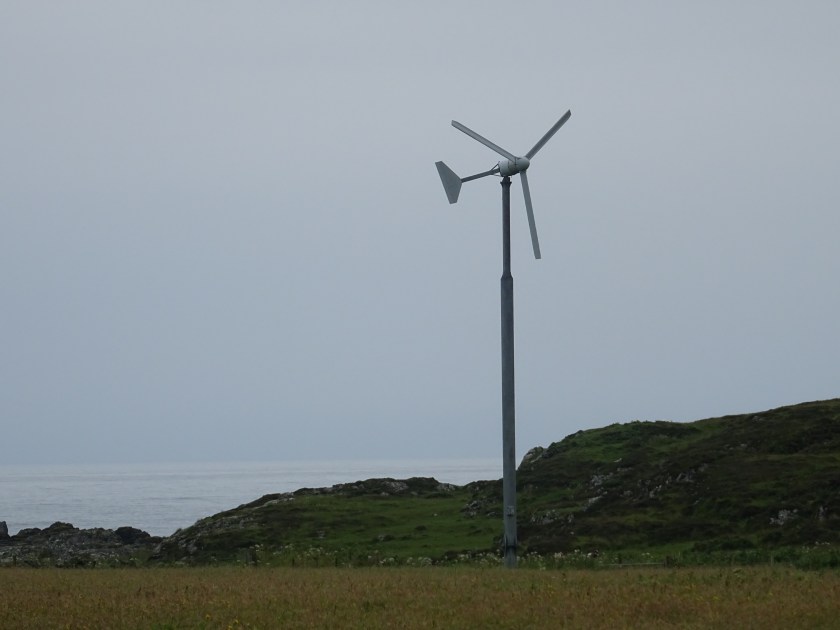
A just transition to renewable energy could be planned and enacted starting now.  New oil and gas exploration could immediately be stopped and a planned rundown of hydrocarbon production and a massive development of renewable resources begun now.

Not a penny of the oil windfall has so far been saved for the peoples of the UK.  Is it not now imperative that all (declining) oil profits must be immediately re-invested in developing the renewables energy sector?  Retraining of the oil industry workforce is a must where there is an expected skills gap in a much-expanded renewables sector.  The current oil and gas workforce can and should be re-deployed to replace the fossil fuel that we can no longer afford to produce.  Without a just transition to renewable energy from sun, wind and wave, we are fucked.

2018-07-19 08.57.05Our children and grandchildren deserve more from us than business as usual.  They and the rest of the remaining life on the planet need a chance of a future that does not include the misery of living through a global meltdown.

GREEN NEW DEAL – AN OPPORTUNITY TO SEIZE THE TIME

Mike Downham notes the publication of the Scottish Green Party’s proposals for a Green New Deal and the need to step up the action on climate at this time of political and constitutional crisis.

On the same day that the Government announced the proroguing of parliament, the Scottish Greens launched their proposals for a Green New Deal. Climate change remains the most urgent of all the issues pressing down on us, and the Green New Deal initiative gives us a concrete opportunity to flex our muscles in the new context of Westminster collapse.

So the people have finally had enough of this UK Government. Its decision to trash democracy left a governing vacuum. Yesterday’s broad-based and widespread protests shows the potential to fill that vacuum and take control. Kicked off by the proroguing of parliament, the protests have escalated to articulate anger against austerity cuts, privatisation and the whole political position of the Tory Party.

The Scottish Greens give this summary of their proposals:

Scotland can

  • Redirect massive investment into low carbon industries
  • Grow a world-leading low carbon manufacturing sector
  • Restore our natural environment
  • Give everyone a warm home
  • And provide access to cheap, reliable and green transport.

But to do this we have to ditch neoliberal economics for good.

At the heart of a Scottish Green New Deal is a belief that the Scottish Government can and must take a direct role, working in partnership with citizens, communities, and companies to deliver the change Scotland and the planet so urgently needs.

Rather than pick holes in these proposals, we can build on them by making three immediate demands. Demands which are focussed, achievable and directly address key desperate needs of working-class people – fuel poverty, poverty in general, and the need for jobs which are properly rewarded, secure and satisfying.

The three demands emerge naturally from the climate movement’s in-depth work over recent years:

  1. We demand a just transition from North Sea oil and gas to renewable energy, starting immediately with the phasing out of North Sea oil and gas extraction, as recommended in the Sea Change report co-authored by Friends of the Earth Scotland, Oil Change International and Platform (2019).
  2. We demand an immediate programme for the insulation and draught-proofing of all homes, public buildings and businesses, as recommended in the One Million Climate Jobs booklet produced by the Campaign Against Climate Change (2014).
  3. We demand an immediate nationwide Free Public Transport system, as argued for by the Scottish Socialist Party since 2007, and now by the Scottish Greens (2019)

We will make it clear that we won’t take no for an answer, confident in the new-found breadth of the movement for democracy and for a break with the Economy of Madness and the Politics of Division.

Green New Deal

Image by Bart Everson, CC BY 2.0 https://www.flickr.com/photos/editor/32447100627

Take action over Hunterston

In previous posts and briefing documents we have argued that HUnterston poses a grave threat to the safety of everyone living in the Central Belt and that moreover, nuclear should have no part in the transition to a sustainable economy.

The Office of Nuclear Regulation has given EDF permission to restart reactor 4 at Hunterston B.  The date is not yet certain but the probable date is 30th August.  Although cracking in Reactor 4 is not as extensive as in Reactor 3, there is an issue of some cracks openings that are greater than 1.2 cm wide (ie ~½ inch).

Actions you might wish to take: 

  1.  Write (with copies to social media) to the following people – (addresses are given below)
  • the Chief Inspector of the Office of Nuclear Regulation (ONR),
  • the Chief Executive of the Scottish Environmental Protection Agency (SEPA),
  • your own MSP and the current Scottish Minister for Energy
  • the Scottish Government’s Director of Energy and Climate Change

In writing to the above and in using social media, you might express the views that:

  • both the Hunterston B reactors should remain closed for good
  • that EDF and North Ayrshire Council should publish their plans for evacuation in the event of a nuclear accident; and
  • that free potassium iodate tablets should be pre-distributed to the population within 50 km of Hunterston B.

Consider planning, organising and participating in demonstrations outside Hunterston.

Useful Addresses

Office for Nuclear Regulation

Building 4, Redgrave Court

Merton Road

Bootle L20 7HS

Or use the online form http://www.onr.org.uk/complaining-about-onr.htm

Scottish Environmental Protection Agency

Strathallan House, Castle Business Park

Stirling FK9 4TZ

or online form https://www.sepa.org.uk/contact/contact-us-via-email/

Minister for Energy, Connectivity and the Islands

The Scottish Government
St. Andrew’s House, Regent Road
Edinburgh EH1 3DG

scottish.ministers@gov.scot

Scottish Government Energy and Climate Change Directorate

Director of Energy and Climate Change

Atlantic Quay, 150 Broomielaw
Glasgow G2 8LU

ceu@gov.scot

North Ayrshire Council 
Cunninghame House
Friars Croft
Irvine KA12 8EE
info@northayrshire.community

email: northayrshireperforms@north-ayrshire.gov.uk

East Ayrshire Council

London Road

Kilmarnock KA3 7BU

https://our.east-ayrshire.gov.uk/AchieveForms

(Thanks to Edinburgh CND for much of this information).

Sheep graze in fields next to British Energy Hunterston 'B' nuclear power station in west Scotland

By Jonathonchampton at English Wikipedia, CC BY-SA 3.0, https://commons.wikimedia.org/w/index.php?curid=11050069

‘Climate jobs, just transition and building a movement with social justice at its heart’

A report from Pete Cannell on a recent ScotE3 workshop.

Back in June I facilitated a ScotE3 workshop on the Monday evening of the Extinction Rebellion Holyrood Rebel Camp.  The workshop was titled ‘Climate jobs, just transition and building a movement with social justice at its heart’.

Around 30 of us squashed together under a gazebo on a bright but chilly summer’s evening.  There was an excellent discussion looking critically at what we mean by Just Transition and how we can make social justice more than just a distant aspiration.  The rest of this post is an attempt to capture some of the content of the workshop.

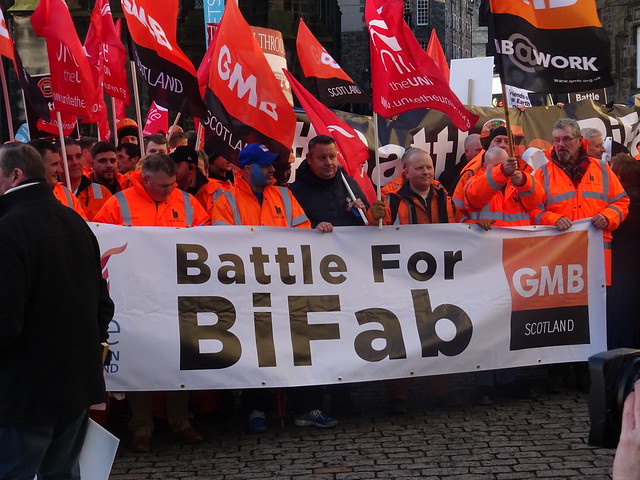
I framed the discussion by explaining the origins of ScotE3 as a collective of rank and file trade unionists and climate activists in Scotland looking to develop the movement for a just transition.   I explained that while ‘just transition’ is a contested term, ScotE3 has taken inspiration from several sources; initially from the campaign for a million climate jobs, from the grassroots campaigns in working class and indigenous communities in the US and from the Lucas plan campaigners; more recently from the BiFab workers, the school student strikes and the urgency injected by XR.  We see climate jobs, social justice and grass roots democracy as the key to just transition and also as central to building the social movement we require to avoid catastrophic climate change.

In the group we discussed the difference between ‘climate jobs’ and ‘green jobs’. Climate jobs are jobs that lead directly to cuts in greenhouse gas emissions.  So for example, workers building and maintaining offshore wind farms replace power stations that burn coal, oil or gas; bus drivers reduce the amount of oil burnt in cars.

We also discussed what is meant by just transition.  It can be a slippery concept because governments, unions and climate activists all use it.  I argued that its value comes from the way it has been used by working class climate rebels who have made it much more than just a vague aspiration. So to be useful just transition and social justice need to inform the demands we make, the priorities we organise for and the nature of the social movement we build.  It is about protecting the individuals and communities whose livelihoods currently depend on the carbon economy.   But it’s not just a conservative demand; it’s also about ensuring that the new sustainable economy is egalitarian, democratic and reflects the diversity of Scotland in the twenty first century.

Thanks to all the participants in the workshop for their contributions and questions.

48074016906_5aa26601cf_z

Image – Pete Cannell Flickr CC0

August organising meeting

We’ll meet at the Edinburgh Peace and Justice Centre 25 Nicolson Square on Thursday 15th August.

Draft agenda includes follow up on work from the July meeting including possible Fife Jobs Forum, Future public meetings (EWJF and Glasgow Sea Change Launch), invite to speak at North and Leith Labour Party event), Website and briefings, Nationalisation of Ferguson Marine.

The two main items for discussion and planning are the ScotE3 conference to take place in Edinburgh on 16th November and 20th September school strikes and solidarity.

Please email ideas for other agenda items to triple.e.scot@gmail.com

DSC03194

Harland and Wolff: occupying for nationalisation, jobs and the climate

As workers at Belfast’s Harland and Wolff shipyard fight to save their jobs, demanding nationalisation as the employer goes into administration, Brian Parkin from ScotE3 reports on the response from the UK Construction Rank and File group, argues for solidarity and highlights links with action to tackle the climate emergency.  This article was first published on http://www.rs21.org.uk

The mighty shipyard of Harland and Wolff, whose enormous cranes, Samson and Goliath, dominate the Belfast skyline, is now facing the final phase of closure. Most famed for being the shipyard that built the ill-fated Titanic, these yards and their local supply companies employed up to 30,000 workers at their peak. Now, after repeated capacity and job-sheddings, only 121 workers remain.

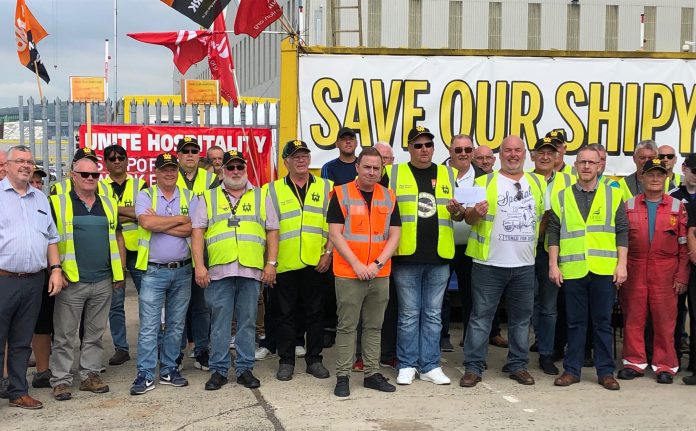
The remaining workers have been given redundancy notices, but have said no to the supposed inevitability of market forces and the whims of hedge-fund capital. In a bid to save their jobs, they have mounted a workplace occupation. These men and women of the Unite and GMB unions are not looking back to the days of mighty ocean liners and battleships. Instead, they have evaluated the productive assets of the yards and have seen them as part of the vital industrial capacity that can begin to turn the tide in the battle against climate change. They have combined their technical skills with their knowledge of the Harland and Wolff production potential with a vision of how they can fabricate the structures and internals of wave, wind and tidal units that can harness the vast renewable resources that can provide clean, affordable and abundant energy.

All too aware of empty promises and crocodile tears of politicians and would-be investors, the workforce have played their ultimate hand: they have occupied and taken over the means of production in order to prevent asset strippers and bailiffs moving in and destroying further the productive potential of their sole means of production – and with it the hope of clean energy technologies so badly needed as climate change accelerates.

But these workers cannot fight alone. So far their unions have promised official support. But that support will be conditional – until a prospective bidder comes along with the any rescue bid inevitably demanding further flexibility and productivity promises of the workforce. Which is why the example of the UK Construction Rank and File in promising solidarity is so important. And now, within weeks of the global climate strikes and protests on 20 September, the climate change movement has a concrete example to put workers’ action centre stage.

Harland and Wolff and an emerging campaign of former BiFab workers in Fife are at last bringing together the issues of jobs worth having within a campaign for a planet capable of being saved.

The UK Construction Rank and File passed the following motion at its annual general meeting on Saturday 3 August:

  1. The Annual General Meeting of the UK Construction workers rank and File note the heroic factory occupation of the Harland and Wolff plant in Belfast in their bid to save jobs.
  2. We further note their demand that the present plant and jobs therein be turned over to the production of renewable energy technologies that will not only meet the growing demand for clean renewable sources of energy, but will also make a vital contribution to the fight against impending and potentially catastrophic climate change.
  3. In their present struggle the H&W workers are showing the way by which in the fight for jobs, the conversion of employment and means of production can be redeployed into both socially and environmentally dedicated ends.
  4. We commend the leadership on Unite for the official support that they are extending to the H&W occupation and call upon the wider labour movement to take up the fight for jobs, communities and the energy needs and environmental responsibilities of future generations.
  5. Furthermore, we urge all workers to support next month’s climate strikes and protests, both as a show of solidarity with H&W, but as a sign of the commitment to the working class’s vital role in the fight against climate change and our planets environment and eco-systems.

Save-Our-Shipyard-e1565021353605-696x431Photo: Unite construction branch on twitter

Sea Change – a review

In May we welcomed the publication of an important report on North Sea Oil and Gas. Ann Morgan shares her reflections on the report here.

Sea Change: Climate Emergency, Jobs and Managing the Phase Out of UK Oil and Gas Extraction

Introduction

Sea Change highlights the tremendous potential for a just transition and in outlining the scale of the potential increase in new climate jobs provides convincing evidence that trade unions, activists, politicians and economists can utilise in designing a sustainable economy.

Bella Caledonia calls the report a ‘landmark’.  A landmark is defined as a’ turning point’ or a ‘critical point.’ However, as the report is released there are very mixed messages from policy makers.  On the one hand the declaration of climate emergency by the Scottish Government and many local authorities and on the other the Oil and Gas Authority press release on 10thJuly 2019 announcing new licences for exploration and exploitation of hydrocarbons.

The Gas discovery by the Chinese State Owned CNOOC in January this year is said to be the largest in over a decade.  Exxon Mobil and Shell and other oil companies are busy extolling the virtues of Natural Gas, greenwashing thus

‘This versatile and abundant resource is contributing to emissions reductions all over the world’

No word of emissions of methane (research is currently underway to assess methane emission underestimated previously in the North Sea).  As we know methane is a potent greenhouse gas and natural gas is not a ‘bridge’ fuel as the report emphasises.

Just transition

The ScotE3 draft manifesto defines a just transition as

‘One that ensures no individual or community suffers economically or socially as old jobs end and new jobs are created’.

Sea Change makes it clear that a just transition to renewable energy is manifestly possible with the potential that three new climate jobs could be created for every North Sea job at risk. 

Just transition is the way to win hearts and minds and the Sea Change report gives an informed and detailed bridge to that improved working and living environment.  An effective campaign is needed to turn around the Oil and Gas Authority (OAG) insistence on opening up applications for the 32ndround of licensing.

Alternatives

To end fossil fuel dependence and move to the alternative, a clean and safe working and sustainable environment, will not be easy.  However the structured and planned transition that Sea Change describes cannot be ignored.  The report notes that oil and gas was developed with Government support and intervention.  Indeed the big energy companies continue to attract subsidy for their hydrocarbon activities. It argues that it is now high time for intervention and investment to enable a renewable transformation.

Sea Change is an outstanding analysis of the importance of energy at the ‘production’ level and has relevance in the systemic changes required, in public ownership, in governance and accountability and in designing new social models.  The report further illustrates a point also made by Asbjørn Wahl that solutions cannot be made on an environmental/scientific analysis alone.  Action is required to change the power imbalance nationally and internationally.

The need to end extraction

Sea Change documents the current impact of North Sea Oil and Gas and demonstrates in the starkest terms that the continued practice of Maximum Economic Recovery (MER) Is incompatible with the Climate Change Act and emissions reduction.  Mary Church Head of Campaigns at FoE (Scotland) puts it succinctly

‘ Climate Science is clear that we urgently need to phase out fossil fuels, yet the government and big oil companies are doing everything they can to squeeze every drop out of the North Sea … we must ban further exploration and redirect the vast subsidies propping up extraction towards creating decent jobs in a clean energy economy.’

The report finds that:

  • The Uk ‘s 5.7 billion barrels of oil and gas in already operating oil and gas fields will exceed the UK’s share of carbon emissions agreed in the Paris Climate goals. Currently Government and industry aim to extract 20 billion barrels.
  • The additional oil and gas extraction enabled by recent subsidies will add twice as much carbon to the atmosphere as the phase out of coal power saves.
  • Given the right policies, clean industries could create more than three jobs for every North Sea oil job lost.

The authors call for the withdrawal of the OAG authority’s 32ndlicensing round.  They recommend that the UK and Scottish Governments work with affected communities and trade unions in a managed phase out of North Sea oil and gas, investing in education, retraining and reskilling (although it is acknowledged that many existing jobs are highly skilled and transferable) and influencing the priorities of the Scottish National Investment Bank with a significant degree of public ownership. Infrastructure costs can be met with a rapid phase out of oil subsidies underpinned by a fiscal policy of support for clean energy to at least the level to which the oil and gas industry have been supported.

Otherwise the future looks bleak.  The report notes that

  • Offshore oil industry increasingly pressurised (See RMT union’s report on North Sea working conditions)
  • Renewables – currently no significant UK jobs creation with manufacturing jobs going overseas
  • Oil and Gas extraction from newly developed fields would push the world beyond climate limits

In short, the Westminster and HolyroodGovernments face a choice between two pathways to stay in climate limits.

  1. Deferred Collapse: Continue to pursue Maximum Extraction through subsidies until worsening climate impacts force rapid action to cut emissions globally. The UK Oil industry collapses pushing workers out of work in a short space of time.
  2. Managed Transition. Stop approving licensing permits and tax breaks and phase out extraction.

Climate jobs

The report argues that a National Energy Strategy can mean an energy transformation that meets climate commitments while protecting livelihoods and economic well being.  Local manufacturing and workforce participation needs to guide this transformation with new approaches in economic development, strong trade union rights and sectoral bargaining.

‘Clearly it is an ambitious project to transform the UK energy sector within a couple of decades, just as the rapid development of the North Sea was an ambitious project …’

The report models the impact on the oil and gas workforce of ending the development of new fields.  Taking into account the jobs created through decommissioning and forecast retirement in the existing workforce, it estimates that 40,000 existing oil workers (direct and support chain) may need to be in a different job by 2030. To examine the scale of jobs that can be created in compatible clean energy industries and the level of policy ambition necessary, it models the numbers of new jobs that would be created in offshore wind, marine renewables and energy efficiency retrofits, sectors that have strong overlaps with existing oil and gas skills and finds that the number of jobs created will be at least three times more than the number lost.

Social Justice

The report also highlights the international justice commitment to ensure transition is fastest in wealthier countries and end operations, which harm poor communities and workers (Jake Molloy in the RMT report notes the harsh working conditions for Asian migrant workers in decommissioning in the North Sea for as little as around £3 an hour).  Decommissioning should be paid for by oil companies and decommissioning plans should detail and provide for a Just Transition for workers.

Overall, Just Transition plans, guided by climate limits, should provide structured pathways for the existing workforce, new workers and communities.  Terms and conditions of workers must be safeguarded and accountability to trade unions and local stakeholders in place.

Finally, the authors report that in other policy arenas restrictions on the supply of harmful substances (e.g. ozone depleting chemicals and asbestos) targeted the substances, whereas with fossil fuels only measures to slow the consumption have been taken leaving the market to determine extraction.  This is beginning to change.  It is to be hoped the banning of fracking in Scotland and UK wide in future will serve as an example of legislative measures to make unsafe practices unlawful.

It is worth noting that the authors place no great faith in carbon negative strategies such as capture and storage.  While these technologies may have their place in future developments, philosophy of enabling business as usual must be guarded against.  To finish with the words of the authors

‘Oil and Gas sucks investment …’

Investment in renewables could swiftly move us to reduction in emissions within climate limits.

‘Today’s decisions shape the long term energy future’.

Let’s begin the sustainable revolution.
38460797761_54baa9052f_z

Sign the UCU petition for strike action on 20 September

The UCU (the union that represents University Lecturers across the UK and College Lecturers in England and Wales say “Greta Thunberg’s call for a climate strike and for adults, workers and trade unionists to join the global school students’ strike on 20 September 2019 is one that trade unionists from all unions must take seriously.” UCU are bringing a motion to the TUC Congress (8-11 September) for the TUC to call a 30 minute workplace stoppage on the day of the strikes. Full text below and here: https://www.ucu.org.uk/article/10181/30-minute-solidarity-climate-stoppage

This would be the first time in over 30 years that the TUC has issued such a call on any issue. To get this motion passed, UCU will need to demonstrate how widespread the support for it is. Please sign  and share, whether you are a trade union member or not.

Sign up here to support the call for a 30-minute workday stoppage in solidarity with the global school student strike on 20 September 2019: https://www.ucu.org.uk/article/10202/Support-the-30-minute-solidarity-climate-stoppage

You don’t have to wait for the TUC conference – see the model motion that you can use now and this video that looks at how to argue for a strike in your workplace.

46379082614_cd45bee14d_z