War on Want’s new report ‘A Material Transition’ exposes the environmental destruction and human rights abuses that mining for renewable energy could unleash. The climate crisis, the Covid-19 pandemic and rampant global inequality all have their roots in our resource-intense society.
The report highlights what can be done to avert this devastation and sets out a pathway for a globally just energy future: respect for the rights of affected communities, ensuring just and fair supply chains, and a reduction to harm for workers and the need for new resource extraction.
We’d like to publish a review of this report please get in touch if you would like to submit one.
In the year that COP26 comes to Scotland Neil Rothnie asks why there is no public debate on the Petroleum Amendment Bill
For the last 15 months the Petroleum Amendment Bill has been sitting on the table in the House of Lords. The Bill is a private member’s bill based on the recommendations of the Sea Change report. It calls for an end to oil and gas exploration, the rapid phasing out of production and a transition for oil and gas workers into the renewables industry. 270,000 jobs are supported by the industry.
So just when were the oil and gas workers, their families and communities going to be informed of the existence of this plan, and get the opportunity to scrutinise and discuss it?
Who has been in on this discussion? Who has been making what plans?
Presumably the Government has a view on the Bill. Why the silence? Their current plan, the Act that the Bill aims to amend, is spectacularly unfit for purpose. It calls for “maximising economic recovery” of North Sea oil and gas. This is at complete odds with their claim to be leading the world against climate change. When UK Cabinet Minister, Alok Sharma, chairs the COP26 discussions in Glasgow in November is he going to be inviting delegates from Russia, Saudi Arabia, America, China and every other fossil fuel producer to follow the UK lead and maximise economic recovery of their own fossil fuels?
Are the trade unions in on the discussion? Have they informed their members on the North Sea what is being proposed?
Does the industry not feel the need to comment on a radical plan that has massive implications for their business on the North Sea and internationally. If it’s necessary in the UK such a plan not necessary internationally?
Do the Labour Party, the SNP and the Greens have positions on the Bill? Lady Sheehan is a Liberal Democrat so presumably her party has a view. What is it?
Why the silence? Does the media, the BBC and the newspapers, know of the existence of this Bill. Are they deliberately ignoring it and going to continue only to report what is written for them in the oil company public relations departments? A proud tradition that has disappeared the North Sea from national scrutiny.
What about the environmental movement itself? Scot.E3 has been campaigning on employment, energy and environment for three and a half years; but such is the silence that it was only alerted when Baroness Sheehan and Mary Robinson (past President of Ireland) alluded to the Bill in a recent article in the Times.
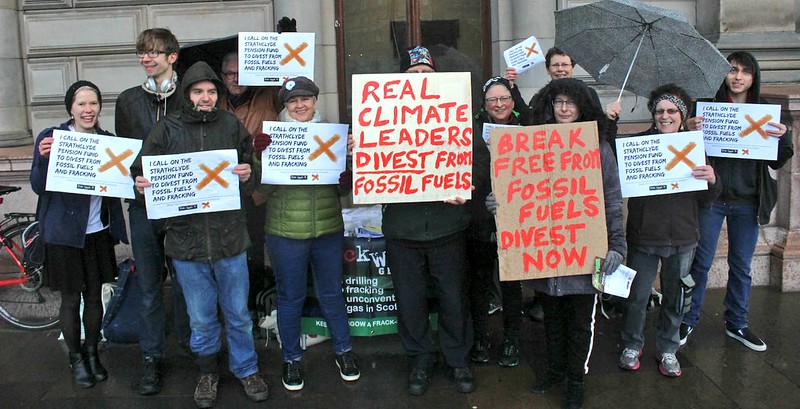
On April 1st Glasgow City Council will be debating whether to end investing pension funds in fossil fuels. If successful, this will be a big step forward for divestment campaigns. The motion is proposed by the Green Party and we post their press statement below.
Image from Friends of the Earth Scotland on Flickr CC BY SA 2.0
Scottish Green Party 25/03/2021Glasgow City Council to vote for end to fossil fuel investments. Today will see the publication of a motion by Scottish Green party councillors in Glasgow for the Council to commit to ending its pension fund investments in fossil fuels. At present the Strathclyde Pension Fund, which GCC is part of, has over £500 million worth of holdings in fossil fuel companies. The motion, included below, is part of the budget agreement between the SNP administration the Scottish Green Party, so is expected to pass with overwhelming support when the vote takes place on April 1st.Green Party Councillor Kim Long, who will be moving the motion on April 1st, said: “It makes no sense, financially or ethically, to continue to invest in the fossil fuels that are destroying our planet. We know that in Glasgow, the climate crisis will impact the poorest communities the hardest – and all the money the city plans to spend on mitigating this damage is wasted if we keep pouring money into the very thing we know is making the problem worse. But this is also an opportunity – local government pension funds are the single biggest public store of wealth in Scotland. We need to stop fuelling the crisis, and instead invest in a Green recovery to create the fairer, greener Glasgow we need. “Isla Scott from Divest Strathclyde, which supports the move, said: “We urge Councillors and the Strathclyde Pension Fund (SPF) committee to show climate leadership as we head towards COP26 and to commit to start divesting immediately. The continued investment of over £500 million in fossil fuels is abhorrent and cannot be justified in a climate crisis. Furthermore, it risks pensioners’ money being lost in stranded assets, money that could be better invested in funding climate solutions and a just transition to a green economy. We will continue to campaign for divestment for as long as the SPF continues to fund the breakdown of our climate.” The motion is below.
Council.
Recalls its previous support for a transformative Green New Deal to respond to the climate and ecological emergencies;
Believes that a Green New Deal for the city region will require massive investment, and that the Council’s own pension investments could play an important part in that; Recognises that the Strathclyde Pension Fund supports low carbon initiatives through its direct investment portfolio, but is concerned that the Fund retains large holdings, worth in excess of £500 million last year, in fossil fuel industries that are driving the climate and ecological emergencies and perpetuating global inequalities;.
Notes the Council’s fiduciary duty as administering authority for the Strathclyde Pension Fund must be paramount in all decision making around the pension fund. Further notes the calls made over many years from campaigners on the issue of fossil fuel divestment and notes that many other major public and private institutions have already made and acted on commitments to fossil fuel divestment, demonstrating leadership on the climate emergency at the same time as protecting the long-term interests of their individual investors;.
Believes that in the year of the COP26 climate summit, when the eyes of the world will be on Glasgow, the city and its institutions must show climate leadership; and therefore.
Resolves to write to the Strathclyde Pension Fund committee, asking that it make a formal commitment to fossil fuel divestment prior to COP26, with the intention of divesting completely as quickly as possible, and no later than 2029; and that it further considers how it can reinvest the Pension Fund Members’ hard-earned money to drive a green recovery for the Glasgow region.
Andrew Smith Communications Officer Scottish Greens 0141 321 7940 07800 972393
The Campaign Against the Arms Trade (CAAT) together with Peace and Justice have published an excellent report ‘Made in Scotland’ which highlights how Scottish arms manufacturers have fuelled the war in Yemen.
Scot.E3 argues that workers in the arms industry should be redeployed to provide the engineering skills that are necessary for building a new sustainable, zero carbon< Scottish Economy. For more on this see Briefing 5.
UK-made warplanes, bombs and missiles have fuelled the conflict in Yemen which has created the world’s worst humanitarian crisis, with 24 million people, 80% of Yemen’s population, requiring humanitarian assistance as of January 2019. Saudi Arabia and the UAE lead the coalition, alongside Egypt, Bahrain, Kuwait and Morocco. Coalition forces have targeted hospitals, clinics and vaccinations centres across Yemen, and after nearly six years of conflict, the country’s healthcare infrastructure has “almost collapsed.”
Polls over recent years have found the Scottish public are significantly opposed to Saudi arms exports. Just 11% of Scots said arms sales to Saudi Arabia were acceptable in a 2019 Opinium poll. In 2018, a ComRes poll gave similar results, with only 14% of Scots supporting continued arms sales to the Kingdom.
Despite this public opposition, weapons and military goods made in Scotland, from Dumfries and Galloway, Fife, Midlothian, Glasgow and Lanarkshire, are all in operation with the Saudi-led coalition forces. At least 16 arms companies operating in Scotland have applied for military export licences to Saudi-led coalition members or worked directly with military forces since 2008.
In the Scottish Parliament, the Government has faced criticism over grants and support given to arms companies by its business support body Scottish Enterprise. Scottish Enterprise provides ten of the companies mentioned with free account management services, yet held meetings around diversification from arms sales with only four of them over the past 12 months.
Congratulations to climate campaigners in Cumbria who have fought so hard to prevent the building of a new coal mine. The council had given the go ahead but the application has now been called in by the Westminster Government with the result that there will now be a public enquiry. The proponents of the mine say that it will bring 500 jobs to West Cumbria. The campaign has argued that tackling the climate crisis means that the carbon must remain in the ground and that serious responses to the crisis will create many more jobs. The report they commissioned ‘The potential for green jobs in Cumbria’ shows exactly how this could happen. Local conditions vary but this is possible everywhere.
Jonathan Neale spoke about his new book “Fight the Fire: Green New Deals and Global Climate Jobs” at a Scot.E3 online public meeting on 12th March 2021. The book is a tremendous resource for climate activists and trade unionists.
You can watch the full video of Jonathan’s talk below. But do read the book – it’s available in hard copy from Resistance Books – make sure your local bookshop stocks it.
“The most compelling and concise guide to averting climate breakdown.”
Brendan Montague, editor, The Ecologist.
The Ecologist has published the digital version of Fight the Fire for free so that it is accessible to all. Click on this link to download a PDF or ebook from the Ecologist website.
A transition to electric cars is part of both the Scottish and UK governments’ plans to tackle the climate crisis. Here we reprint (with permission) a post by SIMON PIRANI first published on the People and Nature blog, which takes a critical look at the Westminster government’s strategy.
The UK government has put electric cars at the centre of its disastrous climate strategy, which doesn’t even aim for half the needed greenhouse gas emissions reductions.
The focus on electric cars – which goes together with a gigantic £27 billion road-building programme – is opposed by researchers of climate science, transport policy, engineering and urban planning. Their advice has in practice been ignored.
The Labour leadership is happy with the electric cars narrative, leaving researchers and campaigners outside parliament to point out that electrification, without an immediate, giant shift towards public transport, cycling and walking – and away from individually-owned cars – will never come close to decarbonising transport at any meaningful pace.
In the run-up to the international climate talks in Glasgow in November, it is vital that the government’s cynical PR strategy is unmasked.
Support for electric cars was a highlight of the government’s ten-point plan for a “green industrial revolution”, announced in November. Sales of new petrol and diesel cars will be banned from 2030 – that is, after the most vital decade for action on climate has already passed.
The plan includes a promise of about £2.8 billion to subsidise manufacture of, and infrastructure for, electric cars – just over one-tenthof the cost of the £27 billion national road-building programme. (That, transport researchers say, will add 20 million tonnes of carbon dioxide equivalent (MtCO2e) to the atmosphere where a 167 million tonne reduction is needed).
Labour called only for a tweak to the government’s plan – bringing forward the ban on hybrid vehicles from 2035 to 2030. Even Greenpeacesaid the electric car policy was the “star of the show”, needing only more support for delivery.
The seductive logic, shared across the political spectrum, is that the cost of electric cars will soon fall fast enough that motorists will snap them up.
The fact that electric cars are far from “zero carbon” gets lost. (See Note 1 below.) The fact that, if we don’t want global temperatures to go more than 1.5 degrees above pre-industrial levels, emissions will have to be cut at more than twice the rate the government intends, gets lost too. (See Note 2.)
The voices of researchers who actually study the role of transport systems in the climate crisis need to be amplified.
Why the ten point plan makes no sense
Although the 2030 phase out of petrol and diesel cars is welcome, “in reality it is a delaying tactic”, argued climate scientists Kevin Anderson and Dan Calverley in response to the ten-point plan. “Climate change requires immediate action, not a promise for action in ten years.”
The plan passes the buck of mitigating climate change to another government, several electoral cycles down the line. More importantly, it obliges our children to remove colossal quantities of (our) carbon directly from the atmosphere, or attempt to live with the consequences of dangerous climate change. […]
Far from being a ‘green revolution’, this is simply business as usual, where the predict-and-provide paradigm of car ownership and road building go hand in hand.
That last point was echoed by Nick Eyre of the Centre for Research on Energy Demand Solutions, a prominent UK energy policy researcher. The government plan is “very far from a coherent strategy”, he wrote.
It “reads like a shopping list of interesting technologies that might be grafted on to the existing energy system” – but “fails to recognise the more fundamental needs for change and links to other policy areas”.
The plan mentions £9.2 billion for public transport, cycling and walking – but “on closer inspection, none of this is new money”, Eyre pointed out. So that would just put pressure on austerity-damaged local councils … while the £27 billion road building plan stays in place – albeit under legal challenge.
For transport researchers, the electric-car-focused plan was proof of government indifference to their calls for integrated transport policy that reduces the number of car journeys, and the speed and number of cars, and boosts public transport, cycling and walking.
“If we really were committed to reducing climate-damaging carbon emissions […] we would cancel road building and switch all the funding to world-best joined up thinking about transport”, wrote John Whitelegg of the Foundation for Integrated Transport.
But of course the government is not really committed, at all. And Whitelegg pointed to one reason why … car culture, that is such a key element of 21st century capitalism:
The prioritisation of cars goes deeper. We allocate huge amounts of space to cars that could very easily be used for green space, affordable housing, trees and parks. We encourage anti-social, unpleasant pavement parking in residential areas so that children and other pedestrians have to walk in the middle of the road. There is no space for anyone with a pushchair or wheel chair. The car takes up space that belongs to the people and this is ignored by councils and central government.
University-based transport researchers have churned out dozens of articles, over years, explaining ways of cutting greenhouse gas emissions.
A recent one highlighted that in order to meet the climate targets implied in the 2015 Paris agreement, the UK would need, first, to ban hybrid cars (that can run on either petrol or electricity) as well as petrol and diesel ones, and, second, support “lifestyle and social change” that would alter the nature of journeys people need or want to make, and encourage non-car ways of making them:
Only the earlier phase-outs [of fossil-fuel-heavy vehicles] combined with lower demand for mobility and car ownership would make significant contributions to an emissions pathway that is both Paris-compliant [i.e. hits the targets set out at the international climate talks in Paris in 2015] and meets legislated urban air quality limits.
Engineering researchers come to similar conclusions via a different route. They reason that the best way to slash fuel use quickly – not in ten years’ time – is to cut the total weight of cars on the road.
Researchers at Cambridge published analysis showing that “fostering vehicle weight reduction” could save more emissions by 2050 than current policies that focus on electrification – unless there is “an extreme decarbonisation” of the UK’s electricity grid, e.g. more than 50%.
Simple. Obvious. But resisted tooth and nail by motor manufacturers.
Thanks in large part to those companies, the average weight of cars in Europe has risen from 1320 kg in 2005 – when they already knew fine well about global warming – to more than 1400 kg now.
Cars on average carry 1.8 people, who weigh on average about one-twelfth of that … “so almost all petrol is used to move the car, not the people”, says the Absolute Zero report, which proposes how the UK could go to zero carbon with current technologies.
The authors’ scenarios imply that the UK could get to a place where non-fossil electricity generation is three times the current level, and transport without fossil fuels uses 60% of the energy it uses now. And that would mean:
Either vehicles are modified – with regenerative braking, reduced drag and rolling resistance (better tyres), and weight reductions, or we can choose to use them less – through ride-sharing, better freight management or an overall reduction in distance travelled.
Simple. Obvious. And because the motor manufacturers won’t hear of it, the government keeps away from it.
Changing transport systems, so that we can live more happily with fewer vehicle-kilometres, is not just about cars, or even just the roads and parking spaces. It is also about the design and layout of the cities in which we live.
Current transport and land use planning practice is “fundamentally unsustainable” at a time of climate emergency, warned a reportlast month by the Royal Town Planning Institute (hardly a bunch of rebellious eco-warriors).
It called for urban planning to be turned upside down to avoid locking-in “car dependent lifestyles”.
The report proposed a four-step pathway. The fourth step is “fuel switching”, i.e. electrification of transport.
But before that, the report urged, (i) “all new development” has to be “planned, designed and delivered to achieve net zero transport emissions”; (ii) demand for transport should be reduced “through local living”, i.e. remaking cities so that necessities (schools, doctors, shops, and so on) are within walking distance; and (iii) government should encourage a shift from private vehicles to walking, cycling and public transport.
Simple. Obvious. But of no interest to the property developers who rule the roost in urban planning.
Researchers vs politicians
Since policy is influenced so profoundly by the relations of wealth and power in society – by the motor manufacturers and property developers, by car culture –researchers who seek to advise government sometimes wonder whether they are hitting their heads against a brick wall.
Three decades into the climate crisis, the transport sector is 98% dependent on fossil fuels, she reminded her colleagues.
“We need a profoundly more challenging mitigation agenda than the academic community has countenanced to date”, she argued. “We have to expose the gap between current measures and what needs to happen.” To “produce the knowledge we need to tell the truth”, research needs to go further, to “challenge the dominant frame held by policymakers” of “neoclassical engineering and microeconomic approaches”.
By implication at least, this call to go further was answered by Giulio Mattioli and his colleagues in an article published last year that highlighted five key elements of the “car-dependent transport system”: (i) the automotive industry; (ii) provision of car infrastructure; (iii) the political economy of urban sprawl; (iv) the provision (and, I would say, lack of provision) of public transport; and (v) cultures of car consumption.
This thorough analysis of the social and economic drivers obstructing decarbonisation concludes that:
Alternatives to car-dependent transport systems will have to be civic-minded, strategically coordinated for the public good […] Such alternatives can not benefit from a purported technocratic or apolitical presentation: instead, they should be argued for on the firm grounds of public coordination and delivery of public goods for all, while continually exposing the hidden workings of car-dependent transport systems.
This goes way beyond the framework of advising government that constrains so much work.
It underlines that the rift between research and politics – which has been so dramatically exposed in the last year with respect to the coronavirus – runs deep when it comes to climate change.
Where’s the opposition?
In the UK, this gulf between rational thinking and politics is deepened by the Labour party’s crisis. There is no functioning political opposition to the dysfunctional government.
Labour’s wimpish response to the government’s ten-point plan was just a symptom. Its own muddled climate policy is tied to discredited notions of pumping up “economic growth”. In fact the “green industrial revolution” slogan was coined by Labour and then stolen from it, and made infinitely more vacuous, by Boris Johnson and his corrupt cronies.
The gap between words and actions runs through Labour’s climate policies as it does the government’s. London mayor Sadiq Khan, arguably Labour’s most powerful elected politician, talks about tackling climate change – but his biggest spending decision has been to go ahead with the £2 billion Silvertown Tunnel project, which would help ensure there is more traffic in the coming decades, when it’s so vital that there is less.
The Labour-controlled Greater London Authority have simply ignored the reality that more roads produce more traffic, and defended the tunnel with the false argument – identical to the government’s – that electrification will make traffic “zero carbon”.
As campaigners in London (me included) have shown, the tunnel project is incompatible with London’s own emissions reductions targets, let alone those implied by the Paris climate conference.
How to turn the tide
So while politicians enthuse about electric cars, and motor manufacturers use them as greenwash, all the carbon emissions reductions from electric car use are being wiped out by the relentless rise in SUV use.
In 2020, a global reduction of oil use of about 2 million tonnes (40,000 barrels a day), achieved by people switching to electric cars, was “completely cancelled out by the growth in SUV sales over the same period”, research published last month by the International Energy Agency (IEA) showed.
While more than 3 million electric and hybrid vehicles were sold in 2020, SUV sales fell – but only to about 27 million, bringing the world’s total SUV fleet to more than 280 million, up from less than 50 million in 2010.
And the SUVs made a noticeable contribution to climate change. Energy-related greenhouse gas emissions fell by about 7% in 2020, across all the categories the IEA tracks … except those from SUVs, which edged up by 0.5%.
What’s more, the electric vehicles being sold are getting larger and heavier, on average, earlier IEA research showed.
Clearly, meaningful action to tackle climate change and make city life better means cutting the total number of cars on the road.
It means communities fighting for investment in cheap and free public transport and infrastructure for cycling, walking and genuinely energy-saving transport modes such as electric scooters. It means combating the influence of motor manufacturers and the car culture on which they thrive.
It means social and labour movements making common cause with workers in the motor industry, to seek ways to use their skills, without producing climate-wrecking gas guzzlers – as is starting to happen with aviation workers.
And it means recognising that electric cars – which, over the long term, can combine with fossil-free electricity generation as a means of transport – are not a short- or medium term fix for the climate emergency.
Note 1. Why EVs are not zero-emission
□ Calling electric vehicles (EVs) “zero emission” is meaningless propaganda. Greenhouse gases are emitted when the car and battery are manufactured, and very often from the power stations that produce the electricity. There are heated controversies about EVs’ lifecycle emissions, measured in grams per kilometre travelled (g/kw), compared to petrol and diesel cars. The bottom line of a recent study by Carbon Brief was that EVs in Europe are usually more than twice as carbon-efficient (i.e. twice as “clean”) as petrol and diesel cars, depending on the make and where the battery is produced. That analysis cast doubt on a headline-grabbing study by the IFO institute in Germany, which warned that EVs would “barely help to cut emissions”. Over time, EVs have the potential to improve carbon efficiency still further, compared to petrol cars, with better batteries and lower-carbon electricity.
□ Carbon Brief found that, in the EU, a Nissan Leaf used half the carbon emissions of an average petrol car on a lifecycle basis. Half is not “zero”.
□ Much depends on how the electricity is produced. In Paraguay or Iceland, where it comes from hydropower, the carbon “cost” of an EV is only that of making the car and battery. But in China or India, where most electricity is produced from coal and EV markets are growing rapidly, most EVs will do worse than comparable petrol cars in greenhouse gas terms. (This is one of many studies with numbers.)
□ Lifecycle assessments do not include emissions from building and maintaining roads and parking spaces, and the knock-on effect of discouraging non- and low-carbon forms of transport. (The numbers are complex. See Transport for Quality of Life’s work on the UK to get an idea.)
□ EV purchases do not necessarily mean that buyers are giving up petrol cars. Research from Norway, which has gone furthest in electrifying transport, shows that the availability of EVs has increased the proportion of families who own more than one car, and decreased the proportion that use public transport to commute.
□ Plug-in hybrid cars (PHEVs), often counted as “low emission”, are being given low emission values from tests, but their real-world emissions are on average two-and-a-half times higher, a briefing by Transport & Environment reports. In 2017 in the UK, researchers fumed, a quarter of all plug-in cars registered were “an SUV in the form of a PHEV and one of the most polluting cars on the road”.
□ Apart from the carbon cost, EVs use metals, in particular lithium, that are mined in the global south under conditions that heap suffering on the people that live there. The huge expansion of EV manufacture envisaged by car companies implies a disastrous assault on those people. Some of the implications were examined by Jamie Morgan, an economist, in this article.
Note 2: Policies lag behind carbon budgets, which lag behind reality
Transport is the UK economic sector that accounts for the most greenhouse gas emissions (in 2019, 113 MtCO2e, 22% of the total). A report commissioned by the Climate Change Committee (CCC), a public body, said in December last year that transport emissions would have to be cut by 70% by the mid 2030s, for the government to meet its own climate targets.
These targets are expressed as “carbon budgets” covering five-year periods. The CCC warns that the government is unlikely to meet them: in the jargon, it is “off track” for the fourth (2023-27) and fifth (2028-32) carbon budgets.
In a letter sent to the government in October 2018, the CCC chair, Lord Deben, specified just how far off track. In 2030, when the CCC wants transport emissions down to around 68 MtCO2e/year, it a projected a 14 MtCO2e/year shortfall due to a “policy gap”, and a further 42 MtCO2e/year “at risk due to lack of firm policies and measures or those with delivery risks”.
In plain language: if the government does not get a grip (and there’s no sign of that, more than two years later), transport emissions could be more or less unchanged by 2030.
All that sounds bad enough. Worse still, climate scientists insist that the “carbon budgets”, on which government and CCC agree, would not even deliver half the necessary emissions cuts.
A key research paper that takes the scientific conclusions of Intergovernmental Panel on Climate Change (IPCC) reports, and applies the principle that rich countries should bear more of the burden (“common but differentiated responsibility”, in the jargon), gives the UK a carbon budget of 3700 MtCO2e for the whole 21st century – compared to the 9000 MtCO2e implied by the government’s targets.
The paper, by Kevin Anderson and others, assumes – unlike the government – that negative emissions technologies will play no substantial part in the next few decades. That means, the authors say, that the UK needs, starting now, to cut emissions by more than 10% per year – as opposed to the 5.1% implied by government targets.
The paper’s assumptions are very modest. That 3700 MtCO2e budget for the UK is based on an assumed global budget, for the 21st century, of 900 gigatonnes of CO2 equivalent (GtCO2e). A briefing paper by the ecological economist Tim Jackson, with a slightly different angle on the IPCC’s numbers, says the UK’s budget is 2500 MtCO2e, and the global budget 420 GtCO2e. It all depends on how much risk of going how far above 1.5 degrees higher than pre-industrial times you think makes sense.
In my view, caution is desirable with all these numbers, because discussion of them often implicitly assumes that politicians and diplomats at the climate negotiations have a right and duty to rule on these matters. I don’t think that, but I do think the science in the IPCC reports is a good place to start in working out our view on emissions cuts. But the government obviously does not.
We reprint a press statement from the PCS Union and Stay Grounded published on February 8th 2021.
Today, the UK trade union PCS and the global network Stay Grounded published together a paper entitled “A Rapid and Just Transition of Aviation – Shifting towards Climate-Just Mobility”. Tahir Latif, PCS Aviation Group President, says: “This paper clearly shows: the aviation workforce needs to accommodate the urgent requirement for a reduction in flying. This is imperative to avoid climate catastrophe. We need to retain job security through retraining and redeployment into jobs, some within aviation and some in other sectors, that help to restore the planet, not destroy it.”
This Paper makes it clear that there is no option to go back to business as before Covid-19: instead of bailing out airlines, airports and manufacturers, recovery packages must directly finance a just transition. This includes providing a living wage and social protection for workers leaving the industry, retraining programmes, creating jobs in climate-safe sectors and fostering alternatives to flights and harmful mass tourism.
“Public money must save people, not planes”, says Magdalena Heuwieser, from Stay Grounded. “If we try to go back to the old high-speed fossil-fuelled transport system, it will crash very soon. Let’s be realistic: aviation will change, and it will do so either by design or by disaster. So let’s choose design.”
The discussion paper has a global scope and is the result of a collective writing process by people active in the climate justice movement, trade unionists, indigenous communities and academics from around the world. Several aviation workers who were involved also advocate for a just transition and less flying, like ex-pilot Paul Taylor: “I was made redundant from my airline due to Covid-19 – and I won’t go back to flying. I realised it’s neither healthy for me, nor for the planet.”
The document has its focus on the question of how to fairly reduce passenger flights and it makes clear links to freight as well as tourism. ”Mass sun and beach tourism is a sector that is highly dependent on aviation and very vulnerable, as the Covid pandemic has shown. We need to focus on more inland and local tourism, based on sustainability, respect for the territory and on more sustainable mobility options,” says Carlos Martínez, member of the Secretary of Environment from CC.OO. The Trade Union Confederation of Workers’ Commissions (Confederación Sindical de Comisiones Obreras) is one of the biggest Spanish unions. In another paper published in January 2021 with the biggest Spanish environmental NGOs, it argues for reducing dependency on mass tourism and air travel.
“It is key that the climate justice movement, trade unions and workers join forces to fight for our future”, concludes Magdalena Heuwieser from Stay Grounded. The demand for a just transition has been developed by trade unions and the climate justice movement. It aims to protect workers and communities currently dependent on fossil fuel industries, but is also a broader process to help safeguard the future of workers, communities and the planet. It is not an argument for delaying the changes needed, rather for managing them effectively, fairly and democratically.
The Public and Commercial Services union (PCS) is one of the largest unions in the U.K., with around 180,000 members. PCS represents workers in the civil service and ex-civil service areas that are now in the private sector, including aviation. PCS is one of six UK unions with members in aviation, representing around 1,800 workers in air traffic management, airport ground and security staff and in civil aviation regulation.
Stay Grounded is a network of about 170 member organisations from all over the world, among them: NGOs, climate justice groups, indigenous organisations, labour unions and civil initiatives against airport noise and expansion. Together, they fight for climate justice and a fair reduction of aviation.
Stuart Graham writes about how trade unionists in Glasgow are organising for COP26 and beyond
Glasgow Trades Union Council (GTUC) attended the STUC Trades Councils conference on Sat 30 January and had requested that a session was added to deal with COP26 and the required level of mobilisation for the Nov summit. Consequently 2 of the Glasgow delegates led the session to discuss the work started on one campaign (Free Our City campaign for free public transport) and the intention to devise another (along similar coalition-building type lines) around a retrofitting agenda for the city. The opportunity to engage with Glasgow City Council on these issues has been presented by the fact that GCC declared a climate emergency in June 2019, published a list of recommendations from the Climate Emergency Working Group that considered the response and has subsequently undertaken public consultations on transport and the wider Climate Emergency Implementation Plan (CEIP). While these are not always going to provide the desired solutions (indeed the transport proposals are particularly frustrating at this stage) this does provide some kind of opening to initiate genuine social dialogue and discuss what social protections are actually needed in the process of just transition. However, we need to ensure that such social dialogue remains genuine and capable of being a two-way conversation and not just a monologue with the option to tell the council in question how much you agree or disagree with an already defined endpoint.
As the provision of renewably-powered, free public transport is one of the significant, societal transformations that the Free Our City coalition (which includes GTUC) has identified as capable of delivering the just transition to a low carbon/carbon neutral economy, GTUC will be meeting with trades councils from the local authorities surrounding Glasgow to devise a common approach to take to the politicians which sit on the Strathclyde Regional Cabinet. Bus service provision in Greater Glasgow cuts across local authority boundaries to such an extent that we will require a common mobilising agenda that is also capable of being adapted as we go. Whether we view this solely from the perspective of municipal bus transit for a domestic population, or consider the amount of visitors we may be hosting come November (if the covid-19 vaccine roll-out permits an in-person attendance at COP26 that we were expecting pre-pandemic), we need to continue to make the case that the Bus Service Improvement Programmes (BSIPs) that continue to subsidise private companies like First Bus and Stagecoach, with public funds, are neither good enough nor capable of delivering what bus users across Greater Glasgow need. Therefore irrespective of the current or anticipated positions of the various administrations which make up the Strathclyde Regional Cabinet, part of any campaign on public transport/buses needs to have the demand for public ownership and democratic control at its centre. Public sector job creation – as drivers or mechanics as well that offered through renewables-focused supply lines – would also result from re-municipalization.
GTUC are in the early stages of devising a local retrofitting campaign too and are watching with interest the progress of and obstacles to Leeds TUC’s retrofitting report and recommendations. Carbon emissions from domestic energy use/consumption remains a significant contribution to the city’s overall emissions levels, and while GCC’s CEIP has a commitment to a retrofitting programme, it is nowhere at the scale or level of ambition which will be required to retrofit all of the city’s homes, which will have different specifications depending on property types, ranging from multi-storey flats to tenemental and four-in-a-block properties. While still in its very early stages, what is known about the scale of the retrofitting task ahead of us all, is that it has massive, public sector job creation potential and this is what we want to see. Hundreds, if not thousands, of jobs created to carry out the deep retrofitting of all homes, with the associated training available to those who want to work in this sector, as well as for those who have lost jobs due to the pandemic or are finding it particularly difficult as they are younger workers with little to no work experience because of the lack of real job opportunities (both pre- and mid-pandemic) and being forced into precarious work. We will once again attempt to do so through coalition-building, and hope that Living Rent will also be one of the coalition partners due to its status and work as the only tenants union in the city.
We appreciate that the priorities detailed are specific to Glasgow/Greater Glasgow and rely upon the demands of urban societies/economies. And we know that some of the more rural local authorities/trades councils eg. Highlands & Islands, will have significantly differing demands, including a greater reliance on electrical vehicles. Once known, these aspects can be better articulated, but will take some time to properly assess. However, the proposal is to use one, other or both campaigns as a mobilising template or impetus which trades councils can then use to build coalitions and bespoke campaigning agendas around. Transport and housing affect everyone – so the aim is to try and harness the energy that type of appeal can bring as a common mobilising agenda across trades councils. Scottish trades councils will be meeting more regularly throughout 2021 under these and other auspices, to bring their affiliates under the banner of the COP26 coalition and call for more participation and action at all levels, and as we (in Glasgow at least) will definitely be here for the Nov summit, to build for it as if we are expecting a million people are (still?) coming to town.
In the lead up to COP 26 in Glasgow the UK government will be pushing governments and corporations to declare new net-zero targets. With every announcement we can expect politicians and large parts of the media to declare that these are real steps on the road to tackling the climate crisis. In most cases this will not be the case.
Far from signifying climate ambition, the phrase “net zero” is being used by a majority of polluting governments and corporations to evade responsibility, shift burdens, disguise climate inaction, and in some cases even to scale up fossil fuel extraction, burning and emissions. The term is used to greenwash business-as-usual or even business-more-than-usual. At the core of these pledges are small and distant targets that require no action for decades and promises of technologies that are unlikely ever to work at scale, and which are likely to cause huge harm if they come to pass.
Typically net zero strategies allow greenhouse gas emissions to continue while assuming that at some stage in the future equivalent amounts of carbon can be removed from the atmosphere. The technologies proposed for this are untested at any significant scale. Moreover, the sums just don’t add up. We’ve written elsewhere on this site about BECCS (Bioenergy with Carbon Capture and Storage). Where they use tree planting or other forms of taking carbon dioxide by plants there is simply not enough space on the planet to achieve the targets.
The report suggests some key questions when net zero plans are being discussed.
When the “net zero” target is reached, how much GHG pollution will still be taking place? Will GHG emissions be reduced to nearly zero – or not?
How much CO2 removal does the plan rely on to reach “net zero”? How and where will this be achieved?
Which sectors and GHGs are included? Some or all?3
How many years or decades before a country or corporation can claim to be at “net zero”?
Between now and the “net zero” target date, how many cumulative emissions in total will have been added to the atmosphere?
Will there be “overshoot”, i.e. accumulating atmospheric emissions that take the planet to more than 1.5°C of warming before the assumed CO2 removals take place, thus significantly increasing the risk of crossing irreversible tipping points?
The conclusion is that effective action on climate requires strategies to drive down greenhouse gas emissions to zero.
Key findings from the report
The term “net zero” is used by the world’s biggest polluters and governments as a façade to evade responsibility and disguise their inaction or harmful action on climate change.
“Net zero emissions” does not mean “zero emissions” and should not be accepted at face value.
There is simply not enough available land on the planet to accommodate all of the combined corporate and government “net zero” plans for offsets and Bioenergy with Carbon Capture and Storage (BECCS) tree plantations.
Collectively, “net zero” climate targets allow for continued rising levels of greenhouse gas (GHGs) emissions, while hoping that technologies or tree plantations will be able to suck carbon dioxide (CO2) out of the air in the future.
By putting the burden for carbon sequestration onto land and tree plantations in global South countries – which have done little to cause the climate crisis – most “net zero” climate targets are effectively driving a form of carbon colonialism.
Many governments and corporations have pledged to achieve “net zero” by a distant date, further compounding the harm caused. “Net zero by 2050” is too little, too late.
When assessing “net zero” targets, we must remember key questions of fairness and ethics: Whose land? Whose forests? Whose emissions? Whose responsibility?
Instead of relying on future technologies and harmful land grabs, we need climate plans that radically reduce emissions to Real Zero.





 Employment, Energy and Environment