
Yesterday (9th August) campaigners from Climate Camp, This is Rigged and Scot.E3 were outside the office of Environmental Consultants Ironside Farrar in Edinburgh. Ironside Farrar have been commissioned to produce a masterplan as part of the rezoning of St Fitticks Park in Torry into an industrial Energy Transition Zone (ETZ). The protest is part of an ongoing campaign to persuade the workers at Ironside Farrar to direct their skills towards projects that contribute to a socially just transition. Mike Downham spoke at the protest. There will be another protest at the Ironside Farrar office next Wednesday 16th August from 8.30am.
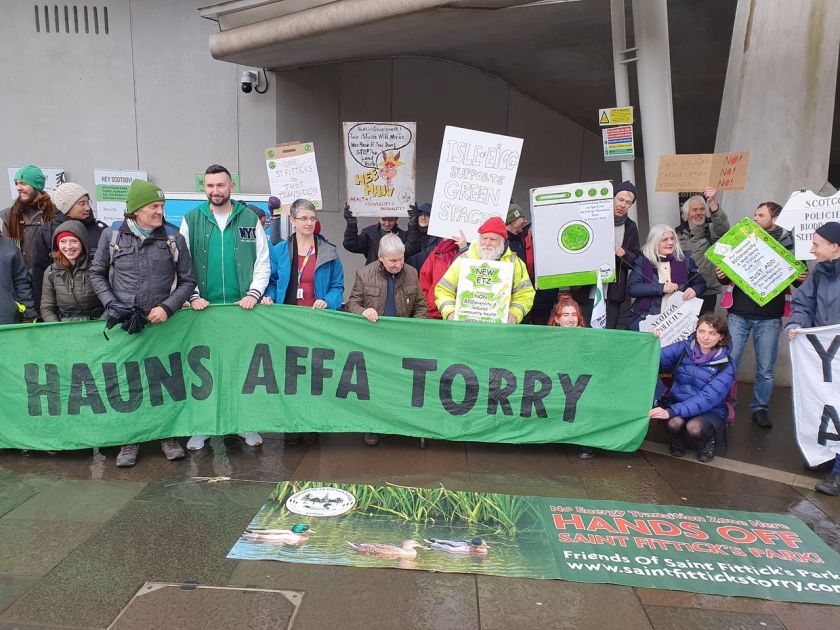
SPEECH OUTSIDE IRONSIDE FARRAR OFFICE 9TH AUGUST 2023
Welcome – and thanks for joining us this morning.I thought I would tell you why we’re here. This is the head office of Environmental Consultants Ironside Farrar – though the door doesn’t say that. We’re here to call on the employees of Ironside Farrar to boycott all further work for ETZ, the company oil tycoon Ian Wood set up to industrialise a large part of St. Fittick’s Park in Torry as an “Energy Transition Zone”. He then commissioned Ironside Farrar to get Planning Permission.
Torry is a suburb of Aberdeen, though it used to be a fishing and boat-building village just across the Dee from Aberdeen City. Then with the discovery of North Sea oil and gas in the 70s most of the village was bulldozed to make space for a Shell oil and gas terminal.
Since then Torry has been dumped time after time with the industrial development that other parts of Aberdeen don’t want – a landfill site, an industrial harbour where the Park used to come down to the beach at Niggs Bay, an incinerator close to the school, and now this threat to the Park which the Torry community cherish as their last green space. The threat to their community is huge. Ian Wood’s money persuaded Aberdeen City Council, who had previously invested much public money in improving the Park, to do a U-turn and re-zone it for industrial development. And Ian Wood’s money persuaded the Scottish Government not to intervene.
Ian Wood says the ETZ will contribute massively to bringing down carbon emissions, but much of the vague talk about what he wants to do is about developing Carbon Capture and Hydrogen technologies both of which are scams. This is in fact an attempt at a land-grab to justify continuing to extract oil and gas from the North Sea and fill the pockets of share-holders and directors in the Oil and Gas Industry.
Torry is about as disadvantaged a community as it gets, with appalling health statistics, appalling air quality and few employment opportunities. Despite this they are rising up and fighting for their lives against this plan to industrialise their Park.
Saving St. Fittick’s Park is exceptionally important, for three reasons:
- If it’s industrialised it will represent a huge win for the Oil and Gas Industry and delay phasing out oil and gas extraction from the North Sea
- It will destroy the significant biodiversity which has developed in the Park as a result of a lot of hard work and fundraising by the Torry community over the past 20 years.
- And it will further sicken and impoverish the people who live in Torry. It’s this last which is arguably the most important of the three. Because if we don’t protect and prioritise the poorer communities up the north east coast of Scotland we’re done for. It’s these communities who can force significant change.
Two big things have happened in the six weeks since we started this campaign, which make Saving St. Fittick’s Park even more important. Climate has broken down across the world at a speed which wasn’t anticipated. Southern Europe and North Africa are on fire, and unprecedented floods in central China have displaced 100,000 people. The second thing is that the Westminster Government has decided to grant at least 100 new drilling licences in the North Sea. That these things can happen at the same time shows just how strong our governments are committed to fossil capital.
I’ll end by quoting a few things from the booklet The Declaration of Torry, a product of The Torry Peoples Assembly in May: on the back of this booklet they commit themselves to six actions:
- We will do everything to stop the land grab
- We will continue to use our Park and increase its already immeasurable value
- We demand the incinerator be decommissioned
- We will seek support to set up a Torry Retrofit Project to insulate our homes
- We insist on a just and fair energy transition
- We will strengthen collaboration within our community and with others in Scotland and beyond
And inside the front cover of the booklet, most powerfully:
THIS IS OUR LAND AND NO ONE ELSE’S
THIS LAND BELONGS TO THOSE WHO CARE FOR IT
Just one thing to leave you with. The people arriving for work this morning are highly trained and have knowledge and skills which will be essential when we’ve made the transition to clean energy. They know about tipping points in global heating, and about the complex relationships which underpin biodiversity. Ever since we started this campaign, we’ve been respectful to these workers, seeing them as part of the solution, not part of the problem.
At the same time they must surely understand the enormity of what Ian Wood is planning in Torry. They have the power between them to Save St. Fittick’s Park, by boycotting further work for ETZ. Even if they aren’t in the team working for ETZ, they can bring Ironside Farrar to a standstill by collectively withdrawing their labour.

 Employment, Energy and Environment