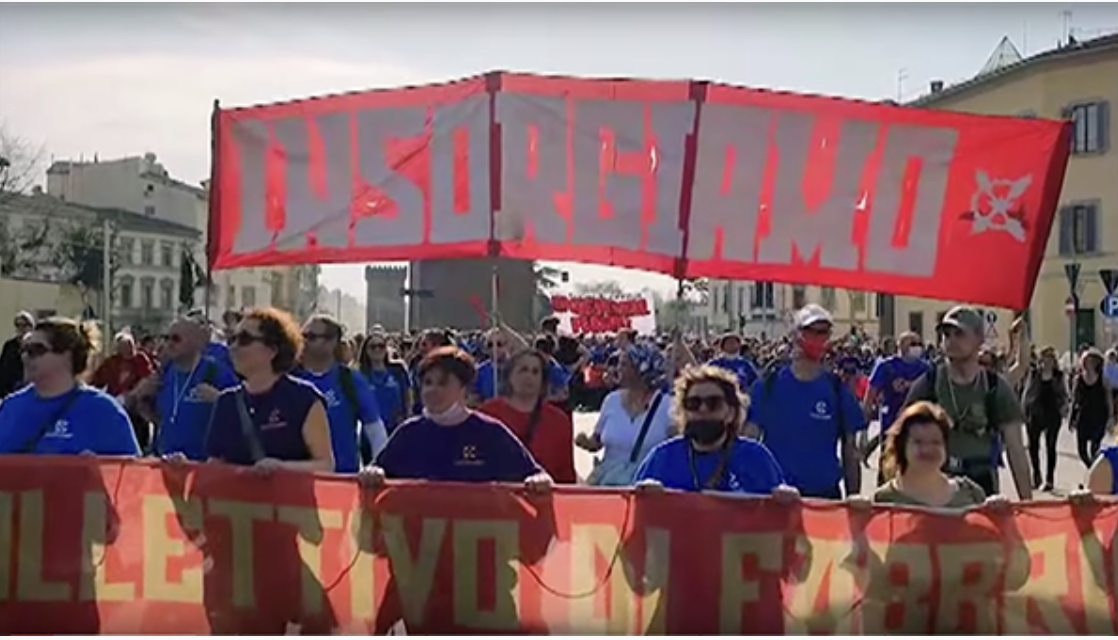
On 17th September ScotE3 teamed up with REELnews to screen their documentaries on GKN where the workers fighting for jobs and a sustainable future have been in occupation for more than three years.
At least two Scottish union branches have bought shares in the cooperative – many more can do so. There will be a delegation from the UK going to the occupation assembly in Florence on 13 October – if you are based in Scotland and interested in going please use the contact form to get back to us.
Not enough people know about this inspirational struggle so we are sharing the videos and some of the text from the REELnews site to spread the word. Please share on social media, raise the issue in your union branch or climate group and think about ways of giving practical solidarity – including raising money to take out a share in the collective enterprise.
The three videos together chart the course of the occupation – the third is the most recent and if you only have time for one it’s the one to watch but for the full story do watch all three.
GKN factory occupation needs YOUR help to start green production under workers control
GKN Workers start hunger strike for a worker led transition in the most important struggle in Europe
GKN Florence: 3 years of permanent assembly, leading the way in bottom up worker led just transition
The following text thanks to REELnews
The most important struggle in Europe This July, workers at the GKN automotive engineering plant in Florence, Italy passed an incredible three years in permanent assembly – by some way the longest factory occupation in Italian history.
That would be historic enough in itself – but what started out as a standard industrial dispute to save jobs has transformed into a visionary rank and file worker led movement for just transition, with a reindustrialisation plan to move from producing parts for luxury cars, to solar panels and cargo bikes. All under workers control, and for the benefit of the community, not for profit.
They know that for this struggle to succeed and be part of a proper transition to ecological, non-exploitative production that benefits workers and communities and not the rich, the whole world has to change around the factory. So through mass assemblies of workers, a movement has been built that is challenging the capitalist model – in a country that has a far-right government. The occupied GKN factory is now acting as a focal point for all struggles to converge; not only to take serious action to combat climate change, but to support refugees, support the struggle for a Free Palestine, show solidarity with trans people under attack from the government, provide solidarity with anti-fascist campaigns and much more.
There have been enormous strides in the past few months. The regional government is now accepting that public intervention could be possible to buy the factory off the current owners and hand it to the workers; they now need to find the technical means to do it. The workers are producing protoypes of the cargo bikes which are being tested out in Italy and beyond to fit them to people’s needs, and most importantly, are being used to hold mass meetings to work out what else need to change and be fought for to make them, together with buses and trains, part of a real transition to sustainable mobility.
But most incredibly, nearly €1million has already been raised to start production via their popular shareholder scheme. Every individual or group who buys shares becomes part of the assembly that will collectively run the factory if the workers win – and the first international assembly is due to be held in Florence on 12-13 October.
Win or lose, the GKN workers have created the blueprint for a just transition – and shown us all how to do it. But if they do win, it would create a laboratory from which we could start activating a just transition everywhere – as well as providing the hope of a positive future so essential for stopping the growth of the far-right.
That is why a GKN factory occupation – UK solidarity network has been set up, involving union activists from rail, education, construction, firefighting and delivery unions. (If you’re interested in coming, email us at info@reelnews.co.uk, and/or join the Facebook group here: https://www.facebook.com/groups/1032188728576043/).
Mike Downham and Pete Cannell review CLIMATE CHANGE AS CLASS WARby Matthew T. Huber: Verso 2022
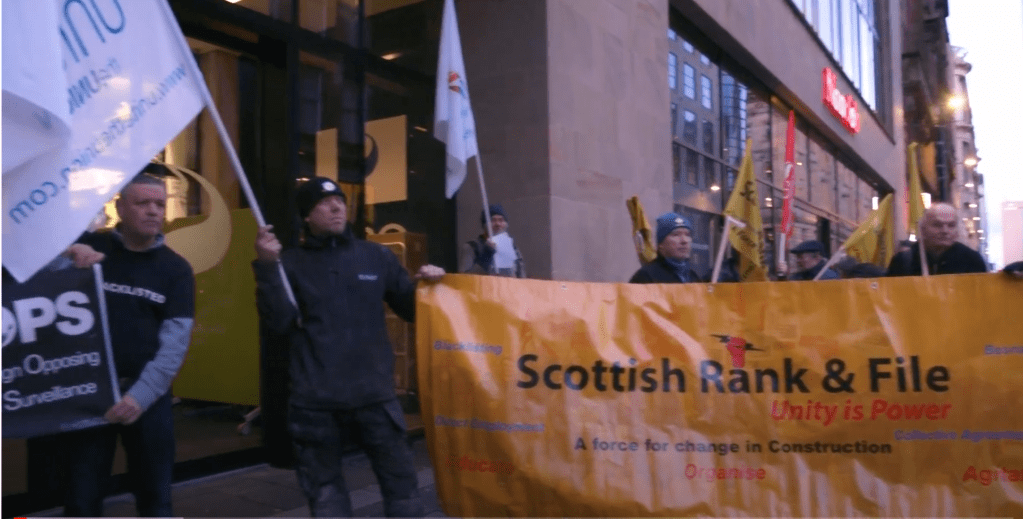
A couple of weeks ago one of us had the opportunity to join an early morning direct action outside the SSE offices in Glasgow. The action, called by Unite rank-and-file construction workers and the Black List Support Group was against the dismissal on Christmas Eve of high-voltage electrician Greig McArthur by Kirby Engineering, an SSE subcontractor. No reason was given for the dismissal, but it followed closely on McArthur’s request for recognition of Unite as the negotiating Union in his workplace. The direct action, which consisted of about 20 of us with leaflets, banners and a film-crew outside the main entrance, resulted in McArthur’s reinstatement. No attempt was made to enter the building, but the perceived threat of entry resulted in the main entrance doors being locked, and visible panic of staff in the foyer as they directed arriving employees to the back entrance of the building. On the back of this win, against one of the five big energy companies in the UK, McArthur’s branch is organising a combine of all electrical and mechanical workers in Scotland to not only push for recognition but also for proper wages and conditions.
As the power of rank-and-file of workers grows, the seizure of the means of production of energy and its distribution moves from being a pipe-dream to something highly possible. Nothing less than public ownership and democratic control of energy is necessary to prevent climate chaos. It’s the only way we can decarbonise energy in time, and the only way we can make sure that workers in the energy sector have secure jobs with proper wages and conditions – two goals which are inextricably linked.
When so much is at stake, when there’s so little time, and when left politics, nationally and globally, remains so weak, it’s inevitable that this will be a time when many people suggest different strategies. None of them will have all the answers. Rather than accept or reject a particular view-point, we need to discuss the strengths and weaknesses of each proposal and evolve a strategy which is truly collective. Discussion of each contribution to the debate is an opportunity to move forward to address the most urgent issue of our time. In our view Mathew Huber’s book Climate Change as Class War has significant strengths but also significant weaknesses. First, we’ll discuss the strengths.
Urgency
Huber writes with refreshing urgency. In his first paragraph he reminds us that
in 2018 the IPCC gave us 12 years (now eight!) to implement rapid far-reaching and unprecedented changes in all aspects of society
Scientists are saying that humanity must unite and face what could be its last fight.
Capitalism
It’s also helpful to be reminded that capitalism has made human emancipation possible because on the one hand it has developed production to the necessary level, and on the other hand it has created a class which has the collective power to emancipate.
Seizing the means of production
This is the focus of Huber’s call to action – as it surely must be for any successful and sustainable climate strategy. The only solution is for global production to become socially coordinated. We need to seize the means of production of energy, housing, transport and food so that they can all be decarbonised.
Reconciliation with nature
Also unarguable is Huber’s contention that the working class, now the vast majority of humanity, is most critically separated from the land, so that its livelihood no longer has a direct relationship with nature. The working class is entirely dependent on a wage for survival. This social coordination of global production, Huber says, needs to be entrenched in a reconciliation of humanity’s relationship with nature.
Species solidarity
Social coordination of production, Huber says, also needs to be rooted in “species solidarity” – which looks beyond international solidarity towards a world ethos
where workers in all countries recognise that the very conditions for species survival are at stake, and that survival depends on defeating the small minority of our species who control production
Encouragement
Recognising the daunting scale of the difficulties ahead of us, Huber encourages us by pointing to the current growth of strikes in the US. Here in the UK, we are also seeing a big resurgence of strike action. Particularly inspiring is the intensification of strikes by NHS workers – Click here to watch video (8 mins 24 secs)
At the same time, we should keep in mind that most strike action is still dominated by a trade union leadership who are concerned to operate within the straitjacket of anti-union law, desperate to get to the negotiating table and ready to compromise on agreements that don’t meet the needs of their members and fail to tackle systemic issues that underpin appalling working conditions. At the moment we don’t have a strong enough rank and file to resist these poor compromises and operate independently of the leadership. Huber also offers the encouraging point that the increasingly stark indifference of the wealthy and powerful to working-class well-being is creating increased militancy. He reminds us too that the working class in the US was able to turn round quickly it’s powerlessness in the late 1920s and early 1930s into power which forced the New Deal of 1933-36.
Where to start? It’s also helpful to be given suggestions of where to make a start. Huber suggests reviving the simple demand of public good over private profit. And he goes to some length to argue his case that we should start by seizing the means of production and distribution of electricity. But there are also significant weaknesses in Huber’s book:
Repetition Huber sets out his arguments four times – in a long introductory chapter, then in a chapter dedicated to each main argument, then in a Conclusion at the end of each chapter, and in a final chapter headed Conclusions. This makes the book a bit of a slog for the reader. It could have been a shorter and more easily digestible book. Moreover, the multiple Conclusions are not always consistent with each other (see the next point).
Professional Class Huber devotes a whole section to his theory that there is a distinct “Professional Class” and that its class interests determine the politics of the climate movement. This argument is not convincing. He seems confused between the idea that almost anyone with a degree is in this class, or whether it’s only some people, particularly lawyers and managers, who occupy contradictory class positions. Furthermore, the Professional Class concept doesn’t survive into the conclusive final chapter, where it gets no mention at all. It’s true, though Huber doesn’t specifically mention this, that in the US non-profit organisations tend to dominate social movements and struggles. They often have shed-loads of money and pay their employees fat salaries. But does this constitute a distinct class? In contrast, Cooperation Jackson made the political decision not to be a non-profit, based on years of activism in organisations where nobody was paid (see Michael Haber’s Breaking Out of the Nonprofit Industrial Complex). US exceptionalism The concept of a Professional Class is perhaps, at least partially, an example of US exceptionalism. Although Huber recurrently and correctly emphases that climate solutions have to be global, he sometimes slips into assuming that the US context is representative of the global context. For example, the considerable detail he goes into about the electricity sector in the US may not be transposable to the electricity sectors of other nations. And levels of unionisation vary widely internationally.
Workers’ Power and State Power Huber argues that organised workers have the potential power to force a transition into new sustainable forms of production. To shift from potential power to actual power he advocates a rank-and-file strategy (RFS). The case for building from the grass roots is clearly made – however, the politics of the strategy and the relationship between the rank and file and the union leadership is less clearly articulated. Is the RFS a means to an end – a reinvigorated union movement – or should it be more than that? Put simply the strategy seems to be that a resurgent working class can force change through the ballot box and then the state can take the decisive action required to transform the economy.
In conclusion Climate Change as Class War is a valuable contribution to the debate about building the power to avert a climate catastrophe. It asks the right questions and does the movement a service in putting production under capitalism at the centre of its concerns. However, in our view, its critique of the politics of the climate movement is undermined by a concentration on the material interests of a so-called professional class. Important questions about why the left internationally is at such low ebb; about the relationship between social movements, parties and working class organisation; and about the role of trade union bureaucracies are not addressed.
We have a small number of copies of the book available at the reduced price of £11 – use the contact on the menu to get in touch if you are interested in a copy.
Thanks to REEL News for this report and access to video from Friday’s direct action in Glasgow
Friday 13th Scottish Construction Rank and File take direct action in Glasgow
UNITE Scottish Construction rank and file and the Blacklist Support Group were celebrating a very significant victory after a campaign of direct action forced Scottish energy giant SSE to reinstate Greig McArthur, branch secretary of the biggest construction branch in Scotland, and two of his colleagues. They were disgracefully sacked two days before Christmas for seeking trade union recognition, despite being only weeks away from an agreement. Now that recognition agreement appears to be imminent – as well as full compensation for loss of earnings.
This is a particularly important victory as it is in the high voltage sector, a key sector in moving away from fossil fuels to renewable energy.
Here’s a video clip of Greig McArthur talking about the importance of the high voltage sector to the transition to a sustainable economy
Now Greig’s branch are organising a combine to not only push for recognition and proper wages and conditions across all renewable energy sectors, but to fight for proper wages and conditions in every single electrical and mechanical sector. They are also calling on the Scottish Government to put some teeth into their “Fair Work Convention” which calls for much better employment conditions, and to put guarantees of stable, well paid direct employment into their at present very weak Just Transition policy.
In addition they calling for UNITE Scotland to step up and start organising properly with the rank and file, something which has been sadly lacking. So the rank and file also visited another site to protest the excessive use of agency staff, and to start a campaign for an above inflation pay rise which should have been started by the union months ago. This is the start of a major campaign by the branch – and the next step is to elect officers to the new combine at a meeting on Saturday January 28th, which will also be a chance to come together to share ideas about winning on all the issues mentioned above. If you’re a construction worker in Scotland and you’re not already a member of the branch, this is the time to join (details at the end of the video) – and build a powerful combine to win.


 Employment, Energy and Environment