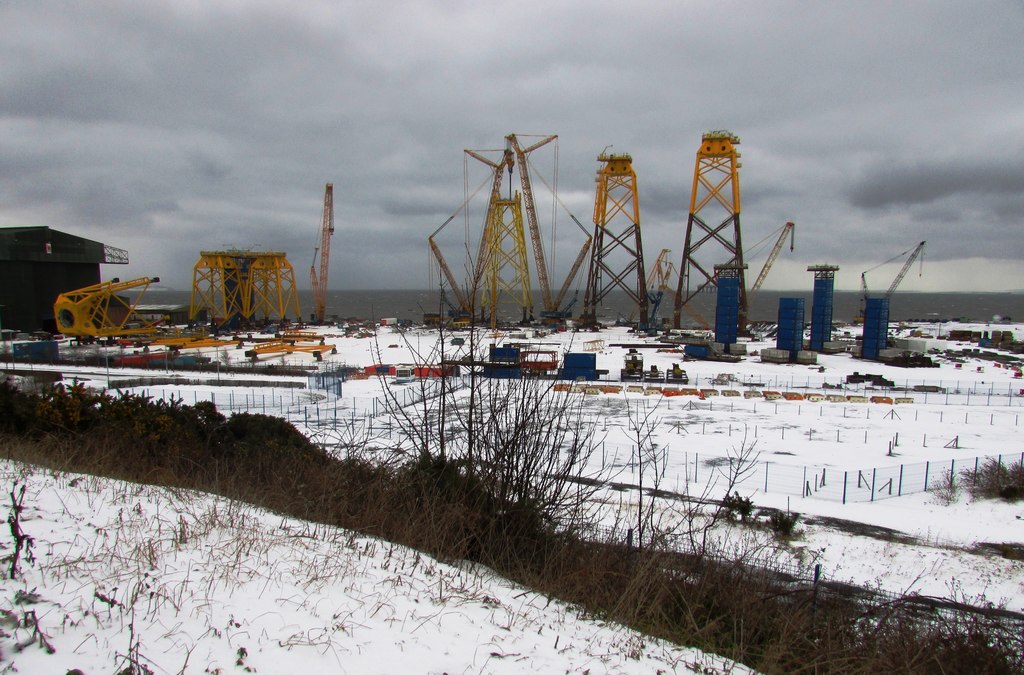
Grangemouth – fight for jobs

Scotland’s only petrol refinery, based on the Firth of Forth at Grangemouth, is scheduled to close in 2025. The closure is not a cause for celebration by climate campaigners, it will be replaced by a new refinery in Antwerp and 500 workers at the Grangemouth site will lose their jobs.  The closure is in no sense part of a transition away from Fossil Fuels and even less is it part of a just transition.

The march assembling outside the Grangemouth stadium – image Pete Cannell CC0

The huge 1700 acre Grangemouth site is owned by billionaire Jim Ratcliffe’s INEOS.  They bought the Grangemouth petrochemical plant and the refinery from BP in 2005.  Then in 2014 the company raided the pension fund originally established by BP and in turn de-recognised the plant unions. The refinery part of the site is now run by Petroineos, a joint venture between INEOS and the Chinese state-owned oil and gas company PetroChina. 

Unite, the main union at the refinery is leading a campaign to ‘Keep Grangemouth Working’.  The union is calling for action to ‘Extend, Invest and Transition’.  On 3 August, they organised a march and rally starting from the Grangemouth stadium on the edge of the INEOS site. Around 600, including refinery workers and their families, and trade unionists from around Scotland and further afield marched to a rally held in a local park.  There were a handful of climate activists.  

At the rally Unite Scottish Regional Secretary Derek Thomson talked about how the union was campaigning locally to raise awareness of the impact that closure would have on jobs and the local economy.  Unite believes that the new Labour Government may be able to persuade Ratcliffe to extend the life of the refinery.  The Tories pledged to provide 700 million Euros in credit to support the development of the new Petroineos refinery in Antwerp and they think that if Labour were to question this it would provide leverage.

Grangemouth is a critical campaign for the climate movement.  There are moments when decisions are made and actions taken, or not made and not taken, that then resonate through the movement and shape its future trajectory.  If the Grangemouth refinery is closed it will be such a moment.  In Scotland another such time was the failure to take the BiFab fabrication yards into public ownership in the autumn of 2017.  The loss of 1400 jobs at BiFab offshore renewables technology yards discredited the idea that action over climate offers opportunities for employment.  The closure of Grangemouth would be not just a blow to the workers, their families and the local economy, it would also send political shockwaves through the climate and workers movements. 
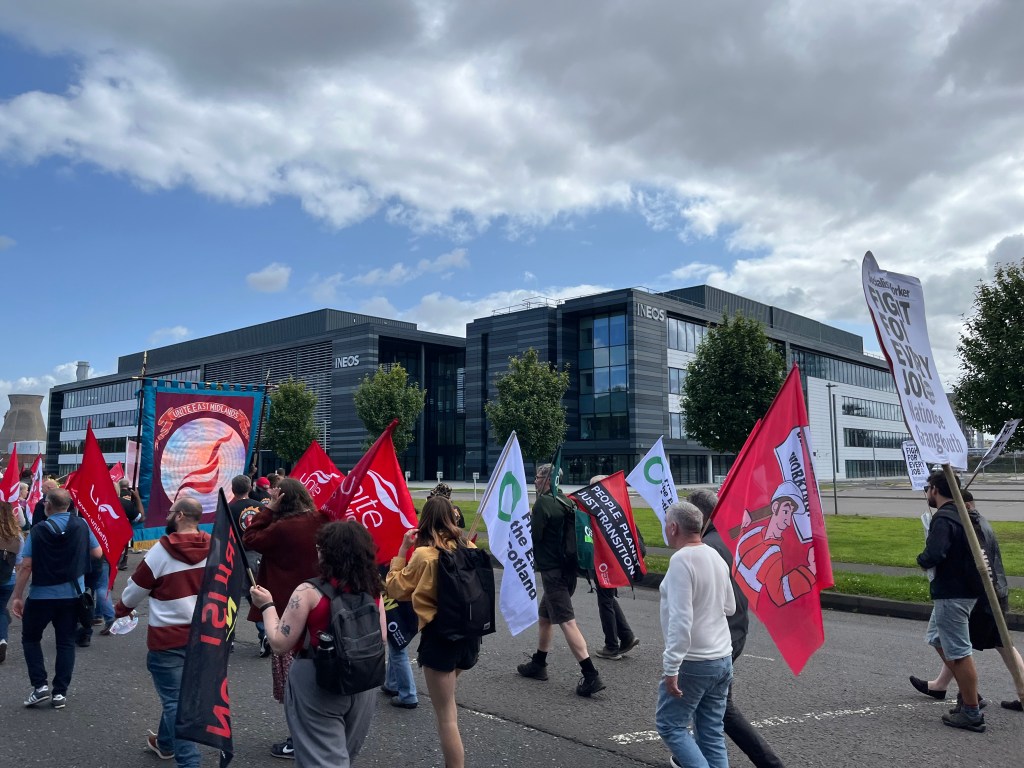
On the march – image Pete Cannell CC0

At the rally on 3 August the speaker from Friends of the Earth Scotland received a great response from the Unite members in the crowd.  It is important that the union and the Grangemouth workers see transition to a sustainable future as a positive goal.  However, there is a real weakness in the current campaign.  Unite’s strategy seems to be based on pressurising INEOS into extending the lifetime of the refinery.  But there’s no evidence that Ratcliffe is interested in doing this or interested in planning for a sustainable transition.  And it’s not that Grangemouth is unprofitable – simply that Antwerp would be more profitable.  None of the speakers at the rally criticised INEOS.  Implicitly or explicitly the focus was on partnership with the company.  

At a time when all the indicators suggest that global heating is increasing faster than the most pessimistic predictions, companies like INEOS and BP are doubling down on investment in fossil fuels.  They aim to make mega-profits while they can.  In these circumstances, when action to decarbonise is overdue, working in partnership with big oil, while talking about the need for transition and social justice is simply greenwashing.  It won’t save jobs, and it sets back progress towards transition.

So, what’s the alternative?  Public ownership, and democratic planning that involves energy workers is essential.  To build the mass campaign that could make this possible the unions and the climate movement need go beyond slogans.  

The private sector is simply not capable of the kind of planning and coordination that is needed to save jobs and manage a just transition. 

Convincing energy workers, winning hearts and minds and building the mass support for public ownership requires brutal clarity about what the oil and gas companies are doing. The profits they’ve made and continue to make, the huge subsidies they continue to attract and the way they expect us to clean up their mess.  Grangemouth has been a site for petrochemicals for a hundred years. Without an enormously expensive cleanup the site is only suitable for industrial use.
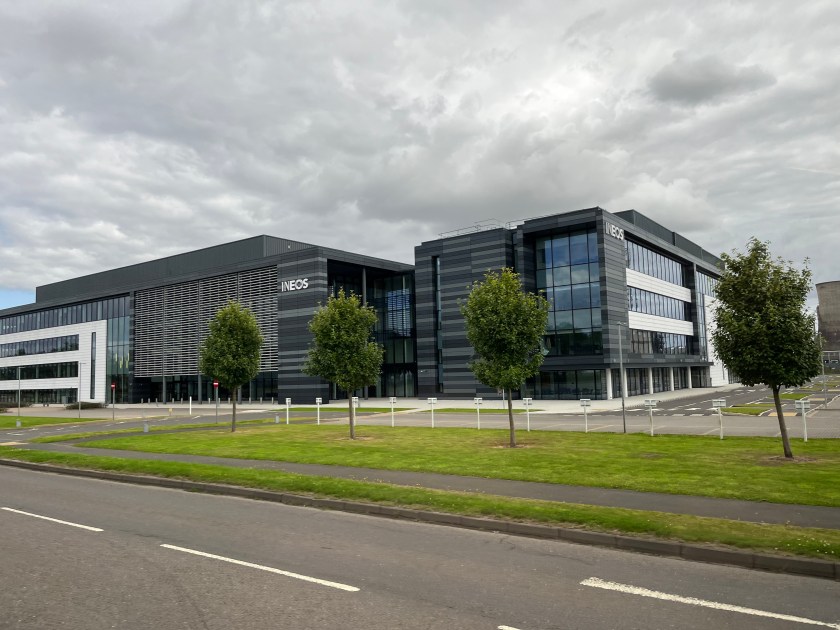
Image Pete Cannell CC0

Partnership with INEOS is a dead end.  The company has no loyalty or regard for the workers or the local population.  There’s no guarantee if the refinery closes in 2025 that the rest of the operations on the site will continue much longer, and with it, the loss of over 2,500 jobs.  Ratcliffe expects us to pay the huge cost of cleaning up the site.  And the residents of Grangemouth having lived with the stink and pollution of the plant for decades will remain with a toxic legacy.

But to win hearts and minds and build the campaign there also needs to be a plan for change.  The vast site at Grangemouth could become a hub for a wide range of renewable technologies.  There’s room to establish new facilities, there’s good communications by land and via the Firth of Forth and there is an established workforce and a cluster of further and higher education institutions in the region that could support the development of a new low carbon economy. 

The nature of the plan matters.  At the Grangemouth rally – ex-MP and deputy leader of the Alba Party, Kenny MacAskill argued that Grangemouth could prosper through the development of green hydrogen and carbon capture and storage.  But these are the solutions that are promoted by Offshore Energy UK, the organisation that represents the interests of the UK oil and gas sector.  Both technologies may have some use in the future but the industry focus on them right now is aimed at maintaining oil and gas production, and the infrastructure and systems that support it, for as long as possible.  Opportunities for rapid progress lie in Wind, Solar, Wave and Tidal technologies together with energy storage and a new smart distribution grid.  Ending partnership between unions and big oil also requires a new and critical view of what technologies support jobs and employment and support rapid decarbonisation and a break from the fake self-serving solutions that are advanced by the oil and gas industry.  Which technologies are prioritised is not simply a technical choice but also highly political.

Scottish Government puts profit before people in public transport stitch up

Public transport campaigners in Glasgow have led the way in showing how a transport system that meets people’s needs is an important part of the transition to a zero carbon economy. Mike Downham explains why Glasgow City Council’s response to the campaign is desperately inadequate.

There’s a stitch up going on between the SNP Scottish Government (led by Michael Matheson, Cabinet Secretary for Transport) and the SNP Glasgow City Council, along with the Glasgow City Region Cabinet of eight local authorities (SNP Councillor Susan Aitken leads the former and chairs the latter).

First Glasgow bus 38225: Image by Calum Cape CC BY 2.0 

A remarkable article about this was published three days ago on the A Thousand Flowers blog.

It says, for example:

While the SNP have made the long overdue renationalisation of Scotrail one of the central themes of their current election campaign, they are actively inhibiting even tentative steps to reintroduce public control to the bus network.

And:

According to Glasgow’s dominant bus operator First, it’s “practical changes on the ground for the people of Glasgow that are needed, not a stale and out of date regulatory debate.” Here at 
ATF we would tend to disagree – questions of ownership, power and accountability are crucial to the functioning of any part of society, whether that’s football clubs or local buses. Scotland’s private bus operators have had three decades to show they can deliver a good service, and it’s been a resounding failure.
But while securing the power for local authorities to tackle this issue is all very well, if it isn’t resourced and worse still, actively undermined, then what’s the point? 

The Transport (Scotland) Act 2019 enabled and encouraged Local Authorities to explore three options – Bus Service Improvement Partnerships (BSIPS), Franchises, and Municipal Ownership. But in November last year the Scottish Government announced a £500 million Bus Partnership Fund, restricting the fund to the development by Local Transport Authorities of BSIPS. “The Bus Partnership Fund will complement the powers in the Transport (Scotland) Act 2019, enabling local authorities to work in partnership with bus operators, to develop and deliver ambitious schemes that incorporate bus priority measures”. The Government hasn’t even given guidelines for the exploration of Franchises or Municipal Ownership. Now Glasgow City Council is talking up their progress with a BSIP, as if Franchises and Municipal Ownership aren’t options – despite having previously committed to exploring all three options.

This sleight of hand, under cover of the public focus on Covid-19, is not only dishonest and utterly undemocratic – it’s potentially disastrous for the millions of people across Greater Glasgow who depend on bus transport and for whom the current system is both unfit for purpose and unaffordable. It amounts to another scandalous hand-out to the private bus companies.

Philip Alston, the UN’s rapporteur on extreme poverty and human rights, spoke in March this year at the Get Glasgow Moving AGM, as a follow-up to his visit to Glasgow in 2018 to collect evidence for his report. He said three things about public transport: first that an efficient and free public transport system in Glasgow would be the most immediate and most realistic way to address Glasgow’s huge poverty and human rights issues; second that there were many examples internationally where this had been achieved through public, democratic control or ownership; and third that there were absolutely no examples internationally where a privately owned public transport system had met needs and rights.

Meanwhile Greater Manchester made history in March “by becoming the first UK city-region to commit to re-regulating its buses since Margaret Thatcher de-regulated them in 1986”, see this report on the Get Glasgow Moving website.

New Hope for BiFab?

It’s excellent news that the BiFab yard in Fife will reopen over the next few months with the prospect of 290 jobs working on the production of eight platforms for the Neart na Gaoithe offshore wind farm project.  It’s a time for optimism but also a time for organising to ensure that this is not another false dawn. 

 Burntisland Fabrications yard at Methil by Bill Kasman CC BY-SA 2.0

Neart na Gaoithe is just 15km off the Fife coast.  When complete the windfarm will have 54 turbines generating enough electricity to power 375,000 homes.  54 turbines require 54 platforms, and it makes environmental sense to build these massive structures as close to the site as possible.  But BiFab will only be making eight, the others will be produced thousands of miles away.   

Announcements from the new private owners are positive about more orders in the pipeline, but we have heard this before – and back in 2017, prior to all production ending in early 2018 there were 1400 workers at BiFab.  There have been four wasted years.

We’ve argued on this site that the Methil yard should be a key part of the engineering infrastructure that’s needed to build a new sustainable, zero carbon economy.  The Methil, Burntisland and Arnish facilities can form part of the much more extensive network of sites required as we build an integrated, full-scale green energy economy.

We’ve also argued that the transition to the new economy we need so urgently can’t be left to the chaos and instability of the market. The workers at BiFab paid the price for the anarchy of the market in 2017/18.  To avoid this happening again, to guarantee jobs and a future for our children and grandchildren, we need public investment, public ownership, long term planning and democratic control.  

Public transport use in Scotland in decline

The decision by the Scottish Government to extend free bus travel to under 19 year olds is a small but positive step.  However, the latest Transport for Scotland Report published yesterday (27th February 2020) shows that the number of bus journeys undertaken is continuing to fall while car usage is rising.  The steepest fall in bus use is in the Highlands and Islands while the decline is least in South East Scotland.  The data in the report doesn’t break down regions by public transport provider but the relatively small decline in the South East is almost certainly a result of increased numbers using publicly run Lothian Buses.

In 2107 transport accounted for 36.8% of Scotland’s total greenhouse gas emissions.  Cars were the biggest contributor accounting for almost 40% of the total.  Cutting the use of polluting car transport is a critical part of shifting to a zero carbon future.  Simply replacing petrol and diesel by electric would put huge pressure on natural resources that are in short supply and whose extraction causes major environmental damage.  The answer must surely be a comprehensive, flexible and well connected public transport system that has electric buses as a key component and is free to users.  There is good evidence that low or free fares results in a massive increase in public transport use.

800px-Lothian_Buses_Envrio400XLB_1071

One of Lothian’s new 100 seat Envrio400XLB buses.  CC-BY-SA 4.0

How can public ownership in Offshore Wind deliver good jobs for the climate transition?

Thanks to Anna Markova from Transition Economics for permission to share this video which she presented at the STUC Energy conference – ‘Building Worker Power in the context of the climate crisis’ on 20th November.  The video looks specifically at offshore wind but raises issues around public ownership and is well worth watching in full.