REELNews Xmas appeal

Crunch time for GKN, the most advanced worker led transition struggle in history 

XMAS APPEAL: Crunch time for GKN, the most advanced worker led transition struggle in history 

The battle by ex-GKN workers in Florence to convert their autoparts factory to zero carbon production under workers control is at a critical stage – and you can help. Find out how below and watch a video of the story of this historic struggle so far – PLUS the latest from the most important strike in Britain, a siginificant victory for education workers in Bristol, and what you can do to help prisoners on hunger strike for Palestine
GKN: Cash urgently needed to start production under workers control

Click here to watch video of the story so far (30 min version)
Click here to watch 5 min version

Those of you who have been following the incredible just transition struggle of ex-GKN workers in Florence (and if you haven’t, you can catch up by watching the video above) will know that the regional council have been stalling on their commitment to put together a consortium to buy the factory off the current owners and hand it to the workers to produce cargo bikes and solar panels – all under workers control, and for the benefit of communities, not for profit.

Now, after delaying the process for months – increasing the suffering of the workers who have now had no wages for 15 months – it’s fallen apart.

The main reason seems to be the drive to war and the increase of arms spending across Europe, with most of the banks who agreed to fund the project now demanding that the workers produce weapons rather than zero carbon products based on equality and social justice. And as the workers point out, “the former GKN is an example they can’t afford. Because a conscious community, insurgent, through the convergence of social and climate justice shows that an alternative would be possible.”

So now the workers have made the decision to go it alone and do everything themselves. Which means raising substantial sums of money from our own workers organisations, social movements and civil society.

CLICK HERE TO READ FULL STATEMENT AND EXPLANATION BY THE WORKERS


WHAT YOU CAN DO TO HELP

1) Make a donation to the workers’ crowdfunder, which has a target of 2 million euros. You can make a donation by clicking here. So if you were looking for somewhere to donate to for Xmas, this is the place!

2) If your trade union branch or organisation, or a collection of individuals can afford 500 euros, that’ll buy you a share in the workers cooperative and be part of the assembly that will collectively run the factory if the workers win.
CLICK HERE TO BUY A SHARE

IMPORTANT: IF YOUR GROUP HAS ALREADY PLEDGED TO BUY A SHARE, CLICK ON THE LINK ABOVE TO PAY THE 500 EUROS FOR IT

And a warning: 
the form to buy shares is not easy to fill in. Having just done it to buy the share for the UK rank and file workers delegation that visited Florence last year, we can give you some help below; if you’re still having trouble, please feel free to email us at info@reelnews.co uk and we can talk you through it.

If you’re not in Italy, fill it in as an individual, not as an organisation. If you try to do it as, for example, a trade union branch, you’ll get a load of questions that are impossible to answer because our union branches are not set up in the same way legally as Italian union branches. So you’ll have to pick a trusted individual who doesn’t mind paying the 500 euros out of their personal bank account and then getting it back from the branch.

Most of the questions are meaningless – but what you answer doesn’t matter. The questions are obiously geared to a generic shareholder issue for companies – but don’t worry about the fact that none of the answer choices fit your situation, just pick anything – the answers seem to be completely irrelevant, so for example there’s no need to reveal your financial circumstances.

When you get to the page that says “send link to continue on your phone, or scroll down to continue, choose the phone option. You’ll findthat it’s actually impossible to scroll down, so in fact you have to continue you on your phone – which is actually just to take a picture of your passport as proof of identity. Once you’ve done that, it’ll return you to your computer.

Once you’ve finished this part, you’ll have to wait for another email to set up payment. This comes in a few minutes, but then once you’ve set up payment (bank transfer seems to be easiest), you’ll have to wait for up to 48 hours for it all to be cleared to actually transfer the 500 euros.

Hopefully that hasn’t put any of you off! But if it feels daunting, please get in touch – we’ve done it and can help you do it very quickly. 

We’ll leave the last word to the workers: “After 4 years of struggle, 15 months without a salary, and 8 months of unemployment, all may seem lost. But at the same time, it may all be enough to claim that, “after all, we won”. The lessons we can learn from this struggle are enormous, its historical legacy will not fade away, and its example will speak for years to come. Then, why insist (on continuing the struggle)? Because we cannot afford to lose this fight and “they” cannot afford to let us win. Because it started with the “simple” aim to keep the factory open, but ended up exposing every “systemic” issue that is dragging us towards the catastrophe today.”

Climaximo at the Scot.E3 conference

The Portuguese ecosocialist group Climaximo contributed to the Scot.E3 conference

Leonor Canadas from the Portuguese group Climaximo spoke in the initial plenary session at the conference. on 18 October. Later she spoke in more detail about Climaximo – how they organise and what they do. We recommend checking out the Climaximo website.

In Climax’s words they are ‘an open, horizontal and anti-capitalist collective.’
They say:

We are the ones who refuse to lose everything without first trying to win, for the risk we take can’t be compared to the risk of not acting.

In 2019 we explicitly and consciously took on systemic change as our social and political mission, declaring a state of climate emergency within Climáximo and launching an in-depth process of internal restructuring. Every year we have updated the measures we take based on reality. In 2023 we changed everything. Read the current declaration of a state of climate emergency within Climáximo here: state of emergency.

The background to Climaximo’s approach to climate action and climate politics, and the sharp change they made in 2023, is summarised in the book All In which we reviewed on this website in April. You can find out how to get hold of the book and access more resources on the All In website.

Crunch time for ex-GKN workers and their just transition plan

Italian workers who occupied a GKN factory to oppose closure went on to make a plan which shows what a just transition can look like. Now it is time to support their plans to start production.

Italian workers who occupied a GKN factory to oppose closure went on to make a plan which shows what a just transition can look like. Now it is time to support their plans to start production.

Matthew Crighton reports on the latest developments.

See previous articles on this site on the workers’struggle here and here.

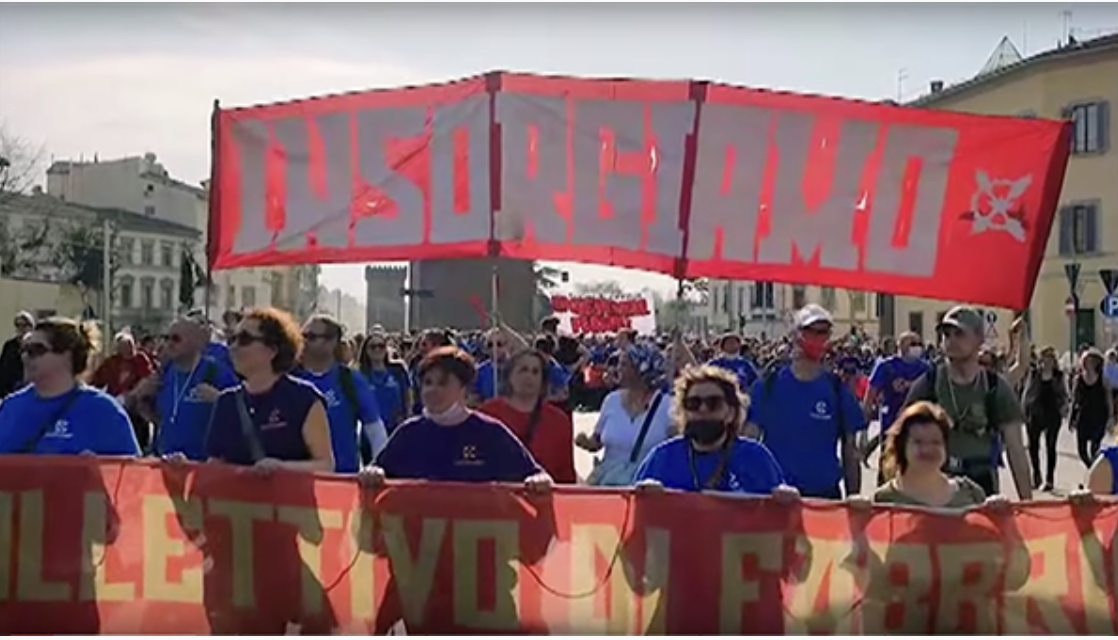
Workers at GKN near Florence occupied the factory against closure over 3 years ago and are still there, after winning 6 legal cases including successful challenges to the lay-offs. They have been sustained by cycles of mobilisation by supporters across Tuscany giving solidarity and practical donations.

The strong trade union organisation in the plant didn’t just oppose closure of their factory, they decided to build a case for re-opening with a plan for socially-useful production, rather than servicing the luxury car manufacturers. Pooling their expertise and reaching outwards, they now have a plan for just transition to make solar panels and cargo bikes.

I was pleased to join a UK delegation to the Solidarity Assembly at the site on 13 October and a public event on the day before about convergence between the trade union and climate movements and even got to speak at it. More of the detail of their story is covered in the articles to which there are links below so here I will just summarise the current situation which we learnt about.

About one third of the original 400 workers are still taking part, now organised into the GFF Collective. After a series of sales, neither GKN nor Melrose, the company which bought from it, are now involved and the workers’ struggle to retain employment has become focused on their plan to re-start production, not of the luxury car parts which GKN made, but products of vital importance for the transition to zero carbon – cargo bikes and solar panels, includingrefurbishment of old panels. This was prepared in consultation with the climate movement in Italy and potential users of the products and its purpose is seen as leading a switch to reindustrialisation through addressing environmental crisis.

The Regional Council of Tuscany has given this plan some support but it has not taken the key next step to provide the Collective with working capital. The most recent development has been that the factory site has been sold again to property companies and the workers fear that they intend to use if for warehousing, retail or housing. As a result, they are looking for options of other sites for their collective enterprise while not giving up on the first one.

The Collective launched an appeal for funds and in particular for the purchase of shareholdings. Two UNISON branches in Scotland have committed to do this and I was able to act for them at the Assembly and report back. The good news which we received is that the Collective has been successful in reaching its target of 1 million euros.

The worrying news was that the Tuscany Regional Council still has no timetable for passing the decision which can enable it to give the funding and support needed. In this light, the Collective’s resolution to the Assembly both set a deadline at which, if there is still not a decision, it will have to reconsider the viability of its plan; and set a target for further fundraising of another 1 million euro.

As things stand at the end of October, the workers have three demands:

  • Pay unpaid salaries to the workers
  • Administration by the national government: the Government is asked to appoint a special receiver to the company
  • That the regional government buys the factory off the current owners and hands it over to the workers to run themselves under workers’ control

The deadline which they have set is 15 November and the date of the next mobilisation and an assembly at which the situation can be re-assessed in 17 November. As the Collective says “It will be a celebration for the start of the plan or anger against an entire system”.

It was inspiring to witness workers reaching out to the climate movement and solidarity received in return. As the attendance showed this has been a rallying point for the left in Tuscany, Italy and wider in Europe.

I was able to bring our experiences in Scotland, of Friends of the Earth and STUC setting up the Just Transition Partnership, to the audience. I emphasised what each movement has learnt from the other and the need for a foundation of respect between them. I was pleased that the next day, Greta Thunberg spoke on the same theme of building a mass movement of workers who want to stop climate change and environmentalist in solidarity with workers struggles.

The ex-GKN workers need solidarity and have a call out to buy shares to raise working capital for their cooperative. The shareholding appeal remains open and also straight donations can be made – see below*. Lastly, this inspiring example and lessons from it need to be widely known. Speakers can be provided.

Here are articles about it:

Rebirth or Surrender – 14 October 2024 – in Italian but Google can translate

The Italian Workers Occupying Against Climate Crisis – 11 October 2024

The GKN Workers Fight Continues – 13 March 2024  – Red Pepper

Facebook Group: GKN Factory Occupation – UK Solidarity Network

Key Learnings:

  • The inspirational impact of workers acting to defend their jobs, to defend the planet and transform the economy.
  • A concrete example of joint work between trade union and climate movements, at activist and formal levels – there is lots for activists in the UK to learn about this…
  • The inertia which arises from neither the trade union structures nor the local government being ready with support for this kind of initiative
  • The need for workers in all industrial enterprises to be thinking ahead and preparing just transition plans
  • The shift from a dispute with an employer about closure to a workers plan for production requires a new combination of skills, organising capacity and resources – fundraising for industrial production, securing a site, arranging finance and organising a workforce while continuing the political struggle is a big challenge
  • The importance of solidarity for keeping this going.

Matthew Crighton

matthewcrighton@gmail.com

* Donations can be made by single or continuous bank transfer to the following Banca Etica current account in the name of Soms Pinerolo IBAN IT81 E050 1801 0000 0002 0000 339 BIC ETICIT22XXX

This is what worker led just transition looks like

After more than 3 years in occupation, the Florence GKN workers’ fight to save jobs and develop alternative production continues as an inspiration to workers and climate campaigners everywhere.

This article by Pete Cannell was first published on the rs21 website.

COP26 in November 2021 represented a moment when the climate and workers movements in Britain converged. The process of building for the huge demonstrations in Glasgow put the idea of ‘worker-led just transition’ to a sustainable economy firmly on the agenda. But that slogan hides real issues about what should be done. And in 2024, rather than workers driving just transition plans forward, we see big job losses in Port Talbot and now confirmation from Petroineos that the Grangemouth oil refinery will be closed in 2025 with the loss of around 500 jobs. 

But it doesn’t have to be this way and we no longer have to look back for inspiration to the 1970s and the Lucas Plan for alternative production. In Italy the workers at the GKN factory in Florence are waging an inspirational campaign to save jobs and establish alternative production.

Until 1994, GKN Florence was a Fiat factory. The workers, members of the CGIL union, had a tradition of organising within the factory and standing in solidarity with other struggles. Ownership passed to the British firm GKN, and by 2019 when GKN sold the factory to Melrose, a Britain-based investment company, there were more than 400 workers engaged in producing components for the car industry – including most of the big luxury brands.

The Melrose takeover was controversial and workers suspected that there were plans to asset strip. They were right and on 9 July 2021 the whole workforce were sacked by email. The workers’ response was to occupy and organise through a process which they describe as permanent assembly. Their initial demands were for the sackings to be rescinded and after a demonstration of 40,000 on 21 September the courts ruled that the sackings were inadmissible. So formally they had their jobs, but Melrose had no intention of restarting production. 

Two weeks later the workers joined an even bigger Fridays for Future demonstration of 50,000 in Milan. This was the start of an intense dialogue with climate activists. What to produce and why? Over the autumn the GKN workers worked on a plan for sustainable transport, converting the factory to produce cargo bikes and solar panels. By December the plan was complete and then Melrose sold the plant to a new owner. It rapidly became clear that the change of ownership was aimed at conning the workforce. There was no new investment and by August 2022 it was clear that there was no intention of restarting production in any form. Moreover, the new owner stopped paying wages. From August 2022 to July 2023 the workers received no wages and because they were under contract they were unable to claim unemployment benefit. Some were forced to resign – at the same time a system of social mutual aid was developed to sustain those continuing the occupation. 

At the end of 2023 the workers once more faced formal dismissal and yet again mass mobilisation and demonstration on New Years eve pushed back the threat. 

By itself the bare narrative of events testifies to the GKN workers commitment and resolve. However, these facts miss the dynamism and creativity of their response. The engagement with the climate movement was the catalyst for developing the plan for alternative production. The workers are clear that simply reopening the factory with new products is not possible. They know that they can’t build an island of sustainable production in an ocean of capitalism. They are clear that in the end it’s not just about GKN but developing collective production models that inspire similar struggles in multiple other sites. They also understand that cargo bikes are currently a niche product – selling either to well-off individuals who can afford the high price tags or enabling the exploitation of precariously employed delivery workers. Similarly, current practices in the production of solar panels are highly centralised, and entail rotten working conditions and little consideration of recycling and waste disposal. 

The workers’ response is to think about and campaign for approaches that are networked into horizontal local energy communities. They are producing prototype cargo bikes and working with local networks and campaigns to develop new models for use, and also evolving systems in which feedback from users shapes the next round of production. They’ve also pooled their practical knowledge with supportive academics from local universities who bring specialised theoretical knowledge to research and develop innovative and sustainable technical solutions driven by the social and political insights of users and workers.

In building solidarity, the workers have also placed the campaign for jobs and alternative production at the heart of wider social struggles. Their organising contributes to wider struggle and also learns from it. They have fought over migrant rights, workplace safety, anti-racism and anti-fascism. Most recently they have made common cause with the Palestine movement. In fighting for the regional government to back their plans for cooperative production under workers control, they set up an encampment outside the regional government buildings, later moving the camp to the centre of Florence. 

Throughout 2024 they have campaigned for donations to a one million euro fund. This, together with political demands on the regional government and the state government, would enable production to restart. Under pressure from the support that GKN has built locally, the regional government has given ground to the workers. The Italian government under Meloni is hostile, characterising the workers as undisciplined hooligans. But if they can get cooperative production started Italian law insists that the national government should contribute. The million euro target has essentially been met. Contributors to the fund – union branches, campaign groups and others – are entitled to a vote in the assemblies which will determine the future trajectory of the plant. 

Over the weekend of 11-13 October in Florence, there will be a mass demonstration led by Fridays for Future on the 11th, an open assembly in the factory on the 12th, and finally on Sunday 13th an assembly for ‘shareholders’. The objective is cooperative production under workers control, linked through democratic processes and democratic decision making to local communities, and national and international networks.

Thanks to REELNews for their reporting and their help with this post. REELnews are organising a trade union delegation to Florence for the 11-13 October demonstration and assemblies.

GKN Florence – the most important struggle in Europe

On 17th September ScotE3 teamed up with REELnews to screen their documentaries on GKN where the workers fighting for jobs and a sustainable future have been in occupation for more than three years.

At least two Scottish union branches have bought shares in the cooperative – many more can do so. There will be a delegation from the UK going to the occupation assembly in Florence on 13 October – if you are based in Scotland and interested in going please use the contact form to get back to us.

Not enough people know about this inspirational struggle so we are sharing the videos and some of the text from the REELnews site to spread the word. Please share on social media, raise the issue in your union branch or climate group and think about ways of giving practical solidarity – including raising money to take out a share in the collective enterprise.

The three videos together chart the course of the occupation – the third is the most recent and if you only have time for one it’s the one to watch but for the full story do watch all three.

GKN factory occupation needs YOUR help to start green production under workers control

GKN Workers start hunger strike for a worker led transition in the most important struggle in Europe

GKN Florence: 3 years of permanent assembly, leading the way in bottom up worker led just transition

The following text thanks to REELnews

The most important struggle in Europe
This July, workers at the GKN automotive engineering plant in Florence, Italy passed an incredible three years in permanent assembly – by some way the longest factory occupation in Italian history.

That would be historic enough in itself – but what started out as a standard industrial dispute to save jobs has transformed into a visionary rank and file worker led movement for just transition, with a reindustrialisation plan to move from producing parts for luxury cars, to solar panels and cargo bikes. All under workers control, and for the benefit of the community, not for profit.

They know that for this struggle to succeed and be part of a proper transition to ecological, non-exploitative production that benefits workers and communities and not the rich, the whole world has to change around the factory. So through mass assemblies of workers, a movement has been built that is challenging the capitalist model – in a country that has a far-right government. The occupied GKN factory is now acting as a focal point for all struggles to converge; not only to take serious action to combat climate change, but to support refugees, support the struggle for a Free Palestine, show solidarity with trans people under attack from the government, provide solidarity with anti-fascist campaigns and much more.

There have been enormous strides in the past few months. The regional government is now accepting that public intervention could be possible to buy the factory off the current owners and hand it to the workers; they now need to find the technical means to do it. The workers are producing protoypes of the cargo bikes which are being tested out in Italy and beyond to fit them to people’s needs, and most importantly, are being used to hold mass meetings to work out what else need to change and be fought for to make them, together with buses and trains, part of a real transition to sustainable mobility.

But most incredibly, nearly €1million has already been raised to start production via their popular shareholder scheme. Every individual or group who buys shares becomes part of the assembly that will collectively run the factory if the workers win – and the first international assembly is due to be held in Florence on 12-13 October.

Win or lose, the GKN workers have created the blueprint for a just transition – and shown us all how to do it. But if they do win, it would create a laboratory from which we could start activating a just transition everywhere – as well as providing the hope of a positive future so essential for stopping the growth of the far-right.

That is why a GKN factory occupation – UK solidarity network has been set up, involving union activists from rail, education, construction, firefighting and delivery unions. (If you’re interested in coming, email us at info@reelnews.co.uk, and/or join the Facebook group here: https://www.facebook.com/groups/1032188728576043/).

Three years of the GKN occupation

Watch this new film from REEL News

New Reel News film out today with all the details of this visionary struggle,as GKN workers mark three years in occupation with an incredible outdoor concert followed by a huge demonstration through the centre of the city – at 2 o’clock in the morning ….and with major steps forward in the most important just transition struggle anywhere in Europe, we’re asking for your help to fund a rank and file contingent to go over to Florence for the first international shareholders assembly.

For more details and how to join the delegation to the international assembly in Florence on 12/13 October 2024 co to the REEL News website

Why we need direct works departments

The built environment accounts for 40% of end use carbon emissions. So, construction has a big part to play in tackling the climate crisis. Most of the emission reductions need to come through retrofitting the existing housing stock.

Campaigns in Edinburgh, Glasgow and elsewhere have highlighted the importance of retrofitting, the impact it could have on jobs for construction workers and on the quality of life of residents – particularly the hundreds of thousands current living in fuel poverty.

But there’s a real problem – both the Scottish Government and Local Authorities have no plans for large scale retrofitting in the next decade and they believe that the private sector will drive the transition.  As University of Westminster researcher into the construction industry Linda Clarke says, this ‘is a sector beset with problems, not least low levels of unionisation in much of the private sector apart from engineering construction. Over half the workforce is classified as ‘self-employed’ for tax purposes, most firms (c. 97%) are SMEs – many of which are micro firms, the subcontracting chain can be very extensive, including labour-only subcontracting, and there are massive ‘skill’ shortages.’  And on top of all this there is no training infrastructure.

Retrofitting the Scottish housing stock requires planning, coordination and a big input from Further Education Colleges to provide the necessary skills training. Private construction firms have little interest in this.  In ScotE3’s view it’s essential that construction workers and climate campaigners come together to campaign for the rebuilding of Direct Labour Organisations in every local authority.  As Linda Clarke says ‘… DLOs, … operating on a non-for-profit basis, politically accountable, unionised, inclusive, offering secure, employment and good working conditions, and providing monitored work experience for trainees, are an obvious way to carry out large-scale retrofitting.’

To read Linda Clarke’s full article on retrofitting and the construction industry go to https://greenerjobsalliance.co.uk/wp-content/uploads/2024/05/GJA-Newsletter-60-FINAL.pdf

Grangemouth – fight for jobs

Scotland’s only petrol refinery, based on the Firth of Forth at Grangemouth, is scheduled to close in 2025. The closure is not a cause for celebration by climate campaigners, it will be replaced by a new refinery in Antwerp and 500 workers at the Grangemouth site will lose their jobs.  The closure is in no sense part of a transition away from Fossil Fuels and even less is it part of a just transition.

The march assembling outside the Grangemouth stadium – image Pete Cannell CC0

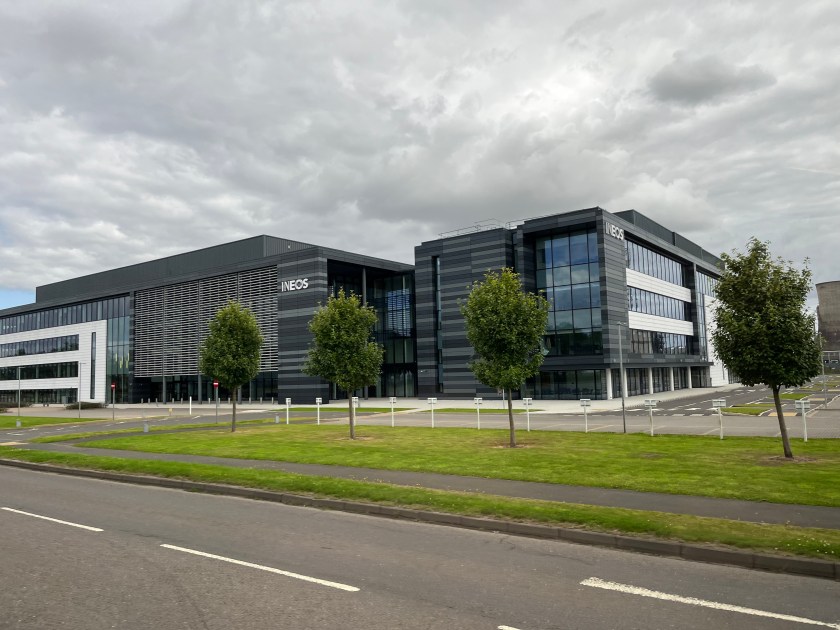
The huge 1700 acre Grangemouth site is owned by billionaire Jim Ratcliffe’s INEOS.  They bought the Grangemouth petrochemical plant and the refinery from BP in 2005.  Then in 2014 the company raided the pension fund originally established by BP and in turn de-recognised the plant unions. The refinery part of the site is now run by Petroineos, a joint venture between INEOS and the Chinese state-owned oil and gas company PetroChina. 

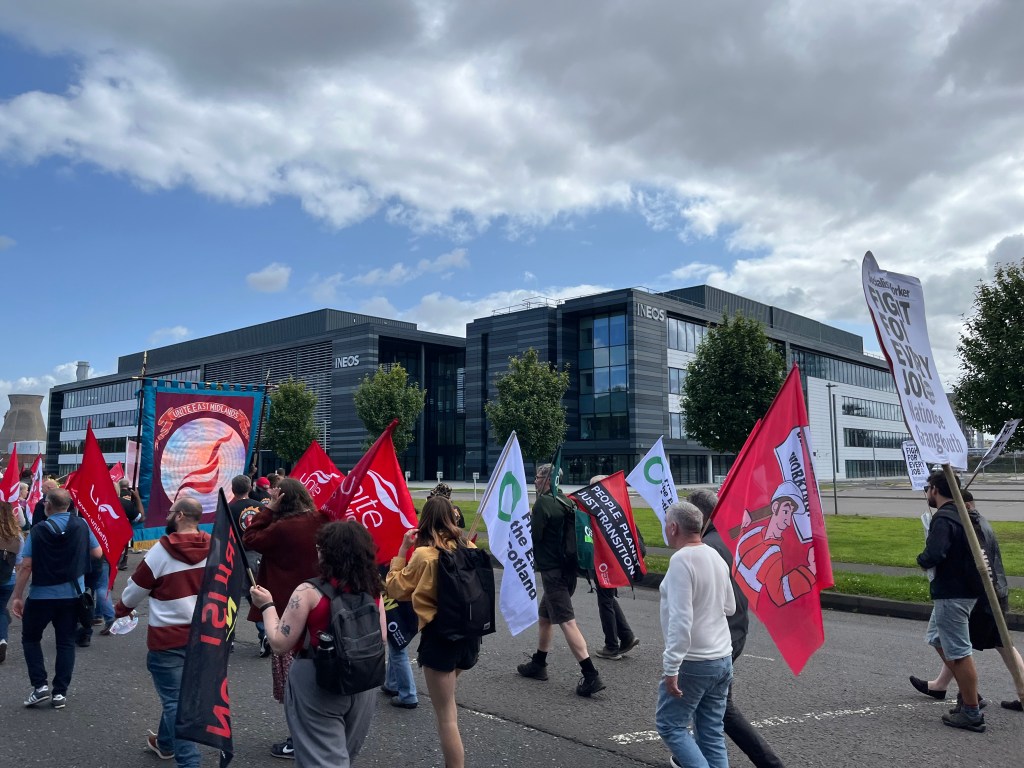
Unite, the main union at the refinery is leading a campaign to ‘Keep Grangemouth Working’.  The union is calling for action to ‘Extend, Invest and Transition’.  On 3 August, they organised a march and rally starting from the Grangemouth stadium on the edge of the INEOS site. Around 600, including refinery workers and their families, and trade unionists from around Scotland and further afield marched to a rally held in a local park.  There were a handful of climate activists.  

At the rally Unite Scottish Regional Secretary Derek Thomson talked about how the union was campaigning locally to raise awareness of the impact that closure would have on jobs and the local economy.  Unite believes that the new Labour Government may be able to persuade Ratcliffe to extend the life of the refinery.  The Tories pledged to provide 700 million Euros in credit to support the development of the new Petroineos refinery in Antwerp and they think that if Labour were to question this it would provide leverage.

Grangemouth is a critical campaign for the climate movement.  There are moments when decisions are made and actions taken, or not made and not taken, that then resonate through the movement and shape its future trajectory.  If the Grangemouth refinery is closed it will be such a moment.  In Scotland another such time was the failure to take the BiFab fabrication yards into public ownership in the autumn of 2017.  The loss of 1400 jobs at BiFab offshore renewables technology yards discredited the idea that action over climate offers opportunities for employment.  The closure of Grangemouth would be not just a blow to the workers, their families and the local economy, it would also send political shockwaves through the climate and workers movements. 

On the march – image Pete Cannell CC0

At the rally on 3 August the speaker from Friends of the Earth Scotland received a great response from the Unite members in the crowd.  It is important that the union and the Grangemouth workers see transition to a sustainable future as a positive goal.  However, there is a real weakness in the current campaign.  Unite’s strategy seems to be based on pressurising INEOS into extending the lifetime of the refinery.  But there’s no evidence that Ratcliffe is interested in doing this or interested in planning for a sustainable transition.  And it’s not that Grangemouth is unprofitable – simply that Antwerp would be more profitable.  None of the speakers at the rally criticised INEOS.  Implicitly or explicitly the focus was on partnership with the company.  

At a time when all the indicators suggest that global heating is increasing faster than the most pessimistic predictions, companies like INEOS and BP are doubling down on investment in fossil fuels.  They aim to make mega-profits while they can.  In these circumstances, when action to decarbonise is overdue, working in partnership with big oil, while talking about the need for transition and social justice is simply greenwashing.  It won’t save jobs, and it sets back progress towards transition.

So, what’s the alternative?  Public ownership, and democratic planning that involves energy workers is essential.  To build the mass campaign that could make this possible the unions and the climate movement need go beyond slogans.  

The private sector is simply not capable of the kind of planning and coordination that is needed to save jobs and manage a just transition. 

Convincing energy workers, winning hearts and minds and building the mass support for public ownership requires brutal clarity about what the oil and gas companies are doing. The profits they’ve made and continue to make, the huge subsidies they continue to attract and the way they expect us to clean up their mess.  Grangemouth has been a site for petrochemicals for a hundred years. Without an enormously expensive cleanup the site is only suitable for industrial use.

Image Pete Cannell CC0

Partnership with INEOS is a dead end.  The company has no loyalty or regard for the workers or the local population.  There’s no guarantee if the refinery closes in 2025 that the rest of the operations on the site will continue much longer, and with it, the loss of over 2,500 jobs.  Ratcliffe expects us to pay the huge cost of cleaning up the site.  And the residents of Grangemouth having lived with the stink and pollution of the plant for decades will remain with a toxic legacy.

But to win hearts and minds and build the campaign there also needs to be a plan for change.  The vast site at Grangemouth could become a hub for a wide range of renewable technologies.  There’s room to establish new facilities, there’s good communications by land and via the Firth of Forth and there is an established workforce and a cluster of further and higher education institutions in the region that could support the development of a new low carbon economy. 

The nature of the plan matters.  At the Grangemouth rally – ex-MP and deputy leader of the Alba Party, Kenny MacAskill argued that Grangemouth could prosper through the development of green hydrogen and carbon capture and storage.  But these are the solutions that are promoted by Offshore Energy UK, the organisation that represents the interests of the UK oil and gas sector.  Both technologies may have some use in the future but the industry focus on them right now is aimed at maintaining oil and gas production, and the infrastructure and systems that support it, for as long as possible.  Opportunities for rapid progress lie in Wind, Solar, Wave and Tidal technologies together with energy storage and a new smart distribution grid.  Ending partnership between unions and big oil also requires a new and critical view of what technologies support jobs and employment and support rapid decarbonisation and a break from the fake self-serving solutions that are advanced by the oil and gas industry.  Which technologies are prioritised is not simply a technical choice but also highly political.

Government accepts “error in law” on coal mine decision!

We’re pleased to be able repost this from South Lakes Against Climate Change. The campaign against the West Cumbria coal mine had been fighting for the last decade. The case for the mine has been in tatters for a long time.

Protest at the site of the proposed mine – image by Pete Cannell CC0

The Secretary of State (SoS) of Levelling Up Housing and Communities (LUHC) has accepted that there was an “error in Law” in the previous decision to grant planning permission for the mine. The Government will therefore not be defending the decision, made in December 2022, to grant planning permission for the new mine, and will argue that it should be quashed.

In a reasoned and careful “Statement of Reasons” the SoS explains that the re-assessment is the result of the Supreme Court’s recent judgement on the “Finch v Surrey County Council” case.  It is now clear that the combustion emissions, i.e. from the use of the Cumbrian coal, should have been assessed as an indirect effect of the new extraction in the Environmental Impact Assessment. 

 If that is agreed by the Court,  the planning application goes back to the SoS to make a fresh decision.

This is HUGE news. We don’t know what West Cumbria Mining will do, but we are pretty sure that the Hearing of our legal challenges will open on the 16th July as scheduled. Only the Court can quash the planning consent, and that is what we are hoping for.

Solidarity with GKN workers – join r+f delegation to Florence

From REELNews

GKN: Rank and file trade union delegation to Florence, are you interested?

Reel News are planning a rank and file trade union delegation from the UK to visit the GKN factory in Florence; not just to show solidarity to this important struggle, but also to spread the workers’ visionary ideas back here. And with thousands of jobs under threat at Port Talbot steel works (of which more below), and Grangemouth oil refinery due to close in 2025 with the loss of another 400 jobs, we can all learn a lot from what’s happening at GKN.

Many of us have been warning for years that if we don’t start planning a just transition away from fossil fuel production, it’ll be imposed on us – and thousands of workers will be thrown on the scrapheap. Now that’s starting to happen, it’s never been more urgent to fight for the alternative: a green future that would create literally millions of jobs globally as well as saving the ones currently under threat.

We’re still waiting to hear back from the GKN workers when would be a good time to visit, but at the moment we’re thinking maybe mid April, depending on how things develop. We want to time the visit for either a big mobilisation/demonstration, and/or if they actually start production under workers control. So the timing might well change. But for the moment, get in touch at info@reelnews.co.uk if someone from your workplace is interested in coming – and especially if you want to help with organising the trip too.

Obviously we’re looking at taking workers directly involved in fossil fuel industries, but every sector needs to make plans for a just transition (click here for a film detailing ideas that came out of a union workshop on a just transition for the hospitality sector for example), so please get in touch if you’re interested wherever you work.

The bosses have now agreed to delay the sackings until at least June 2024, after a NYE party packed out the factory with 7,000 people; and in the past month they’ve DOUBLED the money raised in popular shares to over 600,000 euros.

So now the workers have extended the share scheme until June – and are now very confident they can raise the full million euros. So if your trade union branch, organisation, or even a group of friends want to support this visionary project, there’s still plenty of time. Share packages start from 500 euros.

You can find details of how to take part here, and see the end of the video for more ways you can help. As the workers say, they can’t create an alternative model to capitalist fossil fuel production in just one factory – but they can create an example of what is possible.