Alchemy and imperial delusion: the ideological spell of nuclear power: part 1

Why is nuclear power, a persistently failed energy technology, still so important to the British ruling class.

This article by Scot.E3 activist Brian Parkin was first published on the rs21 website on July 22, 2023. It (and its second part) provides useful background for the discussion on nuclear power that took place on October 18 2025 at the Scot.E3 conference.

A view of the Torness nuclear power station - white concrete buildings
Torness – the remaining operational nuclear power plant in Scotland

The Attlee Labour government of 1945-50 was committed to both a radical social policy programme at home and a colonial-imperialist continuity project abroad – the latter very much approved of by the British ruling class. Before the end of World War II, allied summit conferences at Moscow, Tehran and Yalta had produced a post-war agreement on ‘spheres of influence’ where the USA, USSR and Britain would control their respective allies, colonies, protectorates or dominions as spoils from their joint wartime efforts. But this was not an alliance of equals: the USSR was economically devastated, Britain was economically exhausted, while the USA was on the edge of what was to become the biggest and most protracted economic boom in the history of capitalism.

The USA had also, via the ‘Manhattan programme’, acquired the most devastating weapon ever – the nuclear bomb. Despite the involvement of UK scientists, the USA was initially not prepared to share its bomb making secrets with Britain. And furthermore, the USA was against the UK and France retaining their colonial empires.

A whiff of hydrogen

A clandestine British nuclear programme had begun in 1940, and with the involvement of British scientists in the US nuclear project, the idea of ‘catching up with the Yanks’ almost counterbalanced the losing of empire, and led to hopes of a recovery of imperial status by other means. So it was not long before construction began on a nuclear facility at Windscale in Cumbria (renamed Sellafield in 1981), along with what was initially the highly secret facility at Aldermaston in Berkshire.

These developments arose from a secret decision taken by a small meeting – GEN 75, in January 1947 – when despite an austerity economy it was agreed that the UK should defy the USA’s intransigence and go ahead with its own nuclear weapons programme. As Ernest Bevan, Foreign Secretary and former right wing union boss said: We’ve got to have this thing over here. We’ve got to have the bloody Union Jack on top of it!’

By 1950 a reactor at Windscale had produced highly fissionable uranium235 (the ‘active ingredient’ of an atomic bomb), and by 1952 had produced enough for the first British bomb test on October 3 that year. Then, by stepping up its Magnox reactor programme, Britain was able to produce sufficient plutonium239 for a hydrogen bomb test on May 15 1957. But this came at a high cost. On October 10 1957 Unit One of a Magnox reactor core became over-critical, to the extent that its graphite core caught fire, and for three days released the highly dangerous isotope iodine131 to the outside atmosphere, which on a conservative estimate caused over 400 cancer deaths.

News of this incident was kept confidential, mainly to prevent information getting to a USA government unconvinced that Britain would be a reliable nuclear partner. This was a particularly important as by then a considerable proportion of the plutonium for the USA’s weapons programme was coming from the UK Magnox reactors.

Meanwhile…British insecurity

In 1945, largely at the instigation of the USA, the United Nations held its inaugural session in California. As the war’s biggest victor, the USA wanted to legislate for a world fit for American capitalism. The United Nations gave this a semblance of legitimacy, though it was dominated by a Security Council mostly composed of American allies. And although Britain was on the Council, fear for its fading imperial lustre spurred the Labour government to press ahead to become a paid-up member of the ‘nuclear club’.

But nuclear club membership was nothing without a means of delivery. So in 1947 the government instructed the Royal Air Force to issue specifications and tenders for a new generation of jet-powered long-range, high altitude bombers capable of carrying and dropping nuclear bombs on what, by now, were going to be Russian targets.

Thunderbirds are GO! Britain’s ‘V Force’

By 1952 the UK’s first nuclear-capable bomber – the Vickers Valiant – flew. At that time, the intention was to keep at the forefront of a Western first-strike nuclear alliance, while never forgetting the longer-range requirements of rule over what was left of the empire, and the Commonwealth – hence the presence of V bombers in Rhodesia (the colonial name for Zimbabwe) and Malaysia as late as the mid-1960’s.

By 1964, the RAF had an incredible 159 total of Valiant, Vulcan and Victor bombers, each capable of being airborne in three minutes and in Russian airspace within 72 minutes. However, Russian air-defences had improved to the extent that the V bombers’ maximum altitudes rendered them sitting ducks by around 1965. So then a medium-range series of joint US/UK air launched missiles was considered, only for the US to pull out of the project. The Vulcans last flew in the Falklands war in 1982, carrying out a long-range and not very successful bombing of Port Stanley Airport, before being taken out of service.

‘Atoms for Peace’

On August 27 1957, a small Magnox reactor on the Calder Hall site at Windscale had some of its secondary coolant steam diverted through a turbine to mark the beginning of the world’s civil nuclear power age. The initial contribution to the National Grid was an intermittent four megawatts (then enough to power some 4,000 homes). The idea of nuclear power from a weapons grade plutonium reactor had arisen due to the sheer waste heat given off, and the huge effort required in cooling the process to a safe level.

This ‘seminal’ event was the first step to what was untruthfully called a peaceful civil nuclear power age. What it rather was, was the continuation of a plutonium programme with a significant power byproduct. The military-civil linkage was still intact – as was the superpower nuclear delusion which had spawned it.

Hedging the nuclear bet

The modest Calder Hall event gave rise to a speculative frenzy of nuclear optimism. The very idea of power from nuclear fission created an aura of technological supremacy, and the illusion that Britain could become a leadership nation unafraid of the challenges of power and the military means of exercising it. Because something like that kind of ideological hubris must have fuelled what came next.

In 1959 it was agreed to proceed with a nuclear power programme with a technology ‘proved’ by the Magnox experience at Windscale. This meant a generation of new reactors fuelled by ‘natural’ uranium with graphite moderated cores and with a primary carbon dioxide cooling system. But although the main aim of the new Magnox stations was the production of electricity, some plutonium would be a secondary byproduct.

At this point it is worth recalling the political/economic situation the fading British empire had to face. In 1956, a failed military intervention by Britain and France had failed to resolve the ‘Suez crisis’, sparked by the fear of losing of the Suez canal as a gateway to Asia and Gulf oil supplies. At this point a government committee decided that for energy security reasons, it was decided that Britain would require 6,000 megawatts of nuclear capacity by 1965.

This bizarre reasoning – Britain did not use oil for power generation – was primarily rooted in a ruling class paranoia, which saw nuclear power capacity as protection against a possible miners’ strike. Here nuclear power provided balm to a fading imperial delusion and a deep and abiding fear of organised labour. In Part 2 we shall see how ignorance, hubris and fear continue to fuel the British nuclear tragi-comedy.
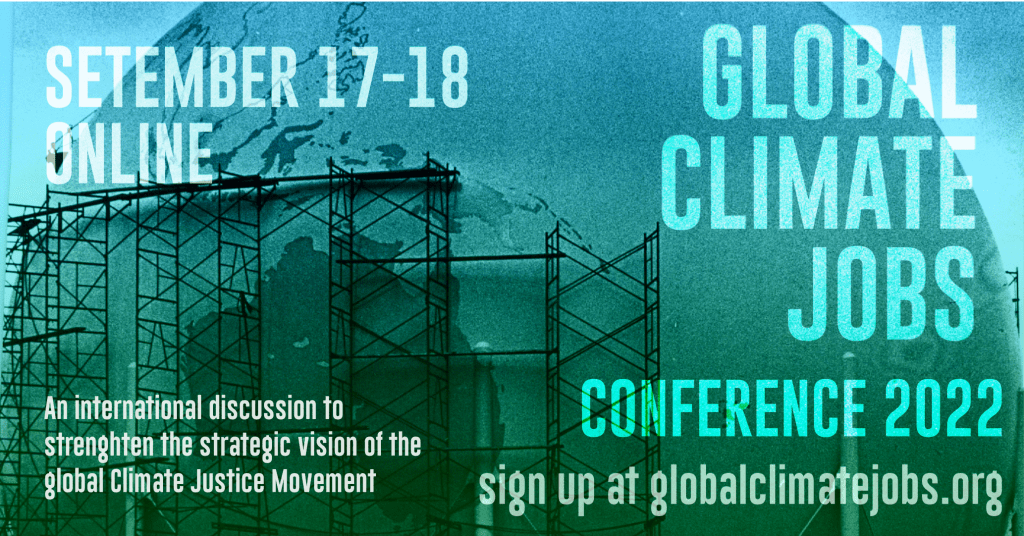
Global Climate Jobs Conference 2022

ScotE3 is part of the Global Climate Jobs network and we hope you’ll be able to attend all or some of the 2022 conference.

Register through the link here: https://forms.gle/i3W1ycKEz74TSMME7

We know that the points of convergence between the labor and the climate movements are immense, but that several challenges lie ahead of us. It is nevertheless of extreme importance and urgency to cut emissions and do so by drawing on plans that are created by the workers and communities and in regard to their interests and needs.

Often, we do know what work needs to be carried out in order to cut emissions, but workers are being left out of the discussion and climate science is being disregarded. We need to build a movement that not only is capable of setting its own program, but that has the power to implement it.

As so, we are bringing together people from all around the world, and bringing together the labor and climate movements to discuss how we win a program that can allow us to stop climate collapse. Join us for two days of thematic sessions about the strategies, technical and social perspectives, and challenges we face in building Climate Jobs Campaigns.

Invited speakers:

  • Negrai Adve; 
  • Max Ajl;
  • Chris Baugh; 
  • Jeremy Brecher; 
  • Leonor Canadas; 
  • Claire Cohen;
  • Rehad Desai; 
  • Patricia De Marco; 
  • Suzanne Jeffries; 
  • Paul Le Blanc; 
  • Josua Mata; 
  • Suda Sim Meriç; 
  • Jonathan Neale; 
  • Andreas Yetterstad 

Schedule

All the sessions will be recorded and available online. Sessions will be 1 hour and 30 minutes and will be composed of a introduction by the invited speakers and a workshop space between the participants.

Saturday, September 17

12:00 GMT [5 pm ET] – General Session: Strategic Orientation

14:00 GMT [7 pm ET] – Special Sessions

1) Building Climate Jobs Movements

2) Food and Farming

16.00 GMT [11 pm ET] – Special Sessions

1) Ecofeminism

2) Racism and Refugees

Sunday, September 18

12.00 GMT [5 pm ET] – General Session: Workers in the Fossil Fuel industry

14.00 GMT [7 pm ET] – Special Sessions

1) Cutting Emissions

2) Resilience

16.00 GMT [11 pm ET] – General Session: Summing Up

Global Climate Jobs Conference 2022

Call for INTERNATIONAL CONFERENCE:  

Climate Jobs, Climate Crisis and Green New Deals 

What, Where & When 

The Global Climate Jobs Network is organising an online international conference Friday June 3 to Sunday June 5, 2022. This will be online to make it easy for activists and organisations to participate from all over the world. 

Themes 

The theme is Climate Jobs, Climate Crisis and Green New Deals. But we are open to sessions on related topics linked to community, union and other climate justice struggles. If you are not sure if your topic would fit, send it anyway and we can chat it over. 

Who 

Our Global Climate Jobs Network will be coordinating the conference. But we want organisations to propose and present your own sessions. 

We are looking for sessions from different organisations, from national unions to local branches, from international networks to national campaigns. From environmental and climate justice community campaigns to local Fridays for the Future groups, student unions, social movements, feminist and LGBT groups, faith groups, farmers and fisherfolk organisations and Green New Deal campaigns and from groups of scientists and engineers. 

We especially want to provide a platform for those fighting for climate justice now and we particularly want to hear about the struggles of the peoples of Africa, Asia and Latin America. 

How 

You can run a session based on your own organisation or you can put forward speakers and we will link them up with speakers from other organisations on similar themes or from the same country. 

We also want to encourage artistic sessions using, music, film, and anything that tells your story and makes the event more like an online festival of resistance, ideas and solidarity. 

You can propose sessions in any language, and you can propose two sessions in different languages. 

We will timetable all the sessions and try to arrange them so you can follow different themes. 

Sessions will last 75 minutes. We suggest no more than three speakers, and at least half of the time is taken up by contributions from the audience and in breakout groups. If you have three speakers, please have at least one be a woman. If you cannot find an appropriate woman speaker, please write to us and we will try to put you in touch with someone. 

What’s Next 

To propose a session or a speaker, to ask a question or talk to someone on the organising committee, please write to: Climatejobs2022@aol.com  

Sponsoring Groups (list in formation):

Global Climate Jobs Network 

Climaximo (Portugal)  

ScotE3 (Employment, Energy and Environment – trade union and environmental activists in Scotland) 

Review of African Political Economy  

AIDC (Alternative Information and Development Centre – South Africa) 

Million Climate Jobs Campaign (South Africa)  

Pittsburgh Green New Deal (USA) 

SENTRO (Sentro ng mga Nagkakaisa at Progresibong Manggagawa – labour federation in Philippines) 

Global Climate Jobs Network – Technical Conference

ScotE3 has been working with other organisations in the Global Climate Jobs Network, the Alternative Information and Development Centre (South Africa) and Climaximo and Empregos para o Clima (Portugal), on a proposal for a technical conference to be held in March 2022.

Call for Papers

Climate jobs and green new deal movements are springing up around the world. This is a call for papers for an international conference on the technical aspects of the jobs that will be necessary, in 10th, 11th and 12th March 2022.

The conference will be on zoom, over three days, and contributors will be able to participate from all continents. We want papers from engineers, scientists, system modellers, designers, architects, planners, educators and trainers, foresters, soil scientists, trade union researchers, NGO researchers and other specialists.

The Climate Jobs Approach

We want contributors to think about the technical and technological implications of a “climate jobs” approach. This approach involves several features:

Massive government spending on public sector, direct employment to make possible reductions of 95% in CO2 emissions, and deep reductions in other emissions, within 20 years. In South Africa or Britain, this would be something like one million jobs a year, or in the United States 8 million jobs.

People who lose their jobs in old, high carbon industries would be guaranteed training and well paid, permanent work in climate jobs.

The work would begin from year one, starting with training a new workforce and shovel ready projects. Over twenty years many new technologies would become possible.

Public sector bodies would share intellectual property across borders.

Profits would be less important. Technologies that are necessary but currently “unrealistic”, could be developed rapidly at scale even if the cost was very high for many years. For example, alternative methods of making steel, substitutes for cement, or expensive forms of renewable energy like marine power and concentrated solar could enter mass production.

We could also move beyond the market, with regulations of many sorts. So we could think about the sort of rail, bus and electric system needed if all flights of 5,000 kilometres or less were banned. Or what could be done if we banned the manufacture of concrete, or F-gases?

Or contributors to think about the details, and the implications, of a building code that required new buildings to have greatly reduced energy use, and to burn no fossil fuels for heating or cooking. In this, we would like not only papers that argue this would be a good idea but think about how that code would be worded in different places, and what technologies and materials would be required, and what research would be required.

For more information about the conference, possible topics, how to participate and the deadline for submitting abstracts please download the full call for papers.