
Our latest briefing (number 12) explains what COP 26 is and discusses some of the issues that it raises. Like all our briefings it’s designed for downloading, sharing and distributing in workplaces and community settings.
What is the COP?
COP stands for ‘conference of the parties’. Organised by the United Nations, it’s normally held on an annual basis and it is the place where the nations of the world come together to discuss policy on climate action. So to give it its’ full title COP26 is the 26th annual Conference of the Parties to the United Nations Framework Convention on Climate Change.
COP 26 was due to take place in Glasgow in November 2020. However, the actual event is always preceded by a number of inter-governmental meetings. These have not taken place because of the global pandemic and as a result it has been postponed until 2021. The new date is not yet known. At the moment Glasgow is still expected to be the venue.
A history of failure
The first COP was held in 1995 in Berlin. It has taken place every year since then. 2020 will be the first year that a COP has been postponed. In terms of making an impact on greenhouse gas emissions the COPs have been an abject failure. The two most common greenhouse gases are carbon dioxide (CO2) and methane. When COP 25 took place in Madrid at the end of 2019 the amount of carbon dioxide in the atmosphere had risen 67 parts per million by volume (ppmv) above what it was when the first COP met in Berlin. To put this in perspective CO2 levels increased by more during the 25 years of COP discussions than they had in the previous 200 years. Methane levels have tripled since 1995. Greenhouse gases act like an insulating blanket over the earth’s atmosphere and are responsible for rising global temperatures. So the massive increase in the amount of these gases in the atmosphere is the reason why the climate crisis is now acute and why rapid action to cut emissions is so important.
The Paris Agreement of 2015
Back in 2015 the COP (21) took place on Paris. The conference ended with an agreement that has since been ratified by 189 out of the 197 countries that participated (The Paris Agreement). Ratification committed countries to developing plans that would curtail global temperature rise to less than 2 degrees centigrade. Those who have not ratified include some important oil producers. Moreover, the USA ratified under Obama but has now withdrawn.
In principle ratifying the Paris Agreement commits countries ‘to put forward their best efforts through “nationally determined contributions” (NDCs) and to strengthen these efforts in the years ahead.’ The reality has been that progress has been negligible. The agreement is essentially voluntary and avoids specific targets. Patrick Bond notes the ‘Agreement’s lack of ambition, the nonbinding character of emission cuts, the banning of climate-debt (‘polluter pays’) liability claims, the reintroduction of market mechanisms, the failure to keep fossil fuels underground, and the inability to lock down three important sectors for emissions cuts: military, maritime transport and air transport.’

COP 26
Along with committing countries to regular reporting on progress the Paris Agreement also scheduled 2020 and COP26 as a major milestone at which all the countries would need to assess progress. Had the COP gone ahead in November an honest assessment could only have been that the Paris Agreement has been a failure. The failure will have intensified by the time COP26 takes place in 2021. No one should have high expectations that COP26 will take action to address this failure but it is an important opportunity for the climate movement to hold the rulers of the world to account. Success for our side must mean a bigger, stronger, better-rooted movement that develops the strength to insist that governments take action.
COP fault lines
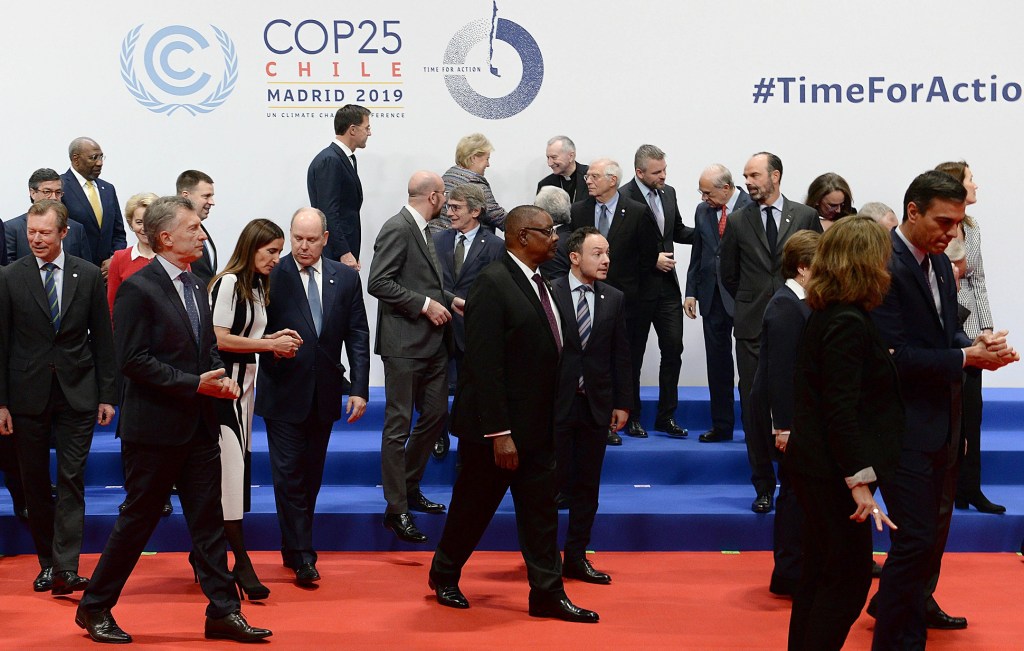
The COP is dominated by the big powers. So in the negotiations there are sharp divisions between the major industrial nations that are responsible for most greenhouse gas emissions and the global south, which endures the biggest impact of climate change. These divisions were much in evidence at COP 25 in Madrid. At the COPs and in the run up to them there is also a great deal of activity from non-state organisations. Businesses, NGOs and union federations lobby before the event and can obtain credentials that enable them to be within the main conference areas. There is of course a huge imbalance in resources between the corporate lobbyists and the climate campaigners. Groups that represent women, indigenous people and poor people struggled to have their voices heard within the conference – indeed in Madrid some were excluded for holding a peaceful protest. The climate movement is mostly excluded from the conference zone by barricades and police; we make our case on the streets and in meetings and the counter summit. This will be the case in Glasgow.
Why should we organise for the COP?
From the start the COP process has operated within the domain of market economic orthodoxy. Crudely it has assumed that market forces will drive a move towards less carbon intensive technologies and hence reduce greenhouse gas emissions. There have indeed been significant developments in sustainable technologies – particularly wind and solar. And yet at the same time the big energy companies have also pursued a ruthless drive to exploit new hydrocarbon resources in a way that is completely incompatible with even the most modest targets for limiting global warming.
COP 26 will take place in 2021 in the economic and social aftershocks of a global lockdown as a result of the Covid-19 pandemic. Mobilising for the COP is necessary because the event will be the occasion for a huge onslaught of ‘greenwashing’, aimed at persuading us all that the leaders of the world know best, and that the market, ‘business as usual’, can protect us. Now more than ever we know that ‘business as usual’ is not simply ineffective in face of global crisis, it costs lives. So building for mass protest in Glasgow is necessary, but is only part of the ongoing struggle to win a just transition to a people centred zero carbon economy.


 Employment, Energy and Environment