
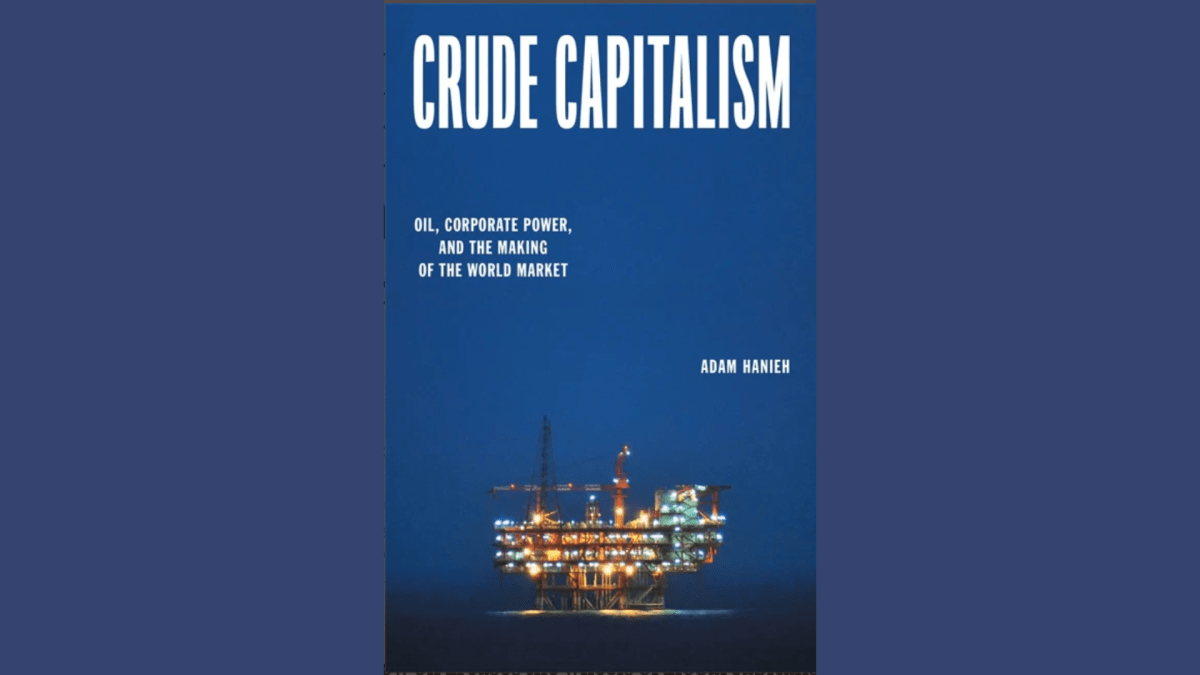
REVIEW | CRUDE CAPITALISM
Pete Cannell • January 19, 2025
What has oil got to do with the history of the global capitalist economy? Pete Cannell reviews Adam Hanieh’s account.
A version of this review was published originally on the rs21 website.
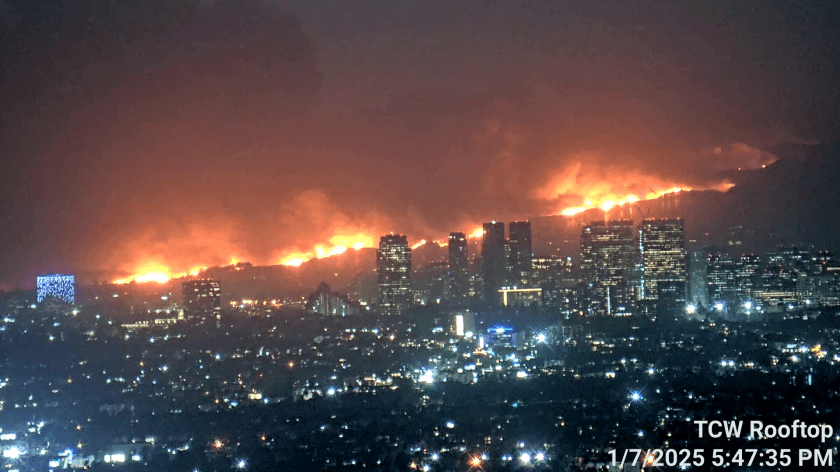
The first commercially successful oil well in California was tapped in 1876 at Pico Canyon in Los Angeles County. Oil extraction and oil profits spurred the rapid growth of the city of Los Angeles. As I write this review 150 years later, LA is on fire. Crude Capitalism – Oil, Corporate Power, and the Making of the World Market charts the development of the oil industry from its early beginnings and shows how its history is intermeshed with the development of the world economy. It’s a book about oil, about the climate crisis and the environment, about economics and the dynamics of the capitalist system. The Los Angeles fires are one more instance, and not even the most destructive, of the global impact of rising temperatures and changing weather patterns. If you want to understand how oil and capitalism link events in 1876 and 2025 and the forces that shaped and continue to shape our world, then Crude Capitalism is a must read.
In 1995 the rulers of the world met in Berlin, ostensibly to tackle the threat of global warming. In the following three decades more carbon dioxide has been added to the atmosphere than in the previous two hundred years. In the same period annual methane emissions have more than tripled. This exponential increase in greenhouse emissions should not be a surprise. Hanieh begins the first chapter of the book by noting that a decade before the first COP, the International Geosphere-Biosphere Programme (IGBP) was already investigating the connection between human activities and changes to the earth’s biological, chemical, and physical systems. When their report was published in 2004, they noted that
The second half of the twentieth century is unique in the entire history of human existence on Earth. Many human activities reached take-off points sometime in the twentieth century and have accelerated sharply towards the end of the century. The last 50 years have without doubt seen the most rapid transformation of the human relationship with the natural world in the history of humankind.1
Crude Capitalism sets out to explain why the mid-twentieth century was such a critical turning point and why despite decades of blah blah blah (to quote Greta Thunberg) the exponential increase in global greenhouse emissions continues.
The core of the book is a chronological account of the development of the oil industry from its early beginnings until the present day. The story begins in the United States in the late 1890s. The second chapter explains how the rapidly developing oil industry became dominated by huge vertically integrated corporations such as Standard Oil. The structure of the new industry owed a lot to the particularity of US property law. The oil majors consolidated their grip through cartels and oligopolistic structures. These modes of organisation were adopted internationally in the decades that followed. A theme that runs through the book is the way in which the oil industry has become global, growing and adapting and often acting as a trail blazer for innovation in organisation and new techniques of capitalist exploitation. An example of this, in the British context, is the privatisation of the North Sea oilfields, which was at the forefront of the neoliberal reconstruction of the British economy.
With World War I, the focus of the book moves to the Middle East and Russia. One of the great strengths of the book is the way in which it deals with imperialism and how economic and military competition ties the global oil industry and the global arms industry together in an embrace of exploitation and callous destruction of the environment and possibilities for genuine human development. World War I generated a massive increase in demand for oil. The British Navy transitioned to an oil-based fleet. Britain’s colonial activities in the Middle East and its role in dismantling the Ottoman empire were critical for Britain to meet its growing demand for oil. It met this demand by developing new oil fields in Iran and Iraq. Collaboration between US big oil and British colonial interests in this new arena of exploitation paved the way for the US majors to go global.
The real acceleration in oil production, chronicled brilliantly in the central part of this book, came after World War II, when European economies joined the developmental path already well established in the US. At this point, the use of oil as a feedstock for plastics and synthetic fertilisers took off on a mass scale. Oil’s initial success lay in its energy density – a given volume of oil provides far more energy than coal or wood – but over the course of the second half of the twentieth century the ubiquity of plastics meant that, in Hanieh’s words, ‘commodity production had become a derivative – or a by-product – of the production of energy.’ This transformation of commodity production to a system powered and based on oil remains the dominant system in the global economy. This continuing domination is the reason why greenhouse gas emissions continue to rise.
In the last decade the US has once again become the largest single national producer of oil and gas. Yet at the same time as the Chinese economy has grown, the centre of gravity of the global industry has shifted east to Asia and new interdependencies have grown between Asia and the Middle East. 22 years after George Bush declared victory in Iraq, the largest oilfield in that country is run by a private Chinese company. But there is also a shift in power from private to state capital: the three biggest oil firms in the world are owned by the Chinese and Saudi Arabian states.
Crude Capitalism is withering in its critique of the oil industry’s corporate greenwashing. Hanieh notes, for example, that BP’s erstwhile rebranding as ‘Beyond Petroleum’ involved spending ‘more on the corporate rebrand than it did on renewable energy.’ The rebrand was short-lived and while many of the big companies are increasing their investment in renewables the rate of increase in investment in hydrocarbons is even faster. Twelve of the biggest companies plan to spend more than $100 million a day on new hydrocarbon projects up to the end of the decade. In addition, the industry is using its power and wealth to push technofixes that are often of limited or no utility for reducing greenhouse gas emissions but allow for the continuation of the infrastructure and systemic economic relations of fossil capital. In Britain the industry body Offshore UK has rebranded itself as Energy UK and its focus on Carbon Capture and Storage and Hydrogen is slavishly followed by the British government.
Adam Hanieh is absolutely clear about the obstacle that big oil continues to present:
Oil, in other words, remains at the core of our economy and our energy systems; without dislodging it from this position there is no possibility of ensuring a future for humanity.
The strength of Crude Capitalism is that it shows how the oil industry is the result of a system that always puts profit first. The final paragraph sums it up:
We cannot behave as if the problem of capitalism does not exist, or can be ignored, or as if our current rulers can be convinced to take an alternative path through the sheer force of scientific evidence. This is an irrational economic system that pits the interests of a tiny few against the vast majority, and only by taking political and economic power away from the logic of the market will it be possible to build a different and better world.
[1] Will Steffen et al., Global Change and the Earth System: A Planet under Pressure, Berlin: Springer, 2004, 81.



 Employment, Energy and Environment