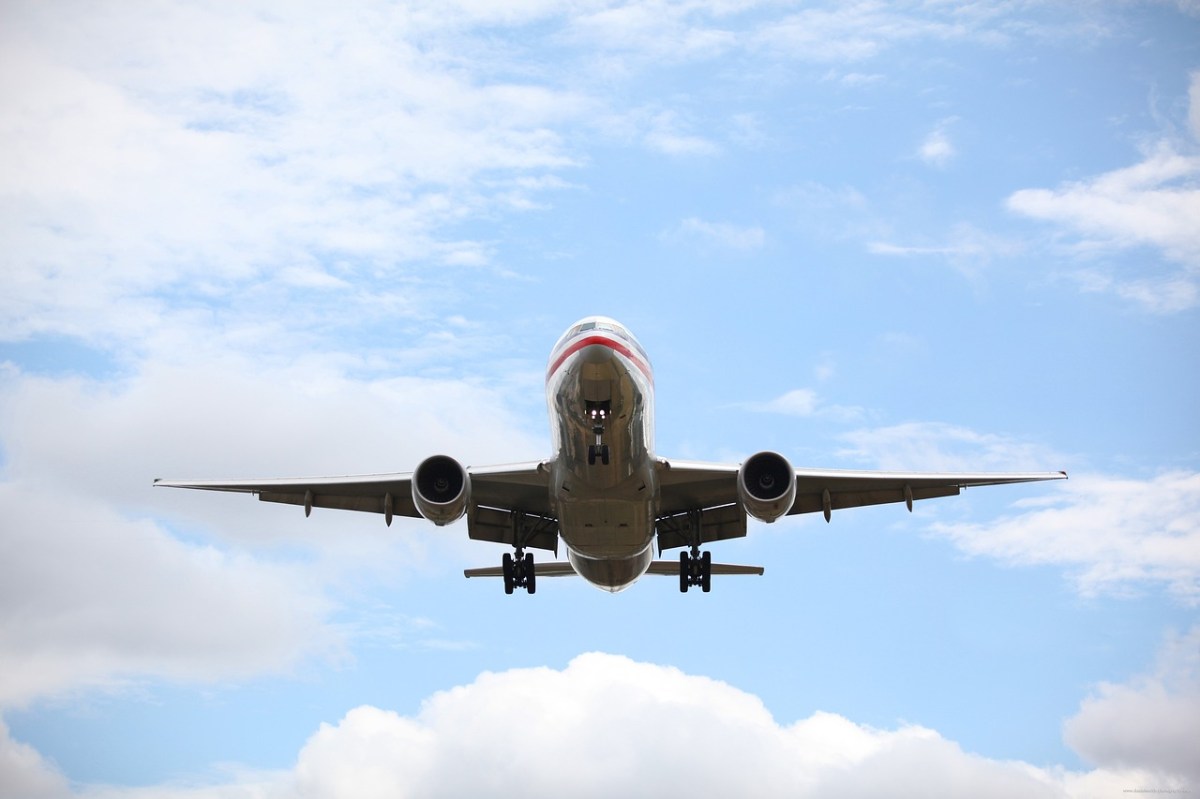
New Briefing: Sustainable Aviation Fuel

Briefing 18 takes a critical look at ‘Sustainable Aviation Fuel’ and the Westminster government’s Jet Zero plan.
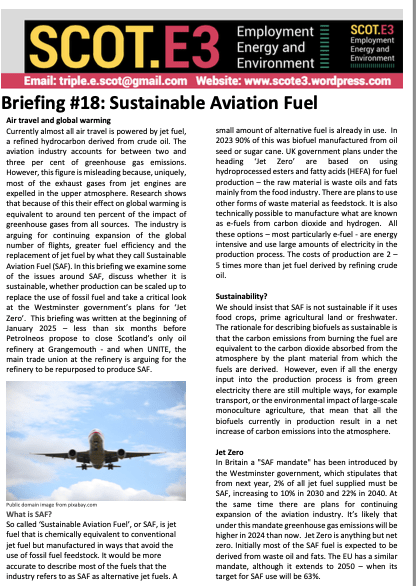
Briefing 18 takes a critical look at ‘Sustainable Aviation Fuel’ and the Westminster government’s Jet Zero plan.

Click on the image to download the briefing

Air travel and global warming

Currently almost all air travel is powered by jet fuel, a refined hydrocarbon derived from crude oil. The aviation industry accounts for between two and three per cent of greenhouse gas emissions. However, this figure is misleading because, uniquely, most of the exhaust gases from jet engines are expelled in the upper atmosphere. Research shows that because of this their effect on global warming is equivalent to around ten percent of the impact of greenhouse gases from all sources. The industry is arguing for continuing expansion of the global number of flights, greater fuel efficiency and the replacement of jet fuel by what they call Sustainable Aviation Fuel (SAF). In this briefing we examine some of the issues around SAF, discuss whether it is sustainable, whether production can be scaled up to replace the use of fossil fuel and take a critical look at the Westminster government’s plans for ‘Jet Zero’. This briefing was written at the beginning of January 2025 – less than six months before PetroIneos propose to close Scotland’s only oil refinery at Grangemouth – and when UNITE, the main trade union at the refinery is arguing for the refinery to be repurposed to produce SAF.

Marching to save jobs at the Grangemouth refinery

What is SAF?

So called ‘Sustainable Aviation Fuel’, or SAF, is jet fuel that is chemically equivalent to conventional jet fuel but manufactured in ways that avoid the use of fossil fuel feedstock. It would be more accurate to describe most of the fuels that the industry refers to as SAF as alternative jet fuels. A small amount of alternative fuel is already in use. In 2023 90% of this was biofuel manufactured from oil seed or sugar cane. UK government plans under the heading ‘Jet Zero’ are based on using hydroprocessed esters and fatty acids (HEFA) for fuel production – the raw material is waste oils and fats mainly from the food industry. There are plans to use other forms of waste material as feedstock. It is also technically possible to manufacture what are known as e-fuels from carbon dioxide and hydrogen. All these options – most particularly e-fuel – are energy intensive and use large amounts of electricity in the production process. The costs of production are 2 – 5 times more than jet fuel derived by refining crude oil.

Sustainability?

We should insist that SAF is not sustainable if it uses food crops, prime agricultural land or freshwater. The rationale for describing biofuels as sustainable is that the carbon emissions from burning the fuel are equivalent to the carbon dioxide absorbed from the atmosphere by the plant material from which the fuels are derived. However, even if all the energy input into the production process is from green electricity there are still multiple ways, for example transport, or the environmental impact of large-scale monoculture agriculture, that mean that all the biofuels currently in production result in a net increase of carbon emissions into the atmosphere.

Jet Zero

In Britain a “SAF mandate” has been introduced by the Westminster government, which stipulates that from next year, 2% of all jet fuel supplied must be SAF, increasing to 10% in 2030 and 22% in 2040. At the same time there are plans for continuing expansion of the aviation industry. It’s likely that under this mandate greenhouse gas emissions will be higher in 2024 than now. Jet Zero is anything but net zero. Initially most of the SAF fuel is expected to be derived from waste oil and fats. The EU has a similar mandate, although it extends to 2050 – when its target for SAF use will be 63%.

Practicality/Scalability

A report published in May 2024 by the Institute for Policy Studies analysed Jet Zero, aviation industry plans and other initiatives and found that there is currently “no realistic or scalable alternative” to standard kerosene-based jet fuels. Jet Zero is not about a transition to a sustainable low carbon industry, and it’s based on fanciful assumptions. There are severe limits to its scalability due to the limited supply of used cooking oil and animal fat. British airlines will be in competition for these supplies with others around the world. For example, in the EU there is only enough supply for about 2% of current demand. It’s also in competition with the production of bio diesel for road haulage which uses the same feedstock. The scale of the gap between Jet Zero and net zero is illustrated by the fact that even with current levels of flights 50% of all agricultural land in Britain would have to be devoted to the production of biofuel to eliminate the need for fossil fuel. If crop-based biofuel is ruled out and SAF were to be produced from other forms of waste as well as cooking oils, it’s estimated that if all the useable waste in the UK was converted to SAF it would still provide less than 20% of the fuel demands from outgoing flights.

Conclusion

UNITE’s plan for the Grangemouth oil refinery suggests that there is an assured future as a biofuel hub for Britain. As we write the details of the plan are not publicly available. We can only assume that they are based on the faulty logic of the British government’s Jet Zero report. Sadly, these figures just don’t add up. There is a powerful case for a plan to support the Grangemouth workforce into a sustainable future, but Jet Zero is an illusion. SAF is not a magic bullet. Current technologies are not capable of meeting the fuel demands of the aviation industry. E-fuels are potentially scalable, but the costs are prohibitive. We will discuss what is to be done about aviation in a future briefing.

Click the link to download Briefing 18

You might also want to look at Briefing 10 – ‘Bioenergy with carbon capture and storage (BECCS)’ and Briefing 17 – Net Zero

All of the ScotE3 briefings can be downloaded from this site’s resources page.
Why the world’s first flight powered entirely by sustainable aviation fuel is a green mirage

This article by Josh Moos and Gareth Dale was first published under a Creative Commons License in The Conversation on 28th November 2023

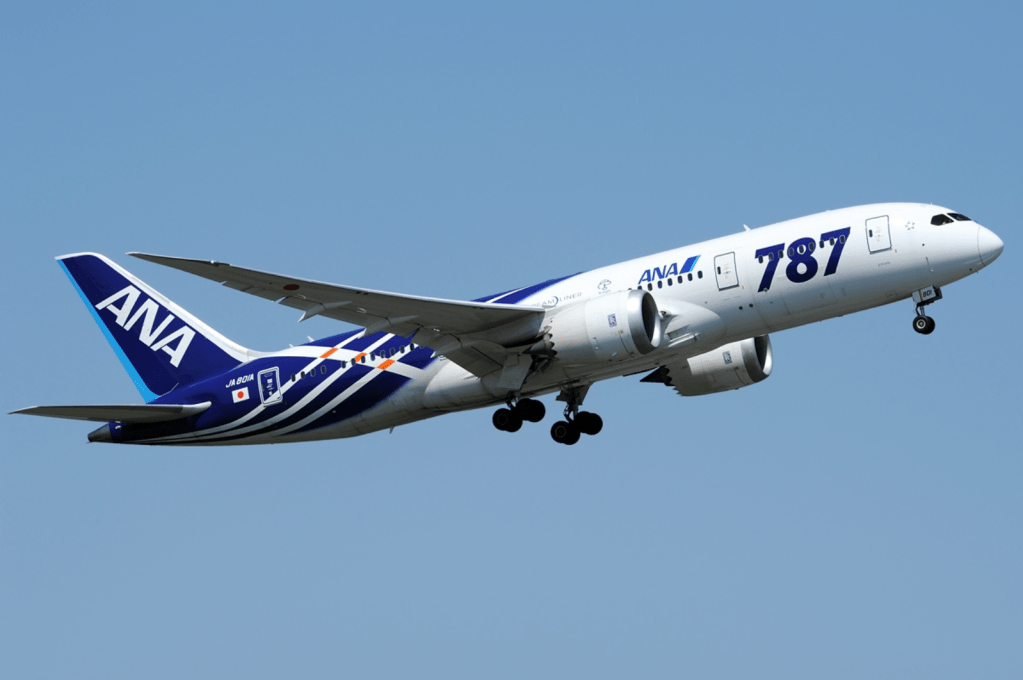
A Boeing 787 Dreamliner is set to take off from Heathrow on November 28 and head for JFK airport in New York, powered by so-called sustainable aviation fuel (SAF). According to its operator, Virgin Atlantic, the world’s “first 100% SAF flight” will mark “a historic moment in aviation’s roadmap to decarbonisation”.

Dreamliner https://commons.wikimedia.org/wiki/File:Boeing_787-8_Dreamliner,_All_Nippon_Airways_-_ANA_AN2105773.jpg

It is proof of concept, we are led to believe, of the dawn of “guilt-free” flying. Unfortunately, we have been here before, and the results last time were anything but green. 

Based on our research into how wealth and power shape the environment, we argue that continued growth of the aviation sector, as with the economy in general, is incompatible with preventing runaway climate change. The technology currently being developed by the aviation industry has zero chance of changing that. And the fuels being used in Virgin’s latest experiment are not significantly more sustainable than those in its previous attempt.

Virgin’s sustainability initiative dates back to the 2000s, when British business magnate Richard Branson was at the helm. In 2008, to some fanfare, a Virgin aircraft flew from London to Amsterdam using a fuel derived in part from palm oil and coconuts. Technically, the mission was a success, but the sustainability claims were laughable.

To have fuelled that short hop with 100% coconut oil would have consumed 3 million coconuts. The entire global crop would supply Heathrow for only a few weeks — and it is one of 18,000 commercial airports worldwide. Following this stunt, Virgin gave up on coconut oil.

Virgin’s latest flight is simply a repeat of 2008. It’s a smoke-and-mirrors exercise to convince governments that SAF will enable aviation to continue its relentless growth on a sustainable basis – and in this, it is succeeding.

Even waste products aren’t sustainable

Virgin’s defence rests on the claim that its new SAF no longer comes exclusively from crops. It is blended with waste products. One of the main suppliers for Virgin’s transatlantic flight is Virent, an organisation based in Wisconsin. Virent makes SAF from conventional sugars such as corn, mixed with wood, agricultural waste and used cooking oil. 

As with coconuts, any crop grown for fuel competes with foodstuffs and pushes the agricultural frontier further into forests and peatlands, with large releases of carbon.

But what of the waste products? Surely reusing cooking oils offers a sustainable solution? Unfortunately, in a notoriously unregulated market, it seems not. 

Another of Virgin’s suppliers, Neste, collects cooking oils from sources worldwide, including McDonald’s restaurants in the Netherlands and food processing plants in California, Oregon and Washington. The US Department of Agriculture alleges that some trade in SAF feedstocks – including from Indonesia to Neste’s refinery in Singapore – may be “fraudulent”. 

Neste has denied the claim. But, even if its used cooking oil is entirely legitimate, there is still an allegation that palm oil from plantations responsible for tropical deforestation is being marketed as used cooking oil

Virgin Atlantic maintains that the SAF it uses is made entirely from used cooking oil. However, if the aviation industry bets big on used cooking oil, it is feared it will turbocharge tropical logging and the extermination of the orangutan and countless other endangered species.

The real kicker is that even if all used cooking oils were traceable and sustainably sourced, they are not scalable. The US collects around 600,000 tonnes of used cooking oil each year. If every last drop were diverted to SAFs, it would meet at most 1% of America’s current aviation demand. 

Capturing the White House

The problems of scalability, the competition of agricultural inputs with foodstuffs, forests and wildlife, and the carbon emissions that result from land use change are just three of the shortcomings that ensure SAFs will not be the magic bullet that the aviation industry would have us believe. Despite this, SAF fever has won over the White House. 

The Inflation Reduction Act set targets for SAF production at 3 billion gallons by 2030 and 35 billion by 2050. These targets are fantasies. But, to the extent that they are approached, they will only add to the pressure on food prices and wildlife.

That SAF is being touted so zealously attests to the shortage of alternative technologies. Battery-powered planes are viable but only as short-haul “flying taxis” that compete with ground transport. The other panacea, hydrogen, confronts colossal technological and infrastructural barriers, problems of scalability, competing uses, and environmental concerns

Tinkering with aircraft technology, such as engine size or wing shape has also faced diminishing returns. Efficiency improvements lag far behind the sector’s growth, which is why aviation emissions are still soaring.

Where do we go from here?

Ahead of the 2008 coconut-fuelled flight, Virgin’s chief executive Steve Ridgway explained its logic. He said the aviation industry needs “to be seen to be doing something”. Fifteen years on and the playbook remains the same. 

The Virgin Atlantic SAF flight promises to rescue the airline from the threat of climate change, allowing them and their passengers to “keep calm and carry on”. In buying into this fantasy, governments give themselves an excuse to avoid taking climate breakdown seriously – an emergency that requires radical action if the planet is to remain habitable for humans.

There is the potential to create a good life for all within planetary boundaries. But getting there requires clipping the wings of the aviation industry. 

This would begin, for short-haul, with ground-based alternatives. Within the US, many flights could be swiftly replaced by coach travel, and over a quarter of flights between EU destinations could be replaced by high-speed rail. For long-haul, the first step is demand management, which will expedite the use of virtual conferencing, marine transportation and other alternatives.

Developing alternatives would be practical, efficient and create jobs. And now is a good time to begin. Americans have been “falling out of love with flying” in recent years, in part due to large numbers of flight cancellations following bad weather, which is only likely to increase with climate breakdown. 

As the weather chaos worsens, the aviation industry will find it harder to shrug off its responsibility through PR stunts and greenwashed gimmickry.

Aviation Workers Demand a Sustainable Future for Air Travel

Safe Landing Press Release

For publication on 23.09.2022: 

Safe Landing demands an Aviation Workers’ Climate Assembly ahead of the International Civil Aviation Assembly (ICAO)’s 41st General Assembly, to include and empower aviation workers to develop an independent vision for the future of air travel.

Date of Release – 23.09.2022

ICAO Headquarters, Montréal, Canada, 21st September 2022, — Safe Landing is a growing global movement of aviation workers campaigning for long-term employment. They do this by challenging business & political leaders to conform with climate science and reject dangerous growth. They advocate for a sustainable and adaptive aviation industry and are proposing that ICAO facilitate anAviation Workers’ Climate Assembly. This would enable aviation workers to navigate a secure future for their careers, in line with current climate science. A Workers’ Assembly would be run independently of corporate and political influence, with a sortition process that would democratically select a group of participants representative of worker demographics across the sector. These workers would be presented with expert information from various climate, technology and policy specialists, before engaging in facilitated deliberation, in order to then produce and vote on output recommendations that can be presented to ICAO and other relevant political & industry organisations.

Safe Landing, founded by Todd Smith and Finlay Asher, has been operating since 2020 and includes aviation workers from across the globe. It now has over 600 active supporters from across the aviation sector. The group demands that business leaders:

be honest about the total environmental impact of flying,

be realistic about the limits of technology to solve this problem,
be transparent about future regulations required to reduce emissions,
and have a robust plan, that accounts for this, and supports workers during any transition

In the absence of these actions, Safe Landing promotes the concept of Aviation Workers’ Assemblies to relevant Trade Unions and organisations operating within the sector: as a tool for aviation workers to design and then demand a sustainable future for the aviation industry, with safe careers within it.

Finlay Asher, 32, co-founder of Safe Landing and aircraft engine designer states “the aviation industry is currently emerging from years of turbulence induced by the Covid-19 pandemic. However, as aircraft return to the skies in ever greater numbers, we run the risk of failing to learn from history, and flying workers straight back into danger. Rather than use this opportunity to pivot aviation and transform air travel: business leaders are doubling-down on business-as-usual growth of fossil fuel reliant aircraft and airports. When the next crisis hits us, it will be workers once again taking the hit. We have to recognise that our current leaders are not on our side, most won’t be around in 2030 to deal with the consequences of the next major industry crash. As aviation workers, we want safe and secure careers spanning decades. It’s time to grab the controls in the flightdeck, and chart our own safe flight path forward.”

Todd Smith, 33, co-founder of Safe Landing and airline pilot, also adds, “with the remaining global carbon budget we have left, we can’t continue to double air traffic every 15 years, as we have done historically. We want to empower aviation workers to understand that we need to change how we fly in the short-term, so that we can safeguard the existence of a healthy aviation sector in the long-term. As pilots, we’re trained to think free from bias and to mitigate risks, in order to preserve life. We must follow our training and ensure that the industry does everything it can to minimise danger to our workforce, our communities and our homes. After all, safety is our Number 1 priority. We need workers to get round the table, then let’s give them the time and the space to do what we do best: come up with solutions. We need all aviation workers on board: on the journey towards a sustainable future for the planet and for our own industry – we are all crew.”

Contact

For more information regarding this press release, please contact Finlay Asher. Press contact for Safe Landing: Finlay Asher
Contact Details: info@safe-landing.org, +44 (0)7984 602404

About Safe Landing

Safe Landing is a group of professionals within the aviation industry: pilots, cabin crew, airline and airport staff, air traffic controllers, aerospace engineers, and factory workers.

Our website: www.safe-landing.org
Why we exist: https://safe-landing.org/why-safe-landing/
Meet our crew: https://safe-landing.org/meet-the-crew/
Group position Q&A: https://safe-landing.org/questionsandanswers/
Aviation Workers’ Assembly explainer: https://safe-landing.org/assembly/
Aviation Workers’ Assembly promo video on Youtube: https://youtu.be/8vjPuwYYEAk ICAO Petition: https://tinyurl.com/aviationassembly

Social media posts: