New Briefing: Sustainable Aviation Fuel

Briefing 18 takes a critical look at ‘Sustainable Aviation Fuel’ and the Westminster government’s Jet Zero plan.
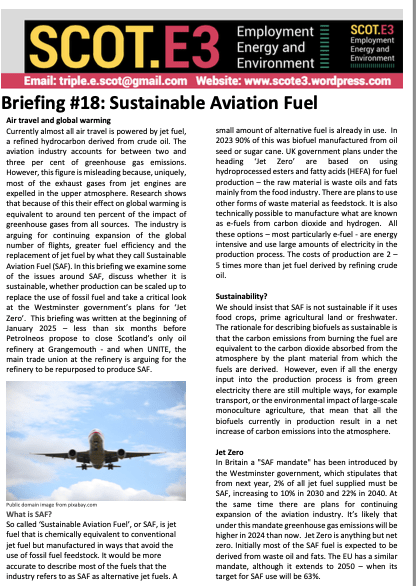
Briefing 18 takes a critical look at ‘Sustainable Aviation Fuel’ and the Westminster government’s Jet Zero plan.

Click on the image to download the briefing

Air travel and global warming

Currently almost all air travel is powered by jet fuel, a refined hydrocarbon derived from crude oil. The aviation industry accounts for between two and three per cent of greenhouse gas emissions. However, this figure is misleading because, uniquely, most of the exhaust gases from jet engines are expelled in the upper atmosphere. Research shows that because of this their effect on global warming is equivalent to around ten percent of the impact of greenhouse gases from all sources. The industry is arguing for continuing expansion of the global number of flights, greater fuel efficiency and the replacement of jet fuel by what they call Sustainable Aviation Fuel (SAF). In this briefing we examine some of the issues around SAF, discuss whether it is sustainable, whether production can be scaled up to replace the use of fossil fuel and take a critical look at the Westminster government’s plans for ‘Jet Zero’. This briefing was written at the beginning of January 2025 – less than six months before PetroIneos propose to close Scotland’s only oil refinery at Grangemouth – and when UNITE, the main trade union at the refinery is arguing for the refinery to be repurposed to produce SAF.

Marching to save jobs at the Grangemouth refinery

What is SAF?

So called ‘Sustainable Aviation Fuel’, or SAF, is jet fuel that is chemically equivalent to conventional jet fuel but manufactured in ways that avoid the use of fossil fuel feedstock. It would be more accurate to describe most of the fuels that the industry refers to as SAF as alternative jet fuels. A small amount of alternative fuel is already in use. In 2023 90% of this was biofuel manufactured from oil seed or sugar cane. UK government plans under the heading ‘Jet Zero’ are based on using hydroprocessed esters and fatty acids (HEFA) for fuel production – the raw material is waste oils and fats mainly from the food industry. There are plans to use other forms of waste material as feedstock. It is also technically possible to manufacture what are known as e-fuels from carbon dioxide and hydrogen. All these options – most particularly e-fuel – are energy intensive and use large amounts of electricity in the production process. The costs of production are 2 – 5 times more than jet fuel derived by refining crude oil.

Sustainability?

We should insist that SAF is not sustainable if it uses food crops, prime agricultural land or freshwater. The rationale for describing biofuels as sustainable is that the carbon emissions from burning the fuel are equivalent to the carbon dioxide absorbed from the atmosphere by the plant material from which the fuels are derived. However, even if all the energy input into the production process is from green electricity there are still multiple ways, for example transport, or the environmental impact of large-scale monoculture agriculture, that mean that all the biofuels currently in production result in a net increase of carbon emissions into the atmosphere.

Jet Zero

In Britain a “SAF mandate” has been introduced by the Westminster government, which stipulates that from next year, 2% of all jet fuel supplied must be SAF, increasing to 10% in 2030 and 22% in 2040. At the same time there are plans for continuing expansion of the aviation industry. It’s likely that under this mandate greenhouse gas emissions will be higher in 2024 than now. Jet Zero is anything but net zero. Initially most of the SAF fuel is expected to be derived from waste oil and fats. The EU has a similar mandate, although it extends to 2050 – when its target for SAF use will be 63%.

Practicality/Scalability

A report published in May 2024 by the Institute for Policy Studies analysed Jet Zero, aviation industry plans and other initiatives and found that there is currently “no realistic or scalable alternative” to standard kerosene-based jet fuels. Jet Zero is not about a transition to a sustainable low carbon industry, and it’s based on fanciful assumptions. There are severe limits to its scalability due to the limited supply of used cooking oil and animal fat. British airlines will be in competition for these supplies with others around the world. For example, in the EU there is only enough supply for about 2% of current demand. It’s also in competition with the production of bio diesel for road haulage which uses the same feedstock. The scale of the gap between Jet Zero and net zero is illustrated by the fact that even with current levels of flights 50% of all agricultural land in Britain would have to be devoted to the production of biofuel to eliminate the need for fossil fuel. If crop-based biofuel is ruled out and SAF were to be produced from other forms of waste as well as cooking oils, it’s estimated that if all the useable waste in the UK was converted to SAF it would still provide less than 20% of the fuel demands from outgoing flights.

Conclusion

UNITE’s plan for the Grangemouth oil refinery suggests that there is an assured future as a biofuel hub for Britain. As we write the details of the plan are not publicly available. We can only assume that they are based on the faulty logic of the British government’s Jet Zero report. Sadly, these figures just don’t add up. There is a powerful case for a plan to support the Grangemouth workforce into a sustainable future, but Jet Zero is an illusion. SAF is not a magic bullet. Current technologies are not capable of meeting the fuel demands of the aviation industry. E-fuels are potentially scalable, but the costs are prohibitive. We will discuss what is to be done about aviation in a future briefing.

Click the link to download Briefing 18

You might also want to look at Briefing 10 – ‘Bioenergy with carbon capture and storage (BECCS)’ and Briefing 17 – Net Zero

All of the ScotE3 briefings can be downloaded from this site’s resources page.

Solidarity with Reclaim The Power

Reclaim The Power had planned to hold a protest camp near the Drax power station in Yorkshire from 8th – 13th August. Before the camp could begin the police made over twenty arrests and impounded tents, cooking equipment and a wheelchair accessible trackway. As a result the camp was unable to go ahead.

At the same time climate think tank Ember produced a report showing that Drax, which burns wood pellets imported from North America to generate electricity, was Britain’s single largest carbon emitter in 2023. Drax has received billions in subsidies since it started to switch from coal to biomass in 2012. In 2023 it was responsible for 11.5m tonnes of CO2, nearly 3% of the UK’s total carbon emissions.

Biomass storage silos and unloading point – image by Steve Knight used under Creative Commons

Reclaim the Power need your support:

Last week our peaceful camp was shut down by the police, acting as Drax’s private security.

A roundup of everything they have done to shut us down:
🚨 Over 20 people were arrested
🏠 Homes were raided across the UK
💻 Personal tech was seized
🚐 Vehicles have been impounded
⛺ All of the kit needed to set up camp has been seized

We are angry, but we are not giving up. To keep up the fight against Drax we need to replace what was seized, fund travel costs for arrestees and pay to get our vehicles back.

👉 https://chuffed.org/project/repair-fund

Appeal from Biofuelwatch

Biofuelwatch is asking UK climate and social justice groups urgently to consider signing this open letter to support frontline communities in North Carolina who are facing the expansion of a huge pellet mill in Ahoskie which supplies wood pellets to burn at UK power stations like Drax and Lynemouth:  

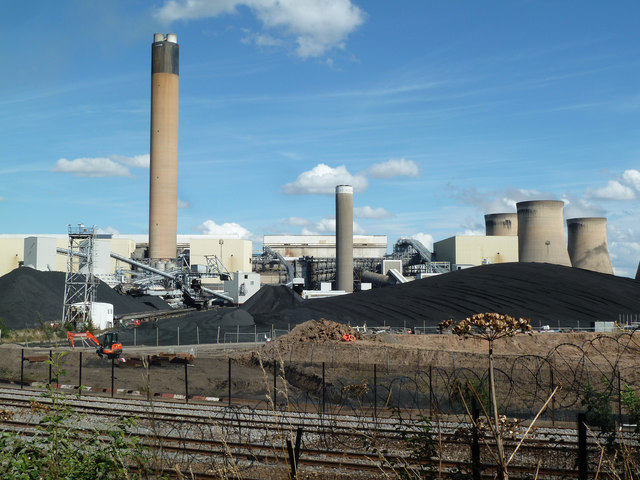
Drax Power Station: Creative Commons Attribution-Share Alike 2.0 Generic .
Image by Paul Glazzard

The mill is owned by the world’s biggest wood pellet producer, Enviva. If this pellet mill expansion goes ahead, it will increase dangerous air pollution for local communities, lead to the destruction of around 24,000 acres of forest, harm wildlife and make the climate crisis worse. 
The pellet mill expansion will also lead to even more wood being burned at UK power stations like Drax, Lynemouth and the new Tees Renewable Energy Plant near Middlesbrough, with very harmful impacts on the health of UK communities and on the climate. 
The letter is calling on the Governor of North Carolina to say no to the expansion of the wood pellet industry in the Southern US and we’re hoping as many UK groups as possible will sign it ahead of a public hearing in North Carolina on Tuesday 16th August
Frontline community activists would like to read out the letter at the hearing to show Enviva and the Governor of North Carolina that they are being supported by groups in the UK. Biofuelwatch would be very grateful if your climate or social justice group would like to sign.

Here’s the text of the letter

Dear Governor Cooper,

We, the undersigned environmental and climate justice groups in the UK, are writing to urge you to say no to Enviva’s plans to expand the wood pellet industry in North Carolina. We firmly stand in support of frontline groups’ complaints about Enviva and share their disappointment as to the lack of action to address the rapidly expanding wood pellet production market in North Carolina. 

If you are to be the climate champion that you claim, the climate, forest, biodiversity and environmental justice impacts of the wood pellet industry must be addressed.

As UK groups, we have a focus on North Carolina because many of your forests that are turned into pellets end up being burned in our power stations: Drax and Lynemouth. If the Enviva Ahoskie facility is permitted to expand, the equivalent of over 24,000 hectares of forest will be cut to meet its new capacity. We understand that North Carolina justice groups warn that this will lead to more logging trucks and more pollution. 

In the UK, the same is true. The wood pellets that Enviva supplies to burn at Drax and Lynemouth Power Stations are producing harmful air pollution and Drax is facing prosecution from the Health and Safety Executive in the UK for risking the health of their workers through exposure to harmful wood dust from pellets. 

Burning wood for energy in UK power stations is also making the climate crisis worse and Drax Power Station alone emitted over 13 million tonnes of CO2 from burning wood in 2021. Any expansion of the Ahoskie pellet mill in the United States will also have consequences for us here and would further exacerbate these health and climate impacts as Enviva is expected to supply pellets to burn at the Tees Renewable Energy Plant near Middlesbrough.

In 2021, 500 scientists from around the world signed an open letter about the impacts of wood bioenergy sourced from forests, warning: “regrowth takes time the world does not have to solve climate change. As numerous studies have shown, this burning of wood will increase warming for decades to centuries. That is true even when the wood replaces coal, oil or natural gas.” 

Although climate scientists agree that the world must significantly increase its ability to retain carbon in forests, American forests are sequestering considerably less carbon today than they did just 30 years ago. Forests are a vital natural carbon sink, and burning them for fuel is a dangerous policy that will exacerbate climate change, particularly since burning biomass is not carbon neutral and in fact produces more pollution and more carbon emissions than the coal it is intended to replace.

It is time to stop this dirty and destructive industry that is harming people, wildlife and the planet. We need standing, natural forests. Forests absorb carbon, filter our water and our air, protect us from dangerous storms and floods, and provide vital green spaces for nature and people. 

For the sake of forests, wildlife, communities and the climate, we urge you to refuse this application for Enviva’s Ahoskie mill expansion and to place a moratorium on any expansion of the wood pellet industry. 

No new subsidies for big biomass plants

Scot.E3 has joined with many other campaigns and individuals in calling on the Westminster Government not to use renewable subsidies to support wood burning power stations. We reprint the Biofuel Watch Press Statement here. The Biofuel Watch website includes links to further reading and sources.

Hundreds of environmental campaigners are calling on the UK Government to take urgent climate action by ensuring that future renewable subsidies are not used to fund burning trees in UK power stations. Over 800 individuals as well as 20 environmental campaign organisations have submitted critical comments to the consultation, which sets out proposals on how to award future renewable electricity subsidies, called Contracts for Difference (CfDs). 

Image by Chris Allen CC BY SA 2.0.   

The NGOs and individual respondents to the consultation have called on the Government to ensure that safeguards vital for meeting climate commitments are reaffirmed, ones which would prevent new subsidies for large biomass plants reliant on imported wood from trees. They have urged the Government to protect forest ecosystems and the climate by ensuring that all future renewable power subsidies go to the cleanest forms of renewable energy, such as wind and solar power, rather than to more wood-burning power stations.

In 2018, the government announced new greenhouse gas and efficiency standards for CfD awards, which resulted in virtually all renewable power subsidies awarded since then going to lower carbon offshore wind and not to polluting biomass plants that emit at least as much CO2 as coal plants per unit of energy. They stated that failure to apply those changes “would lead to greenhouse gas emissions significantly above the projected UK grid average for most of the lifetime of [biomass] CfD projects”. The government’s proposal for future CfD awards, which they have just consulted on, makes no mention of extending those safeguards. The safeguards will automatically lapse unless they are explicitly extended.

Almuth Ernsting from Biofuelwatch said: “The UK already pays some £1.3 billion in subsidies for burning more wood in power plants than any other country in the world. At least, in 2018, the government’s new standards stopped the expansion of inefficient, high-carbon wood burning for electricity and thereby mobilised more money for non-emissive wind power. The government must not let those safeguards lapse now, after parliament acknowledged the climate emergency. It must not allow any more renewables subsidies to be misspent on a high-carbon source of energy which also harms wildlife and communities.”

Rita Frost from Dogwood Alliance added: “Following last Friday’s International Day for Biodiversity, I want to highlight the devastation that the biomass industry causes in the natural world. Living in the Southeastern forests of the North American Coastal Plain, I’ve been in awe of the remarkable biological diversity that’s all around me, and saddened by the devastating destruction of forest ecosystems by the biomass industry. Every day, this world-class biological hotspot of diversity, that includes species found nowhere else on the planet, is destroyed to make wood pellets for utilities like Drax [the world’s largest biomass power station, in Yorkshire]. The government has committed to planting 30,000 hectares of trees a year across the UK by 2025. Yet, just in the Southern U.S. in 2018 alone, over 43,000 hectares of forests were destroyed to feed Drax’s demand. No further biomass projects should receive government support.”  

David Carr from the Southern Environmental Law Center stated: “It is very worrying that we didn’t see any confirmation in the consultation document that the Government will apply the same emissions and efficiency standards to new biomass plants in future as it did in 2018 and ‘19. Those standards were hard-won by environmental campaigners as well as scientists showing the true climate impacts of cutting down trees for burning. We urge BEIS not to backtrack on its own commitments at this crucial juncture for the climate and biodiversity.”