URGENT CALL OUT to support the GKN workers in Florence –
Help them make a just transition to producing cargo bikes and solar panels under workers control
Already one of the most important climate justice struggles in Europe, the campaign by GKN workers is under imminent attack – and they need your help to complete their inspiring struggle
For over two years now, workers have been occupying the GKN autoparts factory in Florence to stop it from closing, in the longest factory occupation in Italian history.
They have received huge support in demonstrations of up to 40,000 people – and crucially, from the climate movement, which inspired the workers to come up with an alternative plan of production.
Instead of autoparts, they plan to produce cargo bikes and solar panels, and use them to build a local economy based on the needs of people. They have already produced a prototype of the cargo bike; now they urgently need your help to make this “just transition” away from fossil fuels a reality.
The bosses are planning on sacking all the workers on January 1st so the first priority is to come to a New Years Eve event at the factory if you can, for a huge concert – and to barricade the factory. They’ve fought off redundancies before; with the same support, they can do it again.
But then they need to raise one million euros in a popular shareholder campaign, to start production off the cargo bikes and solar panels under workers control. So please share this video call out with trade unions, with environmental organisations, with everyone who wants to see a global just transition away from fossil fuels. Shares start from 100 euros, and already they have raised 315,000 euros – you can find details of how to take part at https://insorgiamo.org/100×10-000/.
You can also help by spreading their story; by offering to translate materials into other languages; and if you have the technical expertise, to look at the production plan to help improve it. Also, if you know of a cooperative or progressive group who would be interested in buying the cargo bikes or solar panels, that would be incredibly useful too. If you can help with any of this, email the collective at collettivo.gkn.firenze@gmail.com.
As the workers say, they can’t create an alternative model to capitalist fossil fuel production in just one factory – but they can create an example of what is possible.
Please support them in this absolutely crucial battle for a liveable, sustainable future.
COP is shorthand for conference of the parties. Organised by the United Nations, it’s normally held on an annual basis, and it is the place where the nations of the world come together to discuss policy on climate action. So, to give it its’ full title COP28 is the 28th annual Conference of the Parties to the United Nations Framework Convention on Climate Change. COP 28 is taking place in Dubai.
A history of failure
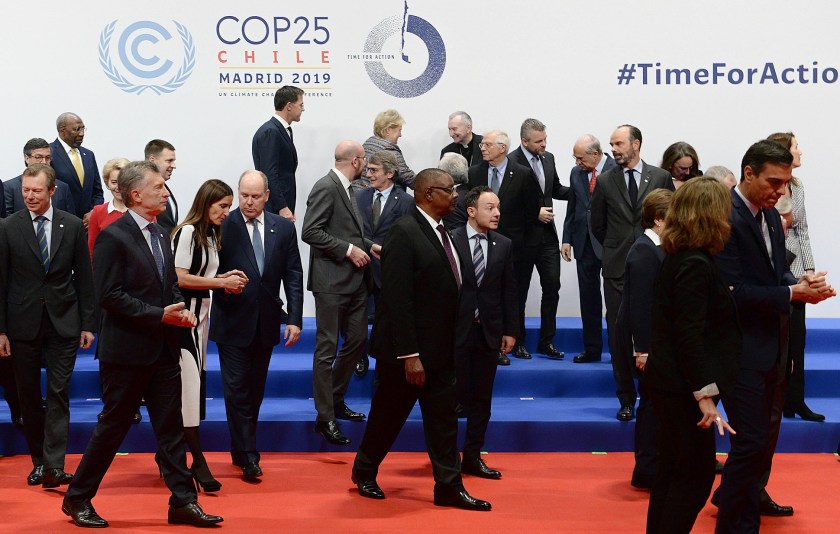
The first COP was held in 1995 in Berlin. In terms of making an impact on greenhouse gas emissions the COPs have been an abject failure. The two most common greenhouse gases are carbon dioxide (CO2) and methane. When COP 25 took place in Madrid at the end of 2019 the amount of carbon dioxide in the atmosphere had risen 67 parts per million by volume (ppmv) above the level it was at when the first COP met in Berlin. To put this in perspective CO2 levels increased by more during 25 years of COP discussions than they had in the previous 200 years. Methane levels have tripled since 1995. Greenhouse gases act like an insulating blanket over the earth’s atmosphere and are responsible for rising global temperatures. So, the massive increase in the amount of these gases in the atmosphere is the reason why the climate crisis is now acute and why rapid action to cut emissions is so important.
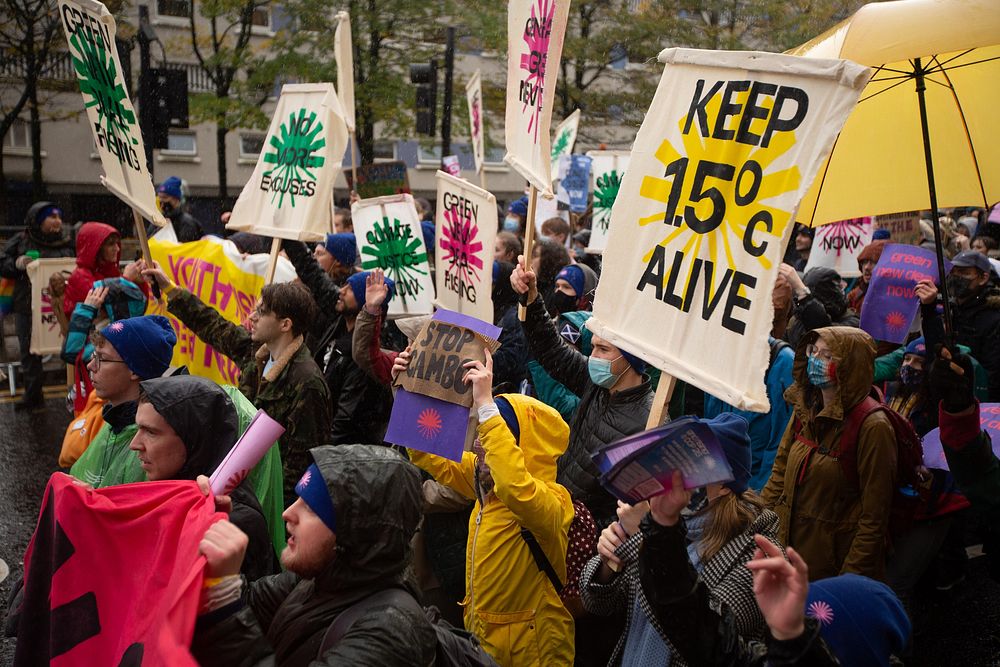
Climate activists bring the message “Insure Our Future” to COP26 in Glasgow, Scotland, UK, on 6th Nov 2021.
More:
Original public domain image from Flickr
The Paris Agreement of 2015
Back in 2015 the COP (21) took place on Paris. The conference ended with an agreement that has since been ratified by 189 out of the 197 countries that participated (The Paris Agreement). Ratification committed countries to developing plans that would curtail global temperature rise to less than 2 degrees centigrade. Those who have not ratified include some important oil producers. The USA ratified under Obama but then withdrew under Trump only to return on the first day of Biden’s term of office.
In principle ratifying the Paris Agreement commits countries ‘to put forward their best efforts through “nationally determined contributions” (NDCs) and to strengthen these efforts in the years ahead.’ The reality has been that progress has been negligible. The agreement is essentially voluntary and avoids specific targets. Political economist and environmentalist Patrick Bond notes the ‘Agreement’s lack of ambition, the nonbinding character of emission cuts, the banning of climate-debt (‘polluter pays’) liability claims, the reintroduction of market mechanisms, the failure to keep fossil fuels underground, and the inability to lock down three important sectors for emissions cuts: military, maritime transport and air transport.’
COP fault lines
The COP is dominated by the big powers. So, in the negotiations at every COP there are sharp divisions between the major industrial nations that are responsible for most greenhouse gas emissions and the global south, which endures the biggest impact of climate change. At the COPs, and in the run up to them, there is also a great deal of activity from non-state organisations. Businesses, NGOs and union federations lobby before the event and can obtain credentials that enable them to be within the main conference areas. There is of course a huge imbalance in resources between the corporate lobbyists and the climate campaigners. Groups that represent women, indigenous people and poor people struggle to have their voices heard within the conference. The climate movement is mostly excluded from the conference zone by barricades and police.
COP28
Sultan al-Jaber, the president of COP28 in Dubai is also the director of the Abu Dhabi National Oil Company. Before the COP began the BBC disclosed leaked briefing documents showing that meetings with international participants were being used to make new oil and gas deals. Jaber denies that this is the case but in truth it should hardly be a surprise. The Financial Times (FT) describes the COP as a trade fair for the oil and gas industry. Total attendance in Dubai is said to be around 80,000 and dominated by bankers, consultant and lobbyists. These people attend to do business while using PR spin to burnish their climate credentials. The chief executives on the UAE’s COP28 guest list included interim BP chief executive Murray Auchincloss, BlackRock’s Larry Fink, commodity trading group Trafigura’s Jeremy Weir and Brookfield Asset Management’s Connor Teskey. Huge asset management companies like BlackRock and Brookfield are investing in renewables and were involved in the $30bn fund launched in Dubai to invest in climate-related projects – but while total investment in renewables now exceeds investment in fossil fuels the latter has risen year on year for the last four years. There is no sign of fossil fuels being phased out as is necessary to prevent runaway climate change.
Organising for the COP
From the start the COP process has operated within the domain of market economic orthodoxy. It assumes that market forces will drive a move towards less carbon intensive technologies and hence reduce greenhouse gas emissions. There have indeed been significant developments in sustainable technologies – particularly wind and solar. And yet at the same time the big energy companies have pursued a ruthless drive to exploit new hydrocarbon resources in a way that is completely incompatible with even the most modest targets for limiting global warming. Since the COP began global emissions have risen by more than two-thirds.
The history of the COPs has been one of dreadful failure. And yet for many climate NGOs representation and lobbying at the COPs is an annual priority. The COPs are a huge exercise in greenwashing, a jamboree for the corporate decision makers who are very much the problem and not part of the solution. So, yes, we should protest when the COP takes place but there’s a growing movement to say that what we should be doing is boycotting its institutions. There is a real need for international coordination but to get the COP process has failed – we need to break from business as usual. This year as COP28 takes place in air-conditioned luxury in Dubai – Earth Social is organising a grass roots conference in Colombia – check it out at earthsocialconference.org
A message from the organisers of the Earth Social conference – timed to take place in Colombia as COP28 takes place in Dubai.
It boils down to whether we are honest with ourselves, or not. UN climate summits are a joke that continue to push the bounds of absurdity. Since they began, yearly global emissions have increased by more than two-thirds. Worse still, no plans have been made to phase out fossil fuels. Should we be surprised when industry lobbyists continue to dominate conferences? Can we expect anything different from this next summit, taking place in a petro-state, chaired by an oil company boss… Are we expected to buy into this charade…?
We, on the other hand, are climate realists. We see where we are being led. We know we need to apply the emergency brake to avoid earth system collapse. That’s why we refuse to participate in a process of trading empty promises any longer.
That’s why we are inviting climate realists to the Earth Social Conference in Casanare, Colombia, from 5th-10th December 2023.
Join us to build the collective force we need in order to pull the emergency break.
Although the conference is in person in Columbia on 7th December it is possible to join some of the sessions by Zoom. Click here to go to the conference website and register.



 Employment, Energy and Environment